
 Today on The Briefing Room with Claire Donovan
The President Will Meet Russia's Leader Privately on Thursday as APEC Opens With Beijing's Tariff Pitch and a Nuclear Agenda
A U.S. official confirms a private Trump-Putin meeting on top of the planned U.S.-China-Russia summit, as Xi pitches open trade, condemns sanctions with Putin and nuclear arms tops the agenda.
Filed November 18, 2026 · 📍 NY 12207
Were you there? Share your story
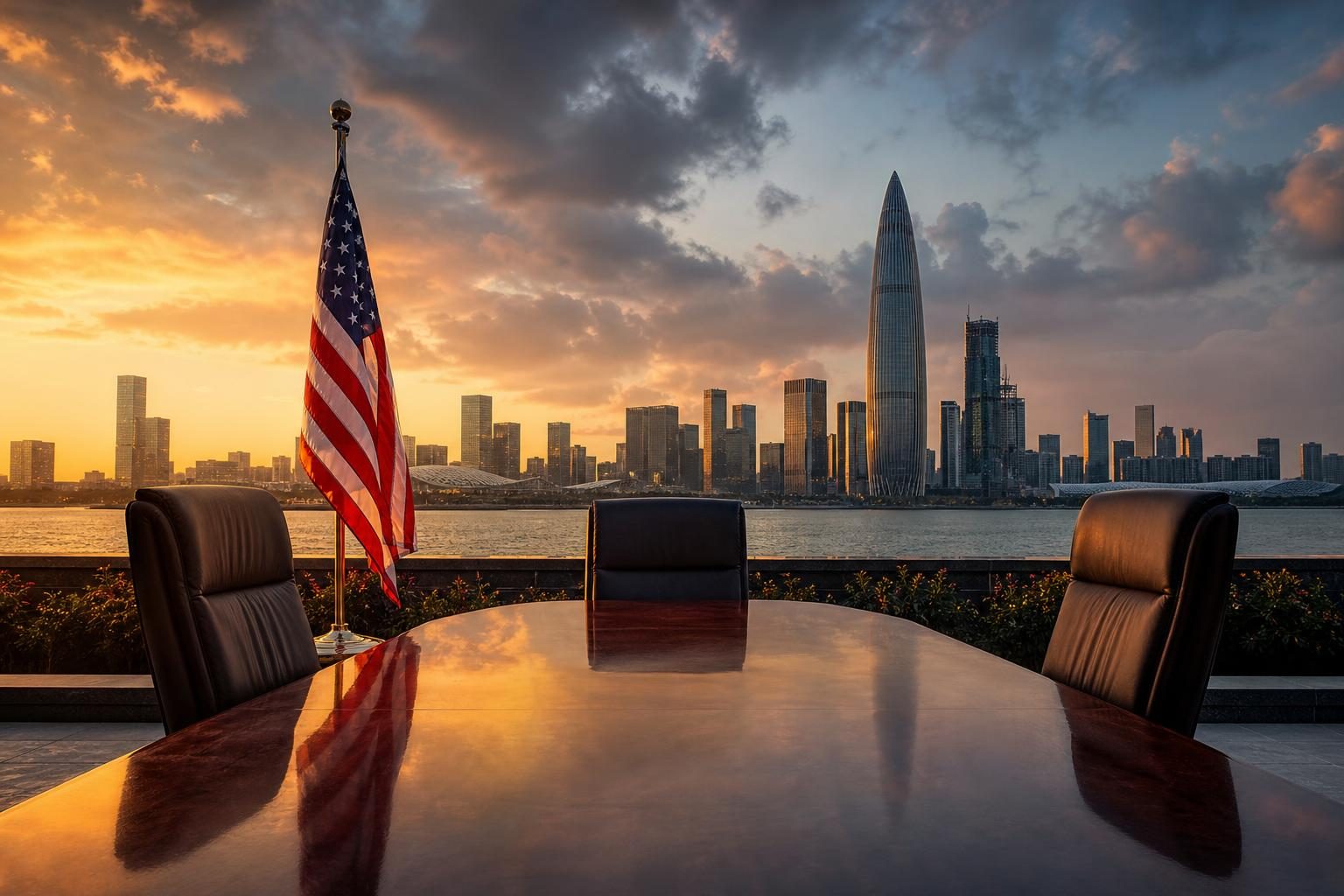
Part of our continuing coverage: Trump, Xi and Putin at One Table: What's on the Agenda in Shenzhen, What's Off It, and Why Bringing China Into Nuclear Talks Matters
Key points
- President Trump will meet Vladimir Putin one-on-one Thursday in Shenzhen, a U.S. official told Axios
- Putin stood at the center of an APEC group photo for the first time in nine years
- Xi promised tariff cuts while he and Putin condemned U.S. sanctions
- Nuclear arms control tops the agenda after the last U.S.-Russia treaty lapsed this year
President Trump will sit down one-on-one with Russia's Vladimir Putin on Thursday in Shenzhen, on top of the planned three-way summit with China's Xi Jinping, Axios reported Wednesday, citing a U.S. official [1]. The private meeting comes as the President makes another push for a breakthrough to end the war in Ukraine [1].
That was the biggest piece of news from a crowded first day in China. Hours after the President's arrival, the leaders gathered for the opening events of the Asia-Pacific Economic Cooperation summit, where Mr. Putin took a spot at the center of the group photograph for the first time in nine years, Bloomberg reported [2]. Mr. Xi and Mr. Putin also used their speaking time to condemn American sanctions, The Hill reported [3], and Canada's prime minister found time for a meeting with the President a day after striking his own deal with Beijing, the Toronto Sun reported [6].
Here is what happened, what it means and what to watch when the three leaders finally sit down together.
A Second Meeting on the Calendar
Until Wednesday, the President's schedule in Shenzhen centered on the trilateral session with Mr. Xi and Mr. Putin. Adding a separate sit-down with the Russian leader changes the shape of the trip. A one-on-one meeting gives the two presidents room to talk about Ukraine without a third party at the table, and Axios framed the meeting as part of the President's renewed effort to bring the war to an end [1].
The meeting will not be easy. The New York Times reported that American intelligence assesses that Mr. Putin intends to keep fighting despite his plans to meet the President [4]. The Times also noted that the President has halted some sanctions on Russia and announced that the United States will buy Russian diesel [4].
Critics will read those steps as concessions. Supporters of the President's approach see a negotiator using every tool he has, pressure and incentives alike, to get the war in Ukraine to a ceasefire. Both sides would agree on one point: Thursday's private conversation will be judged by what Moscow does afterward, not by the handshake.
Putin Back in the Picture
The opening ceremonies carried their own message. Bloomberg reported that Mr. Putin appeared in an APEC "family photo" of leaders for the first time in nine years, standing in a central position alongside Mr. Xi and President Trump [2]. Bloomberg described the image as a powerful rebuff of Western efforts to isolate the Russian leader on the world stage [2].
Beijing chose the staging, and it chose it on purpose. China wants the world to see it as the host who can bring Washington and Moscow into the same room. That is worth keeping in mind as the talks begin. The Chinese government is not a neutral referee. It stood beside Moscow at this very summit in condemning American sanctions [3], and it is the government whose plans to build up its nuclear arsenal make any new arms arrangement so hard to reach [5].
For Americans, the photograph is less important than the outcome. A Russian leader standing at the center of a picture in Shenzhen does not change the facts on the ground in Ukraine. A credible ceasefire would.
Beijing's Trade Pitch, and the Sanctions Complaint
Mr. Xi spent part of the day selling China as the champion of open markets. Speaking at the summit, he said Beijing would cut tariffs and promote free trade, while he and Mr. Putin both condemned U.S. sanctions against their countries, The Hill reported [3].
The pitch is aimed at the region's business leaders as much as at the President. But Americans have heard Beijing promise openness before. The test is not a speech in Shenzhen. It is whether American farmers, manufacturers and technology companies can actually sell into China on fair terms, and whether Beijing stops using its control over critical supply chains as a weapon.
The sanctions complaint deserves a plain answer. American sanctions on Russia exist because of the invasion of Ukraine. American restrictions on China's access to the most advanced technology exist because of the threat that technology could pose in the hands of a rival military. Neither leader acknowledged that in their remarks. The President has shown he is willing to adjust sanctions as part of a negotiation, as the Times reported [4], but adjusting them in exchange for results is very different from dropping them because Moscow and Beijing object.
The Nuclear Question at the Center
Nuclear weapons sit at the top of the list when the three leaders meet. Semafor reported that nonproliferation tops the agenda for the U.S.-China-Russia talks, noting that the last long-running arms treaty between Washington and Moscow expired this year while Beijing wants to build up its arsenal [5].
That is the heart of the matter. For half a century, arms control was a two-way conversation between Washington and Moscow. Today the last long-running treaty between them has lapsed, and China is building toward a far larger arsenal of its own [5]. Any deal that limits America and Russia while leaving China free to build would not make American families safer.
Getting all three governments to discuss the subject at one table would itself be a step forward. No one should expect a signed agreement this week. But even a commitment to keep talking, with China included, would be a real step, and it would be one the President could take home.
Allies in the Room
Not every meeting on Wednesday involved a rival. Canadian Prime Minister Mark Carney met President Trump in Shenzhen a day after reaching a trade deal with Mr. Xi, the Toronto Sun reported [6]. According to the paper, the two leaders discussed the work underway to reach a trade agreement that benefits both countries [6].
The timing will draw attention in Washington. Canada is America's closest neighbor and one of its largest trading partners, and its decision to deepen ties with Beijing while negotiating with the United States raises fair questions about where Ottawa is headed. Wednesday's meeting is a reminder that the President's conversations with allies are happening alongside his conversations with adversaries, and that the allies are watching to make sure no bargain is struck over their heads.
What to Watch Thursday
First, nuclear arms. Watch for any sign that China will agree to follow-up talks. Beijing's long refusal to join arms control is the single biggest obstacle to a new framework, and Semafor's reporting makes clear that the issue tops the agenda [5].
Second, Ukraine. The private meeting with Mr. Putin is the President's best chance on this trip to test whether Moscow is ready to move [1]. The intelligence assessment reported by the Times suggests skepticism is warranted [4].
Third, trade. Mr. Xi's promise to cut tariffs will mean something only if it turns into concrete commitments for American exporters [3].
Fourth, the optics battle. Beijing and Moscow have already shown, through the group photo and their speeches on sanctions, that they want this summit to look like the arrival of a new world order [2][3]. The President's task is to make sure it looks, and works, like America negotiating from strength.
For our readers, these talks can feel far away, but they reach every household. Nuclear weapons shape what America spends on defense and what kind of world our children inherit. The war in Ukraine affects energy prices and the stability of Europe. Trade with China touches the price of goods on store shelves and the market for crops grown on American farms.
Peace through strength is not a slogan. It is the recognition that adversaries negotiate seriously only when they believe the other side can and will defend its interests. The President walked into Shenzhen with that approach, and Thursday will show whether Moscow and Beijing are ready to meet him. We will report what the leaders agree to, and what they do not.
Sources
Israel's new parliament is sworn in. Who would you rather see lead Israel?
- Benjamin Netanyahu
- Gadi Eisenkot
- Someone new
- That's for Israelis to decide
More in World News
Britain Heads Back to Brussels: What Friday's Reset Summit Offers, What It Costs, and Why Washington Should Care
Today on World Watch with Grace Whitfield
Israel Moves Back Into Central Gaza to Hit Hamas Infrastructure: The Hard Questions for a Ceasefire on the Brink
This morning on Cross-Examination with Dominic Kane

Police Investigate After a Three-Year-Old Boy Dies Following a Medical Emergency at a Greater Manchester Nursery
This morning on World Watch with Grace Whitfield
Were you there?
If you were at the scene, or this story touched your life, tell us what you saw and what it was like.
Discussion 0
Sign in or create a free account to join the discussion.
No comments yet. Start the discussion.