
 This morning on The Briefing Room with Claire Donovan
Trump, Xi and Putin at One Table: What's on the Agenda in Shenzhen, What's Off It, and Why Bringing China Into Nuclear Talks Matters
The White House says the three leaders will hold their first-ever joint meeting Nov. 19 on the sidelines of the Asia-Pacific summit, with nuclear arms cuts and the Iran war on the table. No deal is expected. Here is what to watch.
Filed November 14, 2026 · 📍 White House, DC 20500
Were you there? Share your story
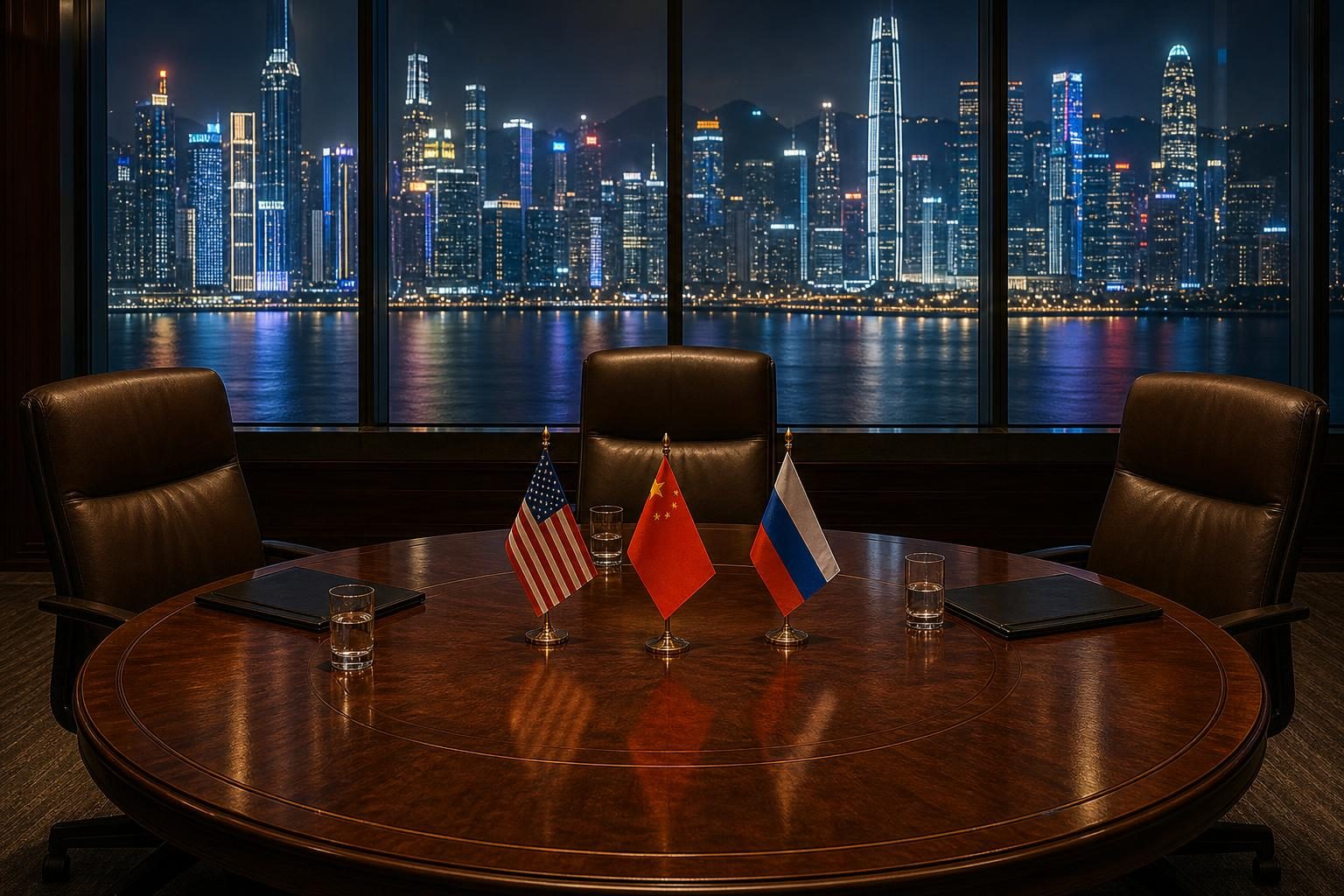
Part of our continuing coverage: Trump Wants Nuclear Arms at the Top of a Possible Shenzhen Summit With Xi and Putin. What Would a Deal Take?
Key points
- The White House says Trump, Xi and Putin will meet Nov. 19 in Shenzhen, the first meeting of its kind.
- Nuclear arms reduction and the Iran war are on the agenda; Ukraine and the Nvidia scandal are not expected to be.
- New START expired in February, leaving no limits on U.S. and Russian arsenals for the first time in decades.
- SIPRI says China is the world's fastest-growing nuclear power, with roughly 620 warheads.
President Trump will sit down with Chinese leader Xi Jinping and Russian President Vladimir Putin in Shenzhen, China, next Thursday, Nov. 19, in what the White House describes as the first three-way meeting of the leaders of the United States, China and Russia [1][2]. The session will take place on the sidelines of the Asia-Pacific Economic Cooperation summit, which brings leaders of 21 economies to the Chinese tech hub on Nov. 18 and 19 [1]. China is this year's host, which gives Xi the advantage of the home stage [1].
The president is set to leave Washington on Monday for the Philippines, where he will attend a meeting of the Association of Southeast Asian Nations before traveling on to Shenzhen, Euronews reported [4]. A White House spokeswoman said Trump will use the meeting to discuss the "reduction of nuclear weapons," according to the BBC [2].
It is a striking moment: an American president seated between the leaders of the two nations that most challenge American power, with the world's three largest nuclear arsenals represented at a single table. Here is what we know, what we do not and why it matters.
What the White House Has Announced
According to U.S. officials, the president will meet Xi one-on-one before the three-way session, but he will not hold a separate bilateral meeting with Putin [1][2]. Nuclear arms reduction and the war with Iran will lead the agenda [1][2]. The New York Times reported that the president is not expected to bring up Russia's war in Ukraine or the spy scandal that has engulfed former Nvidia chief executive Jensen Huang [3].
Expectations are deliberately modest. A senior U.S. official said the administration does not expect to reach any agreement in Shenzhen and described the meeting as the start of a conversation, Al Jazeera reported [1].
The other two capitals have been more guarded. Kremlin spokesman Dmitry Peskov called a meeting of the leaders of Russia, China and the United States extremely significant, while adding that no country should try to impose its own vision of the global order [1]. Beijing had not formally confirmed the three-way session as of Friday, and Chinese state media said only that Xi would hold bilateral talks during the APEC gathering [1].
The Nuclear Stakes: An Arms Race With No Rulebook
The timing is no accident. The last treaty limiting American and Russian strategic nuclear forces, New START, expired on Feb. 5, 2026, leaving the two largest arsenals without any binding limits for the first time in more than half a century, the Arms Control Association reported [5]. Putin had offered to keep the treaty's central limits for one more year. Trump declined, saying he wanted a new, improved and modernized agreement rather than an extension of a deal he considered badly negotiated [5].
The old treaty had already been hollowed out. Russia suspended the inspections and data exchanges at its heart in 2023, and the United States stopped sending its own data in response [5]. Russia's foreign minister later said Moscow would keep observing the treaty's limits as long as Washington did, but U.S. officials said there was no formal or informal agreement to do so [5].
Meanwhile, the third nuclear giant has been building fast. The Stockholm International Peace Research Institute's 2026 yearbook estimated about 12,187 nuclear warheads in the world as of January, roughly 9,745 of them in military stockpiles for potential use [6]. The U.S. and Russia still hold the large majority, but SIPRI identified China as the fastest-growing nuclear power, with an arsenal now estimated at about 620 warheads [6].
Why Bringing China In Matters
For decades, arms control was a two-player game. From the 1987 treaty that eliminated intermediate-range missiles to New START in 2010, the deals were struck between Washington and Moscow alone, while China's arsenal grew outside any limits. Trump has insisted for years that any new agreement must include China, and Beijing has refused to negotiate, the Arms Control Association noted [5].
That is why getting Xi into the same room matters, even if nothing is signed. A treaty that caps American and Russian weapons while leaving China free to keep building would not make Americans safer. It would simply hand Beijing time to catch up. By putting the question to all three leaders at once, the president is forcing the conversation the old framework avoided.
This is peace through strength applied to the nuclear age. Ronald Reagan negotiated with the Soviet Union from a position of confidence, not weakness, and the result was the first treaty in history that eliminated an entire class of nuclear missiles. The same logic applies now. The United States does not need to beg for a deal. It needs a deal that covers every serious nuclear power, can be verified and leaves America secure.
Iran on the Table, Ukraine and Nvidia Off It
The second major item is the war with Iran [1][2]. China and Russia have been Tehran's most important diplomatic partners, and both have leverage the United States lacks. The meeting comes as Iran keeps United Nations inspectors out of its nuclear sites, the standoff Liberty Bell Report detailed this morning, which raises the stakes of any conversation about Tehran's program.
The president's choice to keep Ukraine off the agenda in Shenzhen reflects the separate track of negotiations already under way on that war, and the White House has said the trilateral will not focus on it [3]. Keeping the Nvidia spy scandal out of the room keeps the meeting on the issues where all three nations have something at stake, though the controversy will hang over any discussion of technology and trade with Beijing [3].
The Fair Questions
There are fair questions to ask. Allies in Europe and Asia will want assurance that nothing about their security is decided over their heads, and the White House's decision to keep Ukraine off the agenda will be read closely in Kyiv and across Europe [3]. There is also little evidence yet that Putin or Xi wants limits: SIPRI's latest yearbook found nuclear-armed states, China above all, expanding and modernizing their arsenals as arms control weakens [6].
Those concerns are fair, and they are exactly why the administration has set expectations low. A first conversation commits no one to anything. What it does is establish that the United States intends to lead on the most dangerous question in the world, rather than watch two rivals set the terms.
What to Watch in Shenzhen
Three things will tell Americans whether the meeting succeeded:
- Whether Beijing formally confirms the three-way session and treats it as the start of talks, not a photo opportunity [1].
- Whether the leaders agree on any follow-up, such as working-level talks among nuclear experts, the path Trump has favored since New START lapsed [5].
- Whether Xi and Putin say anything new about Iran, especially about pressing Tehran to let inspectors return [1].
- Whether the three leaders issue any joint statement at all, which would itself be a first for the three powers [1][2].
No one should expect a breakthrough next Thursday. But for the first time in the nuclear age, an American president will have the leaders of both rival nuclear powers at the same table at once. Starting that conversation from a position of strength is how real progress begins.
Sources
- [1]Opens in a new tab ↗
- [2]Opens in a new tab ↗
- [3]The New York TimesTrump to Meet With Putin and Xi in China, With Nuclear Proliferation on the AgendaOpens in a new tab ↗
- [4]Opens in a new tab ↗
- [5]Arms Control AssociationNew START Expires As U.S. Urges 'Modernized' TreatyOpens in a new tab ↗
- [6]SIPRIIncreasing focus on nuclear weapons amid heightened escalation risks: new SIPRI Yearbook out nowOpens in a new tab ↗
With Democrats taking Congress, what should Republicans focus on first?
- Blocking bad bills
- Working on prices and costs
- Winning back the House in 2028
- Confirming judges before January
More in Politics
Jordan Readies a Fighting Minority as Conservatives Keep the Heat on Thune
Last night on The Sterling Report with Ava Sterling
Heckled by His Own Side: Activists Shout Down Jeffries at Democrats' Denver Conference as He Pitches a Bigger Medicare
Last night on The Sterling Report with Ava Sterling

Trump Gives Corner Stores 90 More Days on SNAP Food Rule After a Call From Mamdani
Last night on The Briefing Room with Claire Donovan
Were you there?
If you were at the scene, or this story touched your life, tell us what you saw and what it was like.
Discussion 0
Sign in or create a free account to join the discussion.
No comments yet. Start the discussion.