
 Today on The Briefing Room with Claire Donovan
Trump Wants Nuclear Arms at the Top of a Possible Shenzhen Summit With Xi and Putin. What Would a Deal Take?
With the last U.S.-Russia arms treaty gone and China's arsenal growing, the President is pressing for the first three-way leaders' talks on nuclear weapons, while Moscow eyes Ukraine and Beijing has yet to commit.
Filed November 13, 2026 · 📍 Washington, DC 20001
Were you there? Share your story
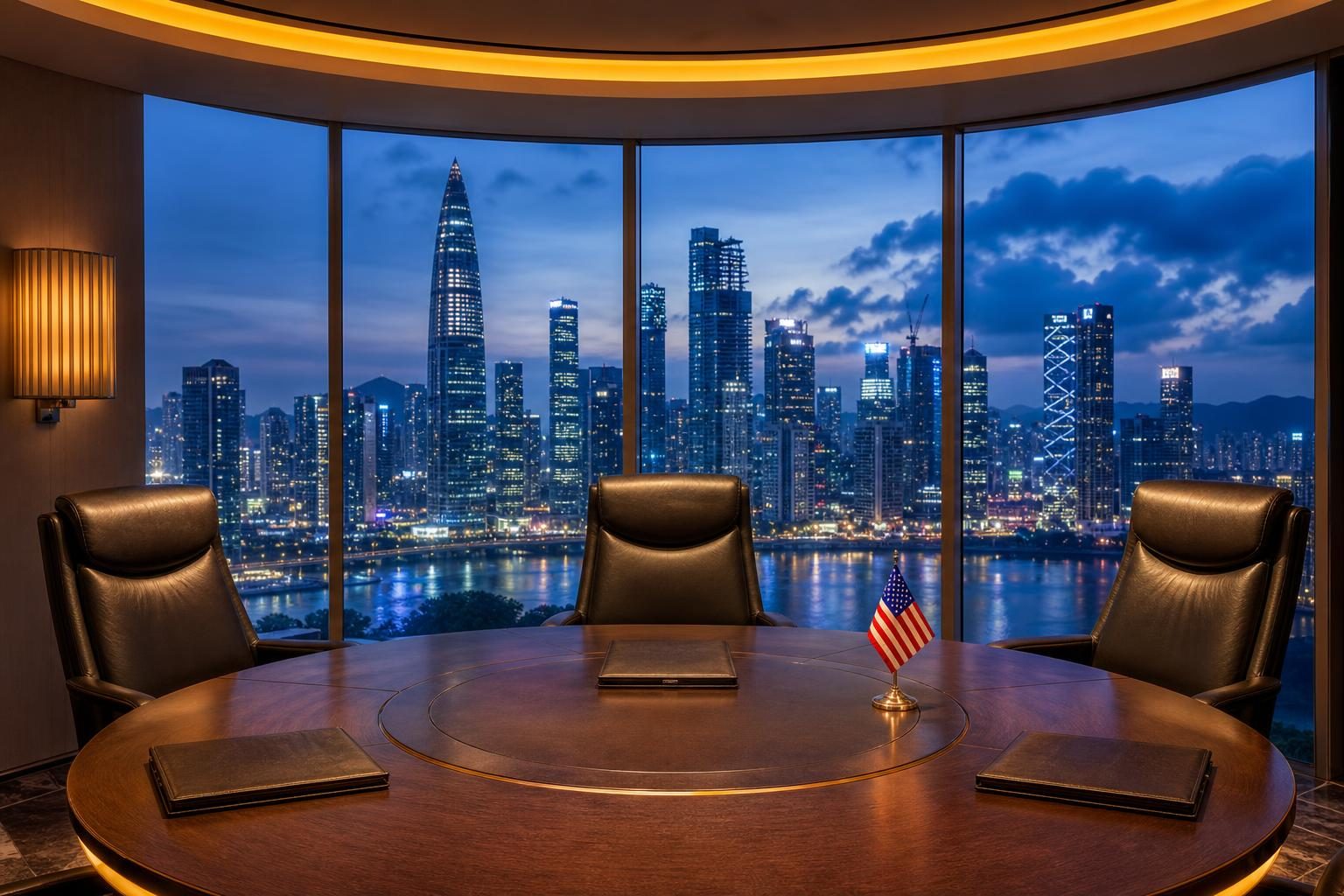
Part of our continuing coverage: Trump Heads to Shenzhen for Third Xi Summit as Nvidia Scandal, Taiwan and Iran Test a Fragile Truce
Key points
- Trump says he expects to see Xi and Putin at the APEC summit in Shenzhen on Nov. 18-19, with denuclearization and ending the Iran war on his list.
- The Kremlin says a Putin-Trump meeting is planned and a three-way session is being prepared; Beijing says no meeting or agenda is final.
- New START expired Feb. 5, leaving the U.S. and Russia without binding limits, while China rapidly expands its arsenal and refuses trilateral talks.
- Experts expect no quick breakthrough, but some see a summit as the start of a longer conversation.
President Trump heads to China next week chasing a goal no American president has reached: putting the leaders of the world's three biggest nuclear powers at one table to talk about their weapons. Trump said on Nov. 8, while flying back to Washington from Florida, that he expects to see both Chinese leader Xi Jinping and Russian President Vladimir Putin at the Asia-Pacific Economic Cooperation summit in Shenzhen on Nov. 18-19, and that denuclearization would be discussed along with U.S. efforts to end the war in Iran, the News Tribune reported [1].
The three-way meeting is not locked in. Kremlin aide Yuri Ushakov said Thursday that Putin and Trump plan to meet in Shenzhen and that work is underway on a session with Xi that would be the first ever in that format, according to the Kyiv Post [2]. Beijing, the host, has said only that it is in communication with the other parties, and no meeting or agenda has been finalized, The Korea Times reported [3].
Liberty Bell Report previewed the Trump-Xi side of the trip earlier this week, including trade, Taiwan and the fallout from the Nvidia scandal. This report looks at the issue the President himself has put first: nuclear weapons.
What Trump Is Asking For
The idea has been building for weeks. Trump said in October that he was open to three-way arms talks with Xi and Putin and that such a gathering would focus on denuclearization, the News Tribune reported [1]. The precise format, timing and agenda of any Shenzhen talks still have not been confirmed [1].
National security experts are tempering expectations. Axios reported that specialists do not expect major arms control breakthroughs from a three-way sit-down, if it happens at all [4]. That caution is fair. But the President's instinct reflects a lesson conservatives learned in the 1980s, when a strong and confident America brought Moscow to the bargaining table on nuclear arms. Talks that begin from strength are the only kind worth having.
The Treaty That Lapsed in February
The urgency comes from a simple fact: for most of this year there has been no treaty at all. New START, the last nuclear arms agreement between Washington and Moscow, expired at midnight on Feb. 5, ending 15 years of caps on the weapons the two countries could deploy on missiles, bombers and submarines, NPR reported [5]. The pact held each side to 1,550 deployed warheads, down from an estimated 12,000 at the height of the Cold War, according to former U.S. arms negotiator Rose Gottemoeller [5].
Its lapse left the two countries without legally binding limits on their strategic weapons, the Arms Control Association reported [6]. NPR described it as the first time in decades that the U.S. and Russia have had no such limits [5].
Putin had offered in September 2025 to keep observing the treaty's central limits informally for another year. Trump at first called it a good idea, but Moscow says Washington never sent a formal reply, the association reported [6]. Under that proposal, both sides would have agreed not to deploy more warheads, though there would have been no inspections to check, NPR reported [5].
Instead, Trump posted on Feb. 5 that experts should work on a "new, improved, and modernized Treaty that can last long into the future," according to the Arms Control Association [6]. He has also said he would make a deal with Russia without the Chinese if China could not be brought in [6].
The administration's reasoning is straightforward. A two-way treaty no longer matches the world as it is. China has long kept a much smaller arsenal than the U.S. and Russia, but it has begun rapidly expanding its nuclear forces with the goal of becoming a strategic equal to both, NPR reported [5]. A deal that binds Washington and Moscow while leaving Beijing free to build would weaken America a little more every year.
Why Beijing Keeps Saying No
China has long refused to join three-way arms control talks, The Korea Times noted [3], and its public posture has barely moved. When New START expired, Beijing called the lapse regrettable, urged Washington and Moscow to resume dialogue on strategic stability and pressed the U.S. to respond positively to Russia's offer to keep honoring the old limits, the Arms Control Association reported [6]. Put plainly, China would prefer that the two larger powers restrain themselves while it keeps building.
Even the format makes Beijing uneasy. Foreign Ministry spokesperson Mao Ning acknowledged last week, for the first time publicly, that China was discussing a possible three-way meeting [3]. But analysts quoted by The Korea Times suggested the event could turn out to be mostly ceremonial, a spectacle without much consequence [3].
What Moscow Wants
Putin's priority is different from Trump's. Ushakov said the full range of issues tied to a settlement of the war in Ukraine would be on the table in Shenzhen, and that no Ukrainian or European representatives would take part, the Kyiv Post reported [2]. The Korea Times reported the same split: Trump has signaled interest in nuclear arms control, while Putin is focused on Ukraine [3].
That gap is where the President will need to be careful. A summit photo of three leaders is a prize for Moscow, which has spent most of the years since its 2022 invasion trying to escape isolation. Any arms understanding should stand on its own merits, and no talk of nuclear limits should become a back door for deciding Ukraine's future without Ukraine in the room.
Iran is the other pressure point. Trump has said Washington is trying to end the war there, and he listed it alongside denuclearization as a topic for Shenzhen [1].
Supporters and Skeptics
Not every expert is dismissive. Andrea Stricker of the Foundation for Defense of Democracies told Axios that a summit "could be the start of a longer conversation" and called the diplomatic effort a positive [4]. Jon Wolfsthal of Pax Sapiens was more doubtful, noting that all of the countries involved are either building up or modernizing their nuclear weapons [4].
Gottemoeller, who negotiated New START, argued earlier this year that a short bridge on the old limits would help keep Russia in check while the U.S. plans how to answer China's buildup, the Arms Control Association reported [6].
Money is part of the case for talking, too. The U.S. is in the middle of a major upgrade of the nuclear weapons it already has, and those upgrades alone are projected to cost about $1 trillion over the next decade, NPR reported [5]. Experts told NPR they do not expect New START's end to set off an immediate arms race, though that could change over time [5].
What Comes Next
The calendar is set even if the table is not. APEC leaders gather in Shenzhen on Nov. 18-19 [1], and the Kremlin says a Putin-Trump meeting is planned there [2]. Whether Xi agrees to host a three-way session is the question that will be answered in the coming days [3].
Scripture calls the peacemakers blessed, and few goals fit that call better than reducing the number of weapons that could end millions of lives in an afternoon. But peace that lasts has always rested on strength and on proof. Any framework that comes out of Shenzhen should include all three powers, real verification and no trade-offs that sell out an ally. If Xi will not sit down, that refusal will tell Americans something important about which capital is serious about arms control and which one is not.
Sources
With Democrats taking Congress, what should Republicans focus on first?
- Blocking bad bills
- Working on prices and costs
- Winning back the House in 2028
- Confirming judges before January
More in Politics
Alito's Warning on the Power of the Purse: What He Said and Why It Matters as Democrats Take Congress
Today on Order in the Court with Harold Whitmore
One Word Could Decide the Coming Subpoena Wars: What Peter Navarro's Supreme Court Petition Means for Trump Officials
Today on Rule of Law with Lauren Pierce
Supreme Court Agrees to Decide Whether Trump's Day-One Border Asylum Order Can Stand
Today on Rule of Law with Lauren Pierce
Were you there?
If you were at the scene, or this story touched your life, tell us what you saw and what it was like.
Discussion 0
Sign in or create a free account to join the discussion.
No comments yet. Start the discussion.