
 Overnight on The Briefing Room with Claire Donovan
Trump Heads to Shenzhen for Third Xi Summit as Nvidia Scandal, Taiwan and Iran Test a Fragile Truce
President Trump meets Xi Jinping at APEC in Shenzhen next week with a trade truce expiring in January, a chip-spy scandal roiling Washington and fresh allied warnings over Taiwan.
Filed November 12, 2026 · 📍 White House, DC 20500
Were you there? Share your story
Key points
- Trump is due in the Philippines Nov. 16-18, then in Shenzhen for APEC on Nov. 18-19 and his third Xi meeting of 2026.
- The State Department said Rubio and Wang Yi agreed leader-level talks matter for peace and denuclearization; China's readout omitted that.
- G7 foreign ministers said China's activity east of Taiwan threatens regional stability and shipping.
- The U.S.-China trade truce and the port-fee pause both run out in January.
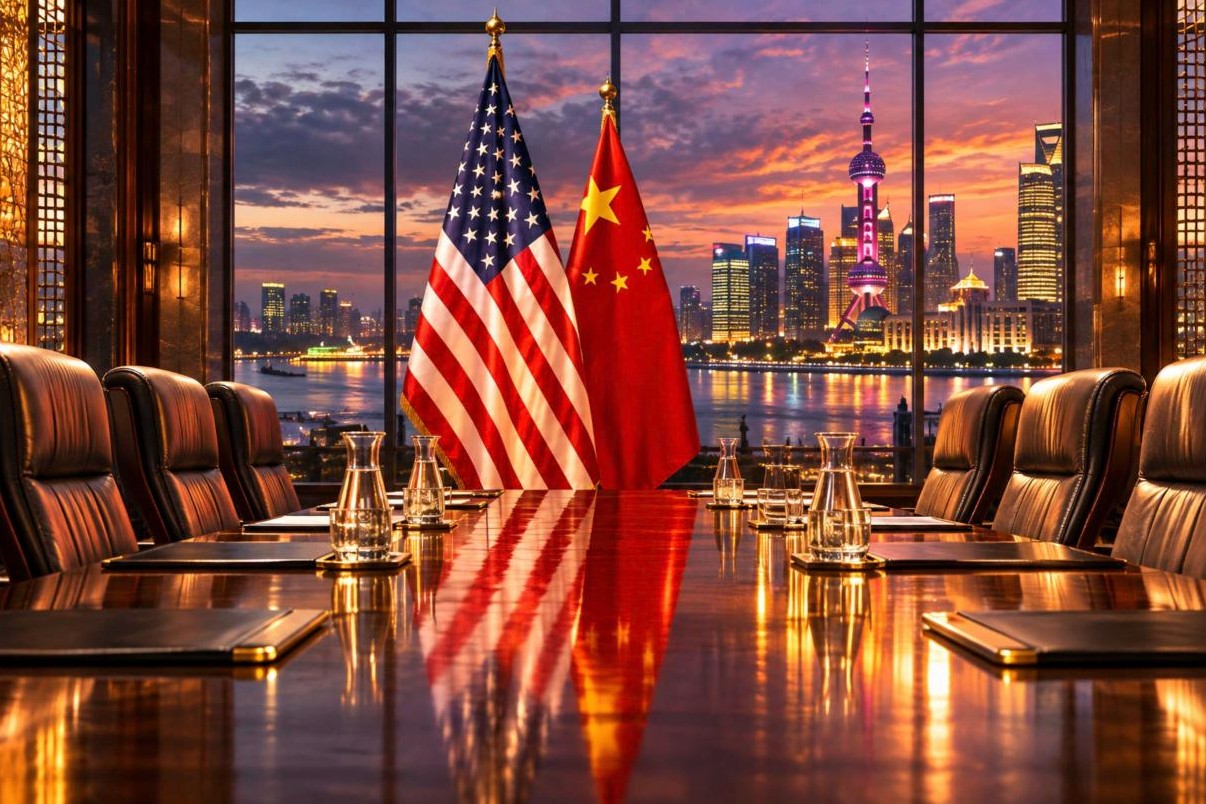
President Trump is heading into his third face-to-face summit of the year with Chinese leader Xi Jinping carrying a short list of demands and a long list of complications. The meeting is set for the Asia-Pacific Economic Cooperation leaders' gathering in Shenzhen, the southern Chinese tech hub, on Nov. 18-19, according to The Daily Wire [5]. Bloomberg, in a report carried by ThePrint, said the summit arrives as a spy scandal surrounding Nvidia chief executive Jensen Huang threatens to unsettle the trade peace Washington and Beijing have spent a year building [3].
The trip opens elsewhere in Asia. The Korea Times, republishing a South China Morning Post report, said Trump is scheduled to be in the Philippines from Nov. 16 to 18 for the ASEAN summit before flying on to Shenzhen for APEC, where he is due to hold his third bilateral meeting of the year with Xi [4].
A Crowded Calendar of Summits
The two leaders first met this year in May, when Trump traveled to Beijing, and Xi returned the visit with a three-day state visit to Washington in late September, The Daily Wire reported [5]. During a tea ceremony in the White House Red Room, Xi announced two more meetings: the Shenzhen summit and a session at the Group of 20 summit in December at Trump National Doral in Miami [5]. If both take place, the two men will have met four times in a single year [5].
Diplomats spent Wednesday laying the groundwork. Secretary of State Marco Rubio spoke by phone with Chinese Foreign Minister Wang Yi on Nov. 11, and the State Department said the two sides agreed on the importance of "meaningful leader-level conversations" to advance peace and denuclearization, including at any three-way summit with Russia, according to a Reuters report published by NTD [1]. Beijing's own account of the call left out both denuclearization and the Russia meeting, NTD reported, while China's state news agency Xinhua described the conversation as positive and constructive [1].
The three-way idea is real but unsettled. Rubio said Tuesday that work was underway to arrange a meeting of Trump, Xi and Russian President Vladimir Putin on the sidelines of APEC, and Trump said Sunday he expected to see both leaders in Shenzhen to discuss ending the war in Iran and denuclearization, NTD reported [1]. The Wall Street Journal reported that Putin proposed a three-way meeting that would also address ending his war in Ukraine, according to the same report, and China has appeared less eager than Washington for three-way nuclear arms talks [1].
The Nvidia Cloud Over the Talks
The newest complication comes from Nvidia. The company's board opened an inquiry on Sunday after The New York Times linked Huang to a Chinese businesswoman whom U.S. intelligence officials suspected of passing information to Beijing, The Korea Times reported [4]. Huang acknowledged in a statement that he had been unfaithful to his wife and said he would cooperate fully, and lawmakers have summoned him to a closed-door briefing on Nov. 18, the opening day of the Shenzhen meetings [4][5]. Bloomberg reported that Nvidia's board is working to identify a possible replacement chief executive amid fresh reports of other affairs [3].
China's Foreign Ministry has dismissed the allegations as unsubstantiated smears, while Trump has defended Huang and said he would still invite him on the Asia trip [4]. Huang joined Trump's May trip to Beijing at the president's personal invitation; it is not clear whether he will be in Shenzhen [3].
The stakes go beyond one executive. Huang had been the most prominent American tech leader urging engagement with China and looser chip export controls, and some lawmakers now want to use the scandal to tighten those controls, Bloomberg reported [3]. House Democratic Leader Hakeem Jeffries backs defense-bill provisions to restrict China's access to advanced chips, and the Chip Security Act, which would require physical tracking of advanced processors, is moving in Congress [3]. "This is the first major test of the truce," said Jeff Moon, a former assistant U.S. trade representative for China affairs, in the Bloomberg report [3].
Analysts are split on how much the furor will matter in Shenzhen. "I really don't see this as having a huge impact on the summit," said Sam Bresnick of Georgetown University's Center for Security and Emerging Technology, while others warned the episode could deepen mistrust or revive pressure in Congress to reverse the administration's approval of advanced chip sales to China, The Korea Times reported [4].
Taiwan and the Western Pacific
Taiwan hangs over every U.S.-China meeting, and America's allies made sure of it this week. Foreign ministers of the Group of Seven, who met in Paris, issued a joint declaration late Wednesday saying China's increasingly assertive activity in the waters east of Taiwan threatens "regional stability, freedom of navigation and the safety of international shipping," according to a Reuters report carried by NTD [2]. The ministers restated their opposition to unilateral attempts to change the status quo, particularly by force or coercion [2].
NTD reported that the statement is the strongest unified expression of concern on the issue so far; the United States, Britain, France and Germany had previously raised it separately [2]. China has stepped up activity off Taiwan's east coast since June, including regular coast guard patrols, and Taiwanese officials believe Beijing is rehearsing for a possible maritime blockade [2]. Taiwan's defense minister, Wellington Koo, said Tuesday that China is conducting area-denial drills in the Western Pacific involving an aircraft carrier [2]. Taiwan's presidential office welcomed the G7 statement, while China's Foreign Ministry did not immediately respond to a request for comment [2].
Those waters matter to American interests because Taipei regards them as a vital wartime supply route from allies in the event of a blockade or conflict, and China has never renounced the use of force to take control of the island [2].
Trade, Ships and What Washington Wants
The economic backdrop is a truce that both sides keep extending rather than finishing. The arrangement grew out of the deal Trump and Xi struck in Busan, South Korea, a year ago, under which Washington agreed not to add new technology restrictions and Beijing agreed to supply critical minerals, Bloomberg reported, with roughly $500 billion in annual trade at stake [3]. During Xi's September visit, the two sides extended the truce by two months, through Jan. 10, according to Treasury Secretary Scott Bessent [5].
The shipping side of the truce has been pushed back to match, as Liberty Bell Report has reported. The U.S. Trade Representative formally extended its suspension of port fees on Chinese-built and Chinese-operated ships through Jan. 9, 2027, and China extended its pause on retaliatory fees against U.S.-linked vessels to Jan. 10, gCaptain reported [6].
What the White House wants from Beijing is fairly clear from its own officials. Bessent and U.S. Trade Representative Jamieson Greer have pressed Chinese Vice Premier He Lifeng on carrying out the Busan deal, and Greer and others say critical minerals are not arriving at the volume and pace promised, Bloomberg reported [3]. Disputes over tariffs, Chinese purchases of American goods, rare-earth exports and technology restrictions remain unresolved, according to the Reuters report carried by NTD [1]. Bessent also said the two countries would advance a new dialogue on artificial intelligence, while cautioning that neither side should harbor illusions about their differences [1].
Iran is the other pressure point. After the September talks, U.S. Ambassador to China David Perdue said Trump made clear that Washington considers Chinese assistance to Tehran unacceptable, The Daily Wire reported [5]. Trump has said he wants the Shenzhen meetings to help end the war in Iran [1].
What Comes Next
The calendar after Shenzhen is tight. Xi is expected in Florida for the G20 next month [1], and both the trade truce and the port-fee pause run out in January [5][6]. Beijing, for its part, worries that an Nvidia probe could justify broader American restrictions on Chinese companies, and a separate U.S. rule extending export curbs to majority-owned subsidiaries of sanctioned firms is suspended only until January, Bloomberg reported [3].
The real test in Shenzhen is not whether the photographs look warm. It is whether the president can hold Beijing to the mineral and purchase commitments it has already made, keep America's most sensitive chip technology away from a rival military, and stand with the allies who see pressure building around Taiwan. Peace through strength has always meant talking with adversaries while never mistaking a handshake for trust. Next week should show which promises China intends to keep.
In pictures
Illustration · Liberty Bell Report
Sources
- [1]Opens in a new tab ↗
- [2]Opens in a new tab ↗
- [3]ThePrint (Bloomberg)Nvidia row puts US-China trade truce to test with Xi set to welcome Trump next weekOpens in a new tab ↗
- [4]The Korea TimesNvidia scandal may test fragile US-China truce, experts sayOpens in a new tab ↗
- [5]Opens in a new tab ↗
- [6]Opens in a new tab ↗
With Democrats taking Congress, what should Republicans focus on first?
- Blocking bad bills
- Working on prices and costs
- Winning back the House in 2028
- Confirming judges before January
More in Politics
Vance Weighs Direct Talks With Iran as Rubio and Miller Back Keeping the Pressure On
Last night on The Briefing Room with Claire Donovan
Trump Taps HUD's Civil Rights Enforcer to Carry On Harmeet Dhillon's Work at the Justice Department
Last night on Rule of Law with Lauren Pierce
Race Against the Clock: Trump's Judicial Picks Hit Republican Roadblocks as the Senate Majority Winds Down
Last night on The Sterling Report with Ava Sterling
Were you there?
If you were at the scene, or this story touched your life, tell us what you saw and what it was like.
Discussion 0
Sign in or create a free account to join the discussion.
No comments yet. Start the discussion.