
 Overnight on The Briefing Room with Claire Donovan
Putin Arrives, Xi Pitches Open Trade: Shenzhen Sets the Stage for Thursday's Three-Way Talks, and What America Wants From Them
As Xi talks up open trade and sits down with Putin, President Trump heads into Thursday's three-way meeting aiming to pull China into nuclear arms talks and keep the pressure on Iran.
Filed November 18, 2026 · 📍 White House, DC 20500
Were you there? Share your story
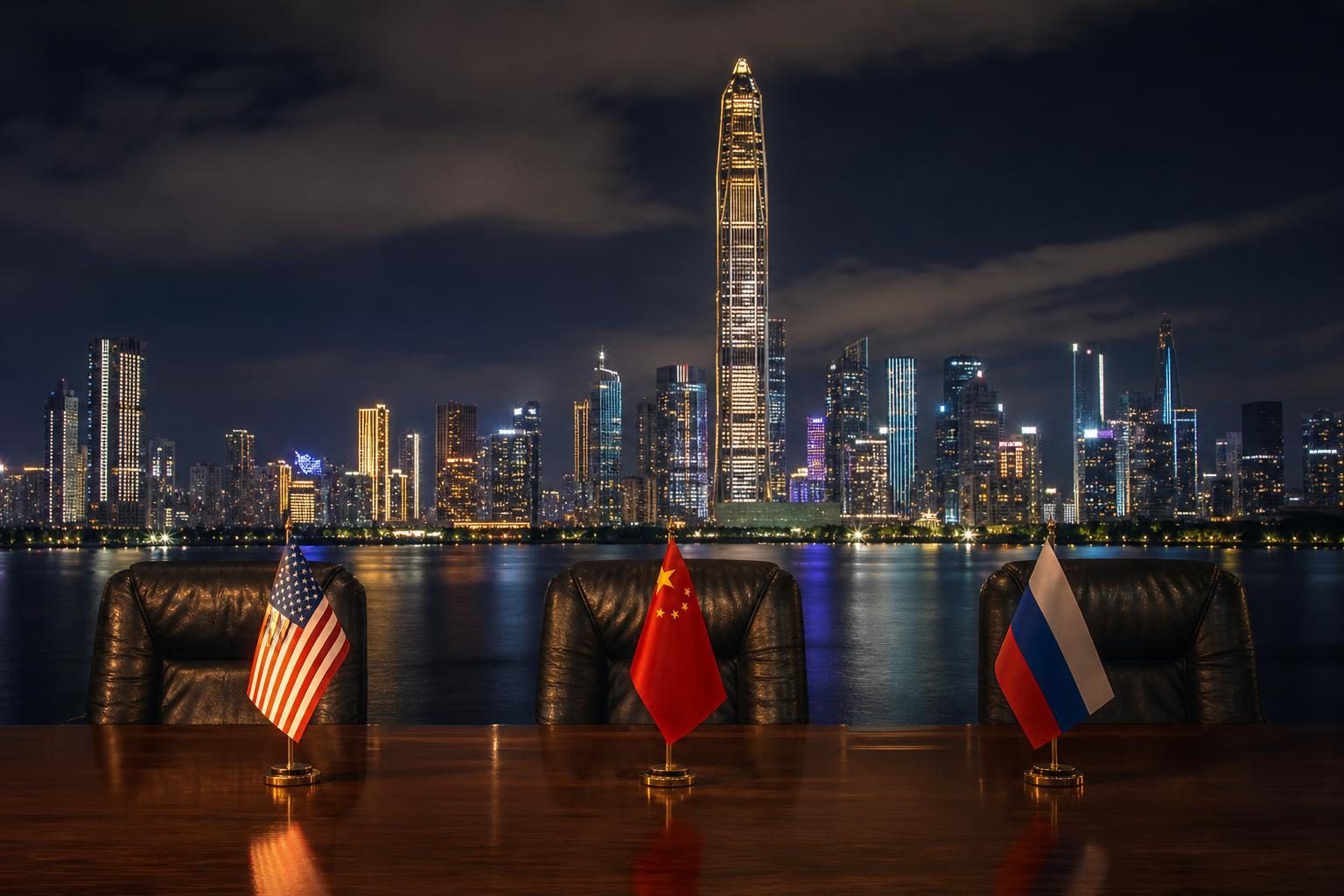
Part of our continuing coverage: Trump Wants Nuclear Arms at the Top of a Possible Shenzhen Summit With Xi and Putin. What Would a Deal Take?
Key points
- Xi met Putin in Shenzhen a day before Thursday's first-ever Trump-Xi-Putin summit.
- Xi warned at APEC that protectionism is spreading and promised lower tariffs.
- The White House says nuclear arms and the Iran war are on the agenda; no deal is expected.
- New START expired in February, and China is expected to have about 1,000 warheads by 2030.
China's Xi Jinping held talks with Russia's Vladimir Putin in the southern tech hub of Shenzhen on Wednesday, one day before the two leaders are due to sit down with President Trump at a first-of-its-kind three-way summit, Euronews reported [1]. The meeting gave the hosts a chance to compare notes before the American president arrives, and it set the stage for the most closely watched diplomatic gathering of the year.
Hours earlier, Xi used his keynote at the APEC CEO Summit to argue that global growth "lacks momentum" and that protectionism is spreading, Bloomberg reported [2]. Reuters, in a report carried by WHBL, said Xi defended a trading system with the World Trade Organization at its core and promised to lower tariffs and open China's markets further [3].
For President Trump, Thursday is about more than trade talking points. The White House has said nuclear arms reduction will be on the table, and the President intends to raise the war with Iran, CNBC reported [4]. The President, in other words, is walking into a room with the leaders of America's two biggest rivals and bringing the issues that matter most to American security with him.
Why this meeting, and why now
Beijing confirmed the gathering this week, billing it as a China-Russia-U.S. summit held alongside the Asia-Pacific Economic Cooperation leaders' meeting, according to CNBC [4]. It will be the first time the leaders of the three countries have met together at one table.
The timing is not an accident. The New START treaty, the last pact limiting the American and Russian nuclear arsenals, expired in February 2026, leaving no binding caps on either country's weapons, Radio Free Europe/Radio Liberty reported [5]. The administration hopes the summit will draw China into broader arms control negotiations, something Beijing has repeatedly refused, with its foreign ministry calling three-way talks unreasonable and unrealistic, RFE/RL reported [5].
Meanwhile, China is expected to field about 1,000 operational nuclear warheads by 2030 as part of a sweeping military buildup, Newsweek reported [6]. That is the heart of the American argument. A deal that limits Washington and Moscow while leaving Beijing free to build would not make American families safer. Getting China into the conversation at all would be a first.
What President Trump wants
The President has set realistic expectations. A senior administration official told Reuters the White House does not expect to reach any kind of agreement and sees the meeting as the start of a conversation, CNBC reported [4]. That is how serious diplomacy with adversaries usually begins: with a seat at the table and a clear statement of interests, not a rushed signing ceremony.
Iran is the second priority. The President plans to raise the U.S.-Israeli war against Iran with both leaders, CNBC reported [4]. Russia and China each keep working ties with Tehran, so any signal from either capital about restraining the regime would matter to American troops in the Gulf and to the tanker crews moving oil through the region.
There is also a quieter goal: showing friends and rivals alike that America negotiates from strength. The President opened this trip in Manila, meeting Philippine leaders at the ASEAN summit before heading to China, CNBC reported [4]. Friends in Tokyo, Seoul, Manila and Canberra will be watching to make sure no bargain is struck over their heads, and rivals in Beijing and Moscow will be watching to see whether Washington blinks on chips, on Iran or on Ukraine. Starting with allies before sitting down with adversaries sends the right signal to both audiences.
No one-on-one meeting with Putin was on the schedule, but the President said he would meet the Russian leader "if it's available," according to CNBC [4].
What Putin and Xi want
For Moscow, the summit is a chance to press its case on Ukraine. A Putin aide said the talks would continue diplomatic efforts toward a negotiated settlement, and Putin said he expects considerable benefits from the meeting, CNBC reported [4]. The messaging from Washington on Ukraine has shifted: a White House official said earlier that the President was not expected to raise the war, but the President has since said he would bring it up, according to CNBC [4].
For Beijing, the message is open trade, at least in words. Xi's speech came just after Washington announced new limits on China's access to advanced chips from companies such as Nvidia, a move that could complicate a fragile trade truce, and China has pledged to retaliate, Reuters reported via WHBL [3]. Bloomberg noted that Xi's pitch for a more integrated world economy followed Washington's push to restrict China's access to the computing power behind advanced technology [2].
Americans have heard Beijing promise open markets before. The test is not a keynote in Shenzhen but whether American farmers, manufacturers and chip makers see fair access in practice, and whether China stops using its grip on supply chains as leverage.
The trade and technology backdrop
The summit opens with both sides holding cards. The United States has tightened the door on the most advanced chips, the core technology of the coming decade, and Beijing has answered with talk of retaliation [3]. China, for its part, is presenting itself to the region's business leaders as the defender of free trade [2] [3].
That contrast is worth watching. A country that champions the World Trade Organization in speeches has also faced years of complaints from Washington over subsidies, forced technology transfers and market barriers. The President's approach has been to use American leverage to force better terms rather than accept promises on faith.
What to watch on Thursday
First, whether China agrees to any follow-up talks on nuclear weapons. Even a modest commitment to keep talking would mark progress after Beijing's repeated refusals [5].
Second, Iran. Any public statement from Xi or Putin about the war, the attacks on shipping or Tehran's nuclear program will be read closely in Washington and in Gulf capitals [4].
Third, Ukraine. Whether the President raises the war, and how Putin answers, will shape the next round of American-brokered diplomacy [4].
Fourth, trade. Watch for any sign of retaliation over chips or a move to steady the truce [3].
The Kremlin and the White House both expect limited results, and analysts have warned not to expect a grand bargain [4]. But the setting itself matters. For the first time, the leader of the free world will sit across from the heads of the two great powers most determined to reshape the world order, and he will be there to put America's interests first.
Why it matters to our readers
Nuclear arms are not an abstraction. They shape how much America spends on defense, how safe our cities are and what kind of world our children inherit. An unchecked three-way arms race would be costly and dangerous. A conversation that brings China in, backed by American strength, is the better path, and it is the one the President is taking.
Peace through strength is not a slogan. It is the recognition that adversaries negotiate seriously only when they believe the other side can and will defend its interests.
The same goes for Iran. A war that threatens oil shipping reaches every family through prices at the pump and the safety of the men and women serving in the region. If the summit produces even small steps on these fronts, it will have been worth the trip.
We will follow the Shenzhen meeting closely and report what the leaders agree to, and what they do not, as the day unfolds.
Sources
- [1]Opens in a new tab ↗
- [2]Opens in a new tab ↗
- [3]WHBL (Reuters)China's Xi calls for free and open trade at APEC summitOpens in a new tab ↗
- [4]Opens in a new tab ↗
- [5]Radio Free Europe/Radio LibertyTrump To Discuss Iran, Nuclear Arms With Putin, Xi At Landmark SummitOpens in a new tab ↗
- [6]Opens in a new tab ↗
Israel's new parliament is sworn in. Who would you rather see lead Israel?
- Benjamin Netanyahu
- Gadi Eisenkot
- Someone new
- That's for Israelis to decide
More in World News
Britain Heads Back to Brussels: What Friday's Reset Summit Offers, What It Costs, and Why Washington Should Care
Today on World Watch with Grace Whitfield
The President Will Meet Russia's Leader Privately on Thursday as APEC Opens With Beijing's Tariff Pitch and a Nuclear Agenda
Today on The Briefing Room with Claire Donovan
Israel Moves Back Into Central Gaza to Hit Hamas Infrastructure: The Hard Questions for a Ceasefire on the Brink
This morning on Cross-Examination with Dominic Kane
Were you there?
If you were at the scene, or this story touched your life, tell us what you saw and what it was like.
Discussion 0
Sign in or create a free account to join the discussion.
No comments yet. Start the discussion.