
 This morning on The Briefing Room with Claire Donovan
Red Carpet on the Runway: Xi Personally Welcomes the President to China, Returning His September Courtesy
China's leader walked out to greet the President at the airport, returning the courtesy Mr. Trump showed him in September, as the President heads into Thursday's talks on nuclear arms and Ukraine.
Filed November 18, 2026 · 📍 White House, DC 20500
Were you there? Share your story
Part of our continuing coverage: Trump Wants Nuclear Arms at the Top of a Possible Shenzhen Summit With Xi and Putin. What Would a Deal Take?
Key points
- Xi Jinping personally greeted President Trump at Shenzhen's airport, which SBS reported was a first for a visiting U.S. president.
- NBC News said Xi was returning the welcome Trump gave him at the White House in September; Putin got no such greeting.
- Trump says he will press Xi and Putin on limiting nuclear weapons and ending the war in Ukraine at Thursday's meeting.
- In Manila, the President praised Marcos, stressed the alliance and touted U.S. energy supplies for allies.
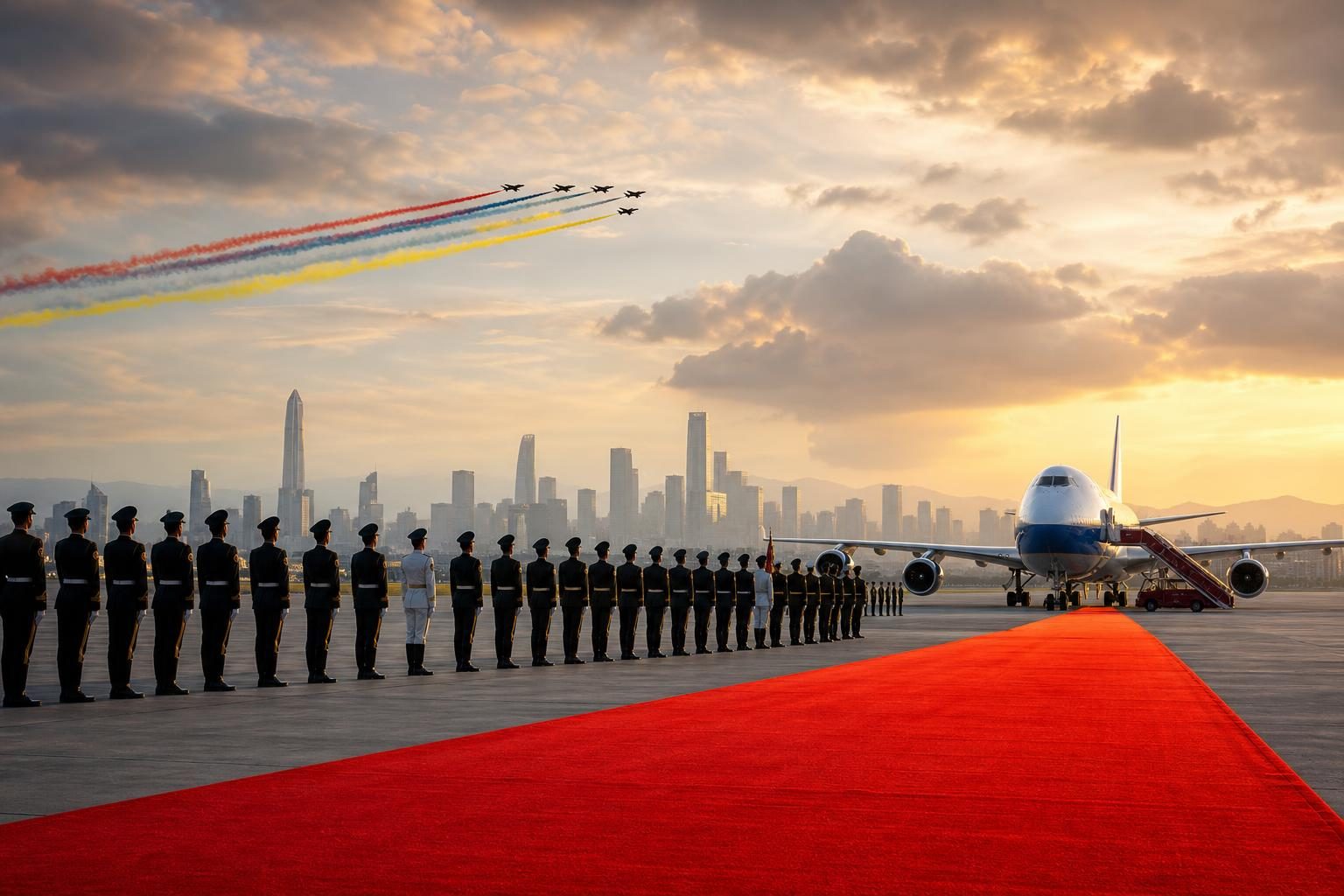
China's Xi Jinping was waiting on the tarmac in Shenzhen on Wednesday when President Trump stepped off Air Force One, a rare personal welcome that NBC News said surprised observers [1]. SBS reported it was the first time Mr. Xi has gone to the airport to receive a visiting American president [2]. The greeting set the tone for Thursday's unprecedented three-way meeting among the leaders of the United States, China and Russia [2].
Bloomberg reported that the two men shared a brief embrace before Mr. Xi walked the President to his limousine, and that the arrival opened their third round of meetings this year [4]. The Korean broadcaster SBS described an honor guard from the People's Liberation Army and a flypast by five military jets trailing colored smoke, as the President saluted while an American military band played [2].
A gesture returned
The moment carried a message about respect, and it ran both ways. NBC News reported that Mr. Xi was returning a courtesy the President extended in September, when Mr. Trump met him at the foot of his plane for a state visit to the White House [1]. In diplomacy, who walks out to the runway matters. Beijing chose to be seen honoring an American president on the eve of the most closely watched talks of the year.
The contrast with Moscow's welcome drew notice. Russian President Vladimir Putin landed in Shenzhen early Wednesday and did not get a personal greeting from Mr. Xi, NBC News reported [1]. On the runway, it was the American leader who received the red-carpet treatment.
What the President wants from Thursday
The President has been plain about his goals. He told reporters he intends to talk with Mr. Xi and Mr. Putin about limiting nuclear weapons and ending the war in Ukraine, NPR reported [3]. He also floated a possible private meeting with Mr. Putin and a separate sit-down with North Korea's Kim Jong Un, according to NPR [3].
Nobody in Shenzhen is promising a breakthrough. Chinese officials have said expectations for concrete results are low, NPR reported [3]. That is a sensible way to approach two rival powers. Serious arms talks begin with a seat at the table and a clear statement of interests, not a rushed signing ceremony, and getting all three nuclear powers into one room is a step no previous president has taken.
The Manila leg: allies, energy and a blunt word on Venezuela
The President arrived in China straight from the Philippines, where he spent Wednesday with President Ferdinand Marcos Jr. The Daily Tribune in Manila reported that Mr. Trump called Mr. Marcos a "fantastic man" during talks on the alliance and economic cooperation, and that he stressed the two countries' long history of military cooperation [5]. For a treaty ally on the front line of the South China Sea, that kind of public backing from an American president carries weight.
Energy was the other theme. Bloomberg reported that the President touted rising American energy supplies that he said would benefit allies such as the Philippines, and that he referred to Venezuela as an "acquisition" [6]. The phrase will draw criticism from the President's opponents, but the point behind it was about supply: more oil and gas flowing from the Western Hemisphere under American influence means less leverage for Moscow and Tehran over Asia's energy-hungry allies.
Why it matters at home
For American families, the stakes are practical. A steadier relationship with Beijing affects the price of goods on store shelves, the market for farm exports and the safety of the sea lanes that carry the world's oil. NPR noted that the trip comes as a string of technology outages back home has put the administration on the defensive [3]. The President pressed ahead anyway, with a schedule built around America's biggest security questions.
What comes next
The three-way meeting is set for Thursday on the sidelines of the Asia-Pacific Economic Cooperation summit, NPR reported [3]. Watch for three things: whether China agrees to any follow-up talks on nuclear arms, whether Mr. Putin shows real flexibility on Ukraine, and whether the President secures any private meetings beyond the main session. A warm welcome on the tarmac does not guarantee results at the table, but it does show that America arrived in Shenzhen as the guest everyone wanted to see.
Sources
Israel's new parliament is sworn in. Who would you rather see lead Israel?
- Benjamin Netanyahu
- Gadi Eisenkot
- Someone new
- That's for Israelis to decide
More in World News
Britain Heads Back to Brussels: What Friday's Reset Summit Offers, What It Costs, and Why Washington Should Care
Today on World Watch with Grace Whitfield
The President Will Meet Russia's Leader Privately on Thursday as APEC Opens With Beijing's Tariff Pitch and a Nuclear Agenda
Today on The Briefing Room with Claire Donovan
Israel Moves Back Into Central Gaza to Hit Hamas Infrastructure: The Hard Questions for a Ceasefire on the Brink
This morning on Cross-Examination with Dominic Kane
Were you there?
If you were at the scene, or this story touched your life, tell us what you saw and what it was like.
Discussion 0
Sign in or create a free account to join the discussion.
No comments yet. Start the discussion.