
 Yesterday on The Briefing Room with Claire Donovan
Trump Opens Asia Trip in Manila With Allies, Trade Progress and Nuclear Talks Ahead
President Trump landed in the Philippines on Tuesday to a festive welcome, meeting Quad and Southeast Asian leaders and advancing a Thai trade pact before heading to Shenzhen for nuclear talks with Xi and Putin.
Filed November 17, 2026 · 📍 Washington, DC 20001
Were you there? Share your story
Part of our continuing coverage: Trump Leaves for Manila and Shenzhen Saying a Kim Jong Un Meeting in China Could Happen, if Xi Makes Room
Story tracker
Key points
- President Trump landed in Manila on Tuesday for a state visit, a Quad meeting and a special ASEAN-U.S. summit; a Malacañang welcome with full military honors follows Wednesday.
- Thailand's prime minister and President Trump were set to sign a joint statement on reciprocal trade, with the final legal text expected within one to two months.
- The Philippines remains a key ally against Chinese pressure; nearly 70 percent of Filipinos say they trust the President.
- On Thursday in Shenzhen, the President is scheduled to meet Xi Jinping and Vladimir Putin on nuclear arms, while China's farm-purchase pledge lags.
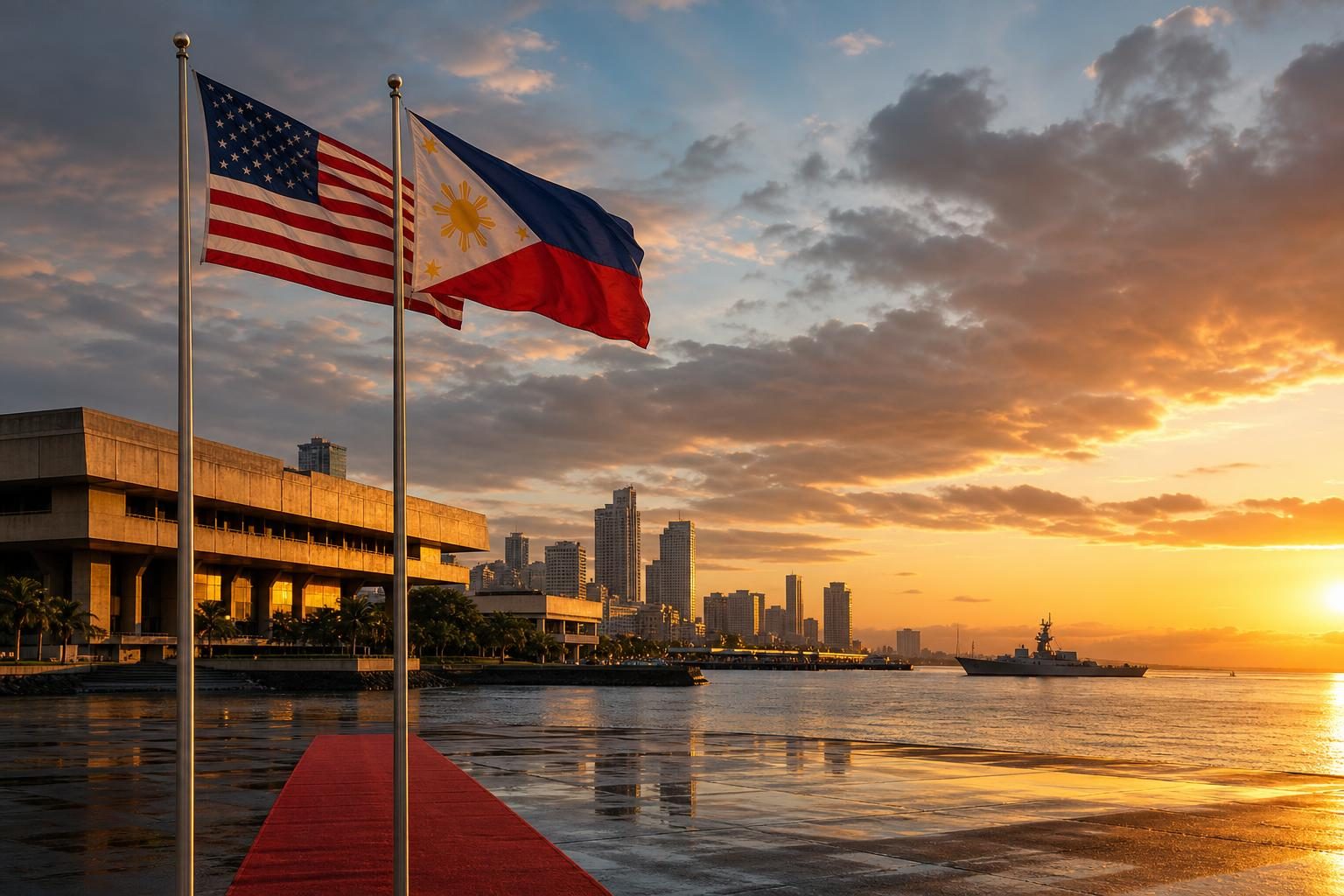
President Trump stepped off Air Force One in Manila on Tuesday to open a three-day swing through Asia built around two aims: better trade terms for American workers and a steadier peace backed by American strength. The Associated Press reported that a marching band and an honor guard met him on the tarmac before he was flown by helicopter straight into an evening of meetings with allied and regional leaders [1].
The welcome was warm by any measure. Executive Secretary Ralph Recto greeted the President on behalf of Philippine President Ferdinand Marcos Jr., joined by the Philippine leader's son, House Majority Leader Sandro Marcos, Rappler reported [2]. From the airport the President went by helicopter to the Philippine International Convention Center, the hub of this year's summit of the Association of Southeast Asian Nations [2].
A packed first night in Manila
Tuesday's schedule was short on hours but long on substance. According to the AP, Mr. Trump was to go directly to a meeting of the Quad, the security partnership that links the United States with India, Japan and Australia, sitting down with Prime Ministers Narendra Modi, Sanae Takaichi and Anthony Albanese [1]. Rappler noted that it is the first time the Quad's leaders have gathered in two years [2]. From there he was due at a special summit with ASEAN's leaders, followed by a gala at which the bloc was honoring him as its guest of honor [1].
Wednesday brings the formal state visit. The AP reported that President Marcos will receive Mr. Trump at Malacañang Palace with a red carpet, full military honors and a state banquet, and that the two leaders are expected to reaffirm the treaty alliance between their nations [1]. The President is also expected to announce a series of commercial deals and investments in aviation, defense, energy and technology before leaving for the Asia-Pacific Economic Cooperation summit in Shenzhen, China [1].
Critics have seized on the timing. Rappler, citing the Washington Post, reported that the summit's closing ceremony was already underway when the President landed, so he missed most of the 49th ASEAN summit, and that he skipped the East Asia Summit [2]. That is a fair account of the clock, but it leaves out the substance. Southeast Asian leaders built a dedicated ASEAN-U.S. summit and a gala around his visit, the Quad's leaders met for the first time in two years, and his second day is a full state visit with a treaty ally [1][2]. A president's trip is measured by what he brings home, not by how many ceremonies he attends.
America First trade, sealed with Thailand
The economic centerpiece of the Manila stop involves Thailand. Thai Prime Minister Anutin Charnvirakul and Mr. Trump were set to sign a joint statement on reciprocal trade during the ASEAN meetings on Tuesday, The Nation of Thailand reported [3]. The document confirms that the two countries have agreed on the substantive elements of their reciprocal trade negotiations, after which each side will complete its own domestic requirements ahead of a formal signing and implementation [3].
Thai officials have been careful to call the statement progress rather than the final word. Mr. Anutin has said no tariff changes would take effect until the full agreement is signed, and earlier this month he said Thailand expected a U.S. tariff of around 19 percent under the deal [3]. Thailand's deputy prime minister and commerce minister, Suphajee Suthumpun, said negotiators expect to finish the legal wording within one to two months of the joint statement [3].
This is the America First method in practice. Instead of leaving lopsided arrangements in place, the administration has used tariff leverage to bring partners, one by one, to put reciprocal terms in writing. Thailand, a longtime American friend, is now on that path, and the joint statement gives both governments a firm date range for finishing the work [3].
A front-line ally against Beijing's pressure
The Philippines is more than a convenient summit host. Semafor reported that relations between Washington and Manila have held up well through the President's second term, with joint military exercises growing in scale and complexity [4]. Citing the Wall Street Journal, Semafor described the island nation as a linchpin for projecting American power across the region and a potential launchpad for the defense of Taiwan [4].
Ordinary Filipinos appear to share that view of the partnership. Semafor reported that nearly 70 percent of Filipinos said they trust Mr. Trump to do the right thing, the highest share among the 36 countries surveyed [4]. For a nation living with steady Chinese pressure in the South China Sea, those numbers suggest that plain talk about American strength is welcomed rather than feared.
Wednesday's reaffirmation of the alliance at Malacañang is the visible sign of that bond [1]. The less visible sign is industry. Rappler described Pax Silica as a U.S.-led effort to strengthen supply chains for critical minerals and semiconductors, an initiative the Philippines has joined [2]. Secure supply lines for the materials that power modern defense and technology are part of peace through strength, too.
Protests in Manila, in proportion
Not every Filipino welcomed the visit. The AP reported that about 1,500 left-wing demonstrators held a loud rally in a downtown Manila square before the President arrived [1]. Rappler reported that hundreds of people had been arrested in connection with protests that began on Sunday, and that demonstrators objected chiefly to the U.S. war with Iran and to the Pax Silica initiative [2].
Peaceful protest is the right of a free people, and these demonstrations deserve to be reported plainly. They also deserve to be kept in proportion. A rally of roughly 1,500 people stands beside polling in which nearly seven in ten Filipinos say they trust the American president [1][4]. The government in Manila, for its part, rolled out the red carpet and is preparing full military honors for its guest [1].
Shenzhen: nuclear talks, Kim and the farm pledge
The road ahead runs to China. The National reported that Mr. Trump is scheduled to meet Chinese President Xi Jinping and Russian President Vladimir Putin on Thursday in Shenzhen, on the sidelines of the APEC summit, in a rare three-way session focused on reducing nuclear stockpiles and on the war with Iran [5]. Beijing has hailed the meeting as groundbreaking and framed it as a discussion of world peace, while U.S. officials have said Russia's war in Ukraine is not expected to be on the table [5].
Expectations are measured. China has long rebuffed efforts to bring it into arms talks with Russia and the United States, which hold the largest nuclear arsenals, and American officials have described Thursday's session as a starting point rather than a finished agreement [5]. Skeptics call that thin. The better answer is that every serious arms-control agreement began with leaders agreeing to sit at the same table, and seating Beijing at one on nuclear weapons, after years of refusal, is a step no recent president has managed.
A fourth leader may yet appear. Asked on Monday whether North Korea's Kim Jong Un could join him in China, Mr. Trump said Kim may come and that the decision was "up to President Xi," The National reported [5]. No meeting with Kim has been formally set, and the President's openness to talks reflects the same approach of engaging adversaries from a position of strength.
Trade will follow the President to Shenzhen as well. Bloomberg reported that China appears unlikely to meet its pledge to buy at least $17 billion a year in American farm products this year, a commitment the White House announced after the President's Beijing summit with Mr. Xi in May [6]. The two sides agreed in September to cut tariffs on a range of farm goods, but nearly two months later those reductions are still pending, according to Bloomberg, which also suggested the President's bargaining hand may be weaker after Republican setbacks in this month's midterm elections [6].
That is exactly why the Shenzhen meeting matters. American farmers were promised purchases, and the President is carrying that promise directly to the leader who made it. Beijing's slow walk is an argument for pressing the case face to face, not for backing away.
The calendar is set. On Wednesday, Mr. Trump is due at Malacañang for the state welcome and talks with President Marcos before flying to Shenzhen for APEC [1]. On Thursday comes the three-way meeting with Mr. Xi and Mr. Putin [5]. And within one to two months, Thai and American negotiators expect to finish the legal text of the trade agreement that Manila set in motion [3]. For an administration that believes strength abroad and fair trade at home go together, the first day of this trip has laid the groundwork for the harder conversations ahead.
Sources
- [1]The Associated Press (via NBC Washington)Trump arrives in Philippines to kick off Asia trip with economic deals, Asia-Pacific allies talksOpens in a new tab ↗
- [2]Opens in a new tab ↗
- [3]The Nation (Thailand)Anutin and Trump set to sign joint trade statement in the Philippines on Nov 17Opens in a new tab ↗
- [4]Opens in a new tab ↗
- [5]Opens in a new tab ↗
- [6]Opens in a new tab ↗
Israel's new parliament is sworn in. Who would you rather see lead Israel?
- Benjamin Netanyahu
- Gadi Eisenkot
- Someone new
- That's for Israelis to decide
More in World News
Britain Heads Back to Brussels: What Friday's Reset Summit Offers, What It Costs, and Why Washington Should Care
Today on World Watch with Grace Whitfield
The President Will Meet Russia's Leader Privately on Thursday as APEC Opens With Beijing's Tariff Pitch and a Nuclear Agenda
Today on The Briefing Room with Claire Donovan
Israel Moves Back Into Central Gaza to Hit Hamas Infrastructure: The Hard Questions for a Ceasefire on the Brink
This morning on Cross-Examination with Dominic Kane
Were you there?
If you were at the scene, or this story touched your life, tell us what you saw and what it was like.
Discussion 0
Sign in or create a free account to join the discussion.
No comments yet. Start the discussion.