
 On Monday on Cross-Examination with Dominic Kane
Regulators From 38 Nations Warn Ukraine's Nuclear Accident Risk Is Rising. Who Will Stop the Grid Strikes?
European atomic safety bodies say Russian strikes on Ukraine's power grid threaten the cooling that keeps nine reactors safe, raising hard questions for the U.S.-led peace talks.
Filed November 16, 2026 · 📍 World desk · Washington, DC
Were you there? Share your story
Key points
- Regulators representing 38 countries, including the U.S., say Ukraine's nuclear accident risk peaks this winter.
- Russian strikes on substations threaten the grid power that plants need to cool reactors and spent fuel.
- Occupied Zaporizhzhia lost all outside power for more than 12 hours on Nov. 8, the IAEA said.
- The warning asks whether a halt to energy strikes should come first in the U.S.-led talks.
Nuclear safety regulators representing 38 countries warned Monday that the danger of a nuclear accident in Ukraine is climbing as winter sets in, and they pointed to the cause: Russia's campaign against the power grid that Ukraine's reactors depend on to stay cool [1]. In a joint statement reviewed in advance by Reuters, the groups called on Moscow to stop attacking Ukraine's energy infrastructure [1].
The warning lands at an awkward moment. American envoys are trying to broker an end to the war, and the regulators' message amounts to a blunt question for everyone at the table: if a settlement on land and security is still months away, can anyone afford to wait that long for the strikes on substations to stop?
What the Regulators Said
The statement came from three European bodies: the Western European Nuclear Regulators Association, known as WENRA; the Heads of the European Radiological Protection Competent Authorities, or HERCA; and the Heads of the Nordic Radiation Safety Authorities, or NORA [1]. According to Reuters, their membership spans every European Union country along with the United States, Britain, Canada and Japan, among others [1].
The regulators said Russia urgently needs to halt attacks on Ukraine's nuclear facilities and on the energy systems those plants require to operate safely [1]. Per Strand, who leads both HERCA and NORA, told Reuters that Russian strikes have grown deadlier in recent weeks, pointing to drones that carry heavier payloads and hit their targets more precisely [1]. He said that "clearly the highest risk will be this winter for a nuclear accident" [1].
The worst case, Strand said, would be a nationwide blackout that cuts power to all nine of Ukraine's producing reactors at the same time [1]. Those reactors sit at the three plants still under Kyiv's control, Rivne, Khmelnytskyi and South Ukraine, the Kyiv Independent reported, while the fourth, Zaporizhzhia, has been in Russian hands since early in the full-scale invasion [2]. Strand added that the danger can still be headed off if action is taken now and Russia is pressed to stop hitting energy targets [1].
Why Winter Raises the Risk
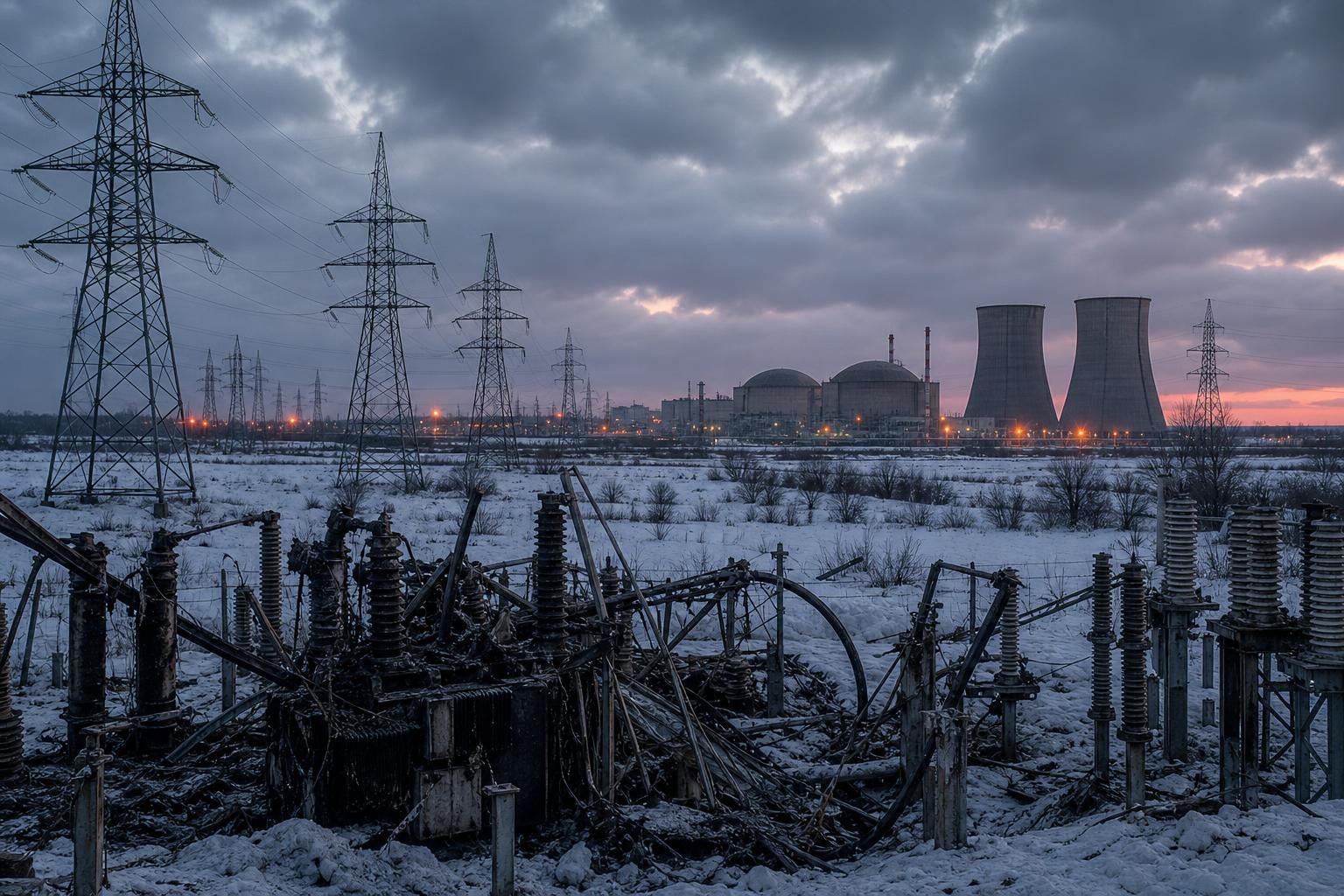
A nuclear plant generates electricity, but it also needs a steady supply from the outside grid to run the pumps and systems that cool reactor cores and spent fuel. Without stable grid power, the regulators said, Ukraine's plants have a harder time keeping nuclear material cool and avoiding a meltdown [1]. The International Atomic Energy Agency has made the same point, noting that plants rely on uninterrupted power delivered through electrical substations to keep their reactors cooled [5].
Winter compounds every weakness. Demand for power peaks as families try to heat their homes, leaving less slack in a grid that is already being battered. In its latest weekly update, the IAEA said instability on Ukraine's grid caused by military activity forced several power reductions at operating reactors over the past week [3]. Each of those cutbacks is a reminder that the weak link is no longer the reactors themselves but the network of lines and transformers around them.
The strikes are not abstract. On Nov. 3, Russia launched 289 drones, 17 ballistic missiles and 59 cruise missiles at Ukraine, and three of those drones were aimed at a substation critical to the stable operation of the Khmelnytskyi nuclear plant, Energy Minister Denys Shmyhal said, according to the Kyiv Post [4]. Shmyhal called the attack a serious escalation, told G7 and European Union ambassadors that such strikes threaten Europe's nuclear safety, and said Kyiv had reported it to the IAEA [4]. The extent of any damage to the substation had not been independently established [4].
Zaporizhzhia's Fragile Lifeline
The plant in the most precarious position is the one Ukraine's own regulators cannot reach. Zaporizhzhia, Europe's largest nuclear power station, sits near the front line in the south under Russian control [2]. Its six reactors are shut down, but idle reactors and their spent fuel still need constant cooling [3].
According to the IAEA, the plant lost all off-site power for more than 12 hours on Nov. 8 after damage to the Ferosplavna-1 line, the single 330-kilovolt connection it has relied on since late March, and emergency diesel generators had to carry its essential safety systems [3]. The agency was also informed that one plant employee was killed in a drone attack on Nov. 9 and another in an explosion the following day [3]. Russia and Ukraine accuse each other of striking the plant and severing the lines that feed it [1].
That leaves a question no communique has answered. Who is accountable for the safety of a reactor complex that one country's army occupies, while another country's engineers and regulators are shut out? So far the honest answer has been a team of international inspectors, a stock of diesel fuel and a running tally of blackouts.
What the IAEA Has Done
The IAEA, the United Nations' nuclear watchdog, has not been idle. In January, its board of governors met in a special session in Vienna, requested by the Netherlands, over fears that Russian attacks on energy facilities could trigger a nuclear accident [5]. Director General Rafael Grossi told members the war remains the world's biggest threat to nuclear safety, and an agency expert mission was sent to assess 10 substations he described as crucial to nuclear safety [5]. The same coverage noted that the Chernobyl site had temporarily lost all off-site power the week before, and that Russia and Ukraine had agreed to a localized ceasefire so crews could repair the last backup line serving Zaporizhzhia [5].
Those steps matter, and the inspectors who keep working in a war zone deserve credit. But they also show the limits of the agency's reach. The IAEA can inspect, report and help arrange repair windows. It cannot stop a drone. Nearly 10 months after that emergency session, the regulators are saying the danger is greater, not smaller [1].
How This Fits the Peace Talks
Russian, American and Ukrainian negotiators met in Abu Dhabi on Nov. 10 for their first round of talks since February, with envoys Steve Witkoff and Jared Kushner leading the U.S. side [6]. Liberty Bell Report has covered the opening of that round, Kyiv's account of a U.S. trial balloon trading Donbas territory for NATO membership, and the hard questions hanging over the entire peace push, so we will not rehash them here.
What the regulators add is a question of sequencing. Borders, security guarantees and alliance membership take months to settle. Strikes on substations threaten reactors now. If Strand is right that an accident can still be prevented only if pressure is applied immediately [1], then a halt to attacks on power infrastructure looks like the one step that should not wait for the rest of the package. Moscow, which holds Zaporizhzhia and is pounding the grid, has the most to answer for, though fairness requires noting that each side blames the other for the danger at Zaporizhzhia [1][2]. Kyiv, for its part, has struck Russian refineries, as this site has reported, which means any energy truce would have to run both ways.
Behind the technical language are families sitting in the cold and dark, and plant workers who keep showing up for duty under fire. Protecting them is not a bargaining chip; it is a basic moral obligation that should be honored regardless of where the talks go.
What It Means for Americans and What Comes Next
Americans have a direct stake. U.S. diplomats are the mediators [6], and the United States is among the nations represented by the bodies sounding the alarm [1]. A radiological release in the middle of Europe would fall on NATO allies, unsettle energy markets and test the alliance at the worst possible time. Ukraine is also home to Chernobyl, whose 1986 disaster remains the world's byword for nuclear catastrophe; a second accident on Ukrainian soil would be a humanitarian disaster and a strategic one, and it would shake public confidence in nuclear power far beyond Europe.
The coldest months are still ahead. The IAEA will keep publishing its weekly reports on Ukraine's plants [3], and the regulators have put their warning on the record [1]. Three things are worth watching: whether Moscow responds to the call to stop hitting the grid, whether Zaporizhzhia's single remaining line holds through the winter, and whether a halt to energy strikes moves up the agenda when negotiators meet again.
The regulators have done their job by sounding the alarm before the snow, not after an accident. The question now is whether the people with the power to stop the strikes will act on it.
Sources
- [1]Reuters (via U.S. News & World Report)Exclusive-Risk of Nuclear Accident in Ukraine Increasing This Winter, Atomic Safety Regulators SayOpens in a new tab ↗
- [2]Opens in a new tab ↗
- [3]International Atomic Energy AgencyUpdate 375 - IAEA Director General Statement on Situation in UkraineOpens in a new tab ↗
- [4]Kyiv PostRussia Fired 365 Drones, Missiles at Ukraine, Targeting Substation Key to Khmelnytskyi Nuclear PlantOpens in a new tab ↗
- [5]Opens in a new tab ↗
- [6]Opens in a new tab ↗
Israel's new parliament is sworn in. Who would you rather see lead Israel?
- Benjamin Netanyahu
- Gadi Eisenkot
- Someone new
- That's for Israelis to decide
More in World News
Britain Heads Back to Brussels: What Friday's Reset Summit Offers, What It Costs, and Why Washington Should Care
Today on World Watch with Grace Whitfield

The President Will Meet Russia's Leader Privately on Thursday as APEC Opens With Beijing's Tariff Pitch and a Nuclear Agenda
Today on The Briefing Room with Claire Donovan
Israel Moves Back Into Central Gaza to Hit Hamas Infrastructure: The Hard Questions for a Ceasefire on the Brink
This morning on Cross-Examination with Dominic Kane
Were you there?
If you were at the scene, or this story touched your life, tell us what you saw and what it was like.
Discussion 0
Sign in or create a free account to join the discussion.
No comments yet. Start the discussion.