
 Last night on Cross-Examination with Dominic Kane
Gaza's Ceasefire Is Running Out of Road, Trump's Board of Peace Warns the U.N., as Israel Says Hamas Still Holds Its Guns
The board's bleak report presses Israel to let a civil administration and police start work, but its own words say neither side can hide behind the other, and the hard question is still Hamas's weapons.
Filed November 17, 2026 · 📍 World desk · Washington, DC
Were you there? Share your story
Story tracker
Key points
- The Board of Peace told the U.N. Security Council the Gaza truce could collapse without full implementation.
- The report says Israel has not yet let the board's civil administration start work or settled the terms for a police force.
- It also says neither Israel nor Hamas may use the other's delay as an excuse for its own inaction.
- Israel says Hamas has not surrendered a single weapon and must disarm before rebuilding begins.
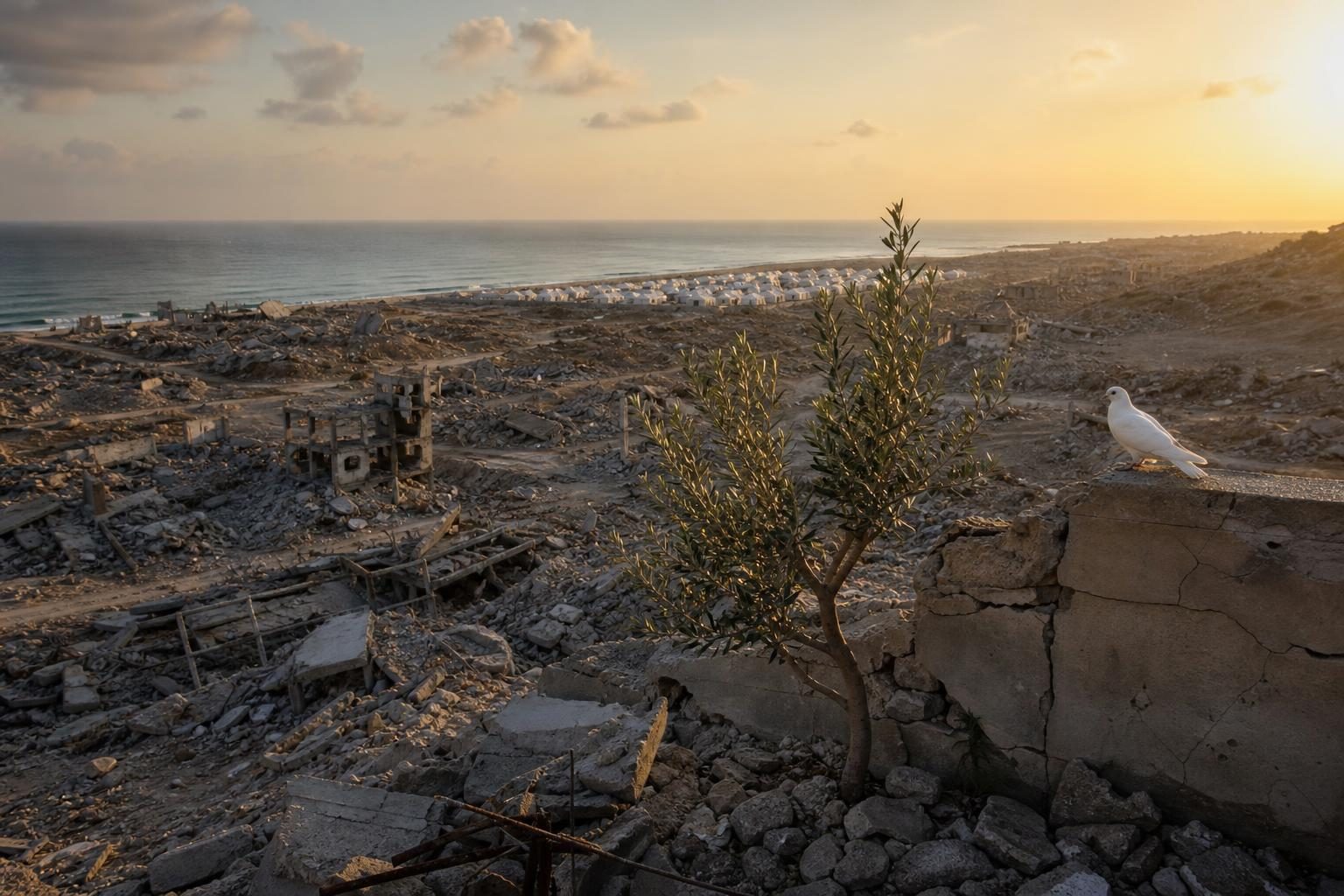
The body President Trump created to shepherd Gaza from war to rebuilding told the United Nations Security Council on Tuesday that the ceasefire could collapse unless the parties move quickly to carry out the rest of the deal. The Board of Peace, which oversees the U.S.-brokered truce between Israel and Hamas and is charged with reconstruction, delivered what the Associated Press called a bleak report on its progress [1].
"A ceasefire that delivers nothing visible cannot be sustained indefinitely," the report warned, according to the AP [1].
What the Report Says
Much of the report's frustration is aimed at Israel. It says the technocratic civil administration the board set up to run Gaza on an interim basis has still not been allowed by Israel to begin its work inside the territory, and that Israel has not decided the conditions for training, deploying and returning civilian police, the AP reported [1]. The board called on the Israeli government to make those decisions without delay [1].
Those missing approvals, the report says, have in turn delayed the international stabilization force, which is tied to the other pieces of the plan: Israeli withdrawal, the disarmament of Hamas and the start of reconstruction [1].
But the report does not let Hamas off the hook. It calls on both Israel and Hamas to keep the commitments they made under last year's agreement and says neither side may treat the other's delay as permission for its own inaction, according to the AP [1]. It also points to continued Israeli strikes and Hamas military activity as reasons the road map has stalled, The Independent reported [2].
The AP noted that in May, Nickolay Mladenov, the board's top official for Gaza, said the deadlock over disarming Hamas had paralyzed progress [1].
Israel's Answer
Israel's government has made its position plain in recent days. The prime minister's office has insisted that winter supplies are entering Gaza, and that Hamas must disarm before reconstruction can begin, the Times of Israel reported [3]. Israeli officials rejected the board's criticism of its handling of aid and said Hamas's refusal to give up its weapons is what is blocking the rebuilding of Gaza, according to The Media Line [4].
Prime Minister Benjamin Netanyahu put it bluntly in response to the board: "Hamas has not surrendered a single weapon," Israel National News reported [5].
The Hard Questions
The report raises questions that deserve straight answers, from both Jerusalem and the terrorists who started this war.
First, what does full implementation mean if Hamas keeps its guns? The plan was built on a sequence. Hamas gives up its weapons and its grip on Gaza, an international force steps in, Israeli troops pull back, and the rebuilding begins. A civil administration and a police force that start work while armed Hamas units still roam the streets would be working at the mercy of the very group the plan was meant to remove. Israel's caution about who carries a badge in Gaza is not stubbornness. It is the lesson of Oct. 7, 2023.
Second, why should Israel be asked to move first? The report's own language says neither side may hide behind the other's delay [1]. That cuts both ways. If Israel must approve the civil administration and the police, Hamas must show it is ready to put down its weapons. So far, Israel says it has not handed over a single one [5].
Third, can the board keep the confidence of both sides? Its value is that it is an honest broker with American weight behind it. If it starts to sound like every other international body that finds fault with Israel first, it risks losing the trust of the democracy whose cooperation the whole plan depends on.
None of this means Israel should ignore the board. Families in Gaza face a hard winter, and the Times of Israel reported that the pressure on Jerusalem over winter supplies is mounting [3]. Getting tents, food and medicine to civilians is both right and in Israel's interest, because a desperate population is Hamas's best recruiting tool.
What Comes Next
The report now sits with the Security Council, which the board urged to back the plan's execution [1]. The next test is whether the stabilization force can be stood up, and whether Hamas will finally accept disarmament as the price of a future for Gaza.
For American Christians who pray for the peace of Jerusalem, the goal has not changed: a Gaza that no longer threatens Israel, and a people in Gaza freed from the group that led them into ruin. The Board of Peace can still help get there, if it keeps its eyes on the guns.
Sources
- [1]The Washington Times (AP)Board of Peace delivers bleak report on Gaza, warning of ceasefire collapse without immediate actionOpens in a new tab ↗
- [2]The IndependentBoard of Peace delivers bleak report on Gaza, warning of ceasefire collapse without immediate actionOpens in a new tab ↗
- [3]The Times of IsraelUnder criticism, PM's office insists winter supplies entering Gaza but Hamas must disarm before reconstructionOpens in a new tab ↗
- [4]The Media LineIsrael Rejects BoP's Gaza Aid Criticism, Says Hamas Refusal To Disarm Blocks ReconstructionOpens in a new tab ↗
- [5]Israel National NewsNetanyahu responds to Board of Peace: "Hamas has not surrendered a single weapon"Opens in a new tab ↗
Israel's new parliament is sworn in. Who would you rather see lead Israel?
- Benjamin Netanyahu
- Gadi Eisenkot
- Someone new
- That's for Israelis to decide
More in World News
Britain Heads Back to Brussels: What Friday's Reset Summit Offers, What It Costs, and Why Washington Should Care
Today on World Watch with Grace Whitfield

The President Will Meet Russia's Leader Privately on Thursday as APEC Opens With Beijing's Tariff Pitch and a Nuclear Agenda
Today on The Briefing Room with Claire Donovan
Israel Moves Back Into Central Gaza to Hit Hamas Infrastructure: The Hard Questions for a Ceasefire on the Brink
This morning on Cross-Examination with Dominic Kane
Were you there?
If you were at the scene, or this story touched your life, tell us what you saw and what it was like.
Discussion 0
Sign in or create a free account to join the discussion.
No comments yet. Start the discussion.