
 Tonight on Command Post with Dan Whitaker
From Threat to Partner: Hegseth Lands in Caracas and Signs a Deal to Rebuild U.S.-Venezuela Military Ties
Ten months after American forces captured Nicolás Maduro, the Pentagon chief met acting President Delcy Rodríguez and announced joint training and intelligence sharing. The harder work, a free election and a stable country, still lies ahead.
Filed November 18, 2026 · 📍 Pentagon, VA 22202
Were you there? Share your story
Key points
- Hegseth made an unannounced visit to Caracas Wednesday and met acting President Delcy Rodríguez at the presidential palace.
- He said the two countries signed a deal to reestablish military ties, from joint training to intelligence sharing.
- The Pentagon has not released the text, and Venezuela's path to elections remains unsettled.
- The trip came the same day Hegseth was due in Colombia, part of a wider push against the cartels.
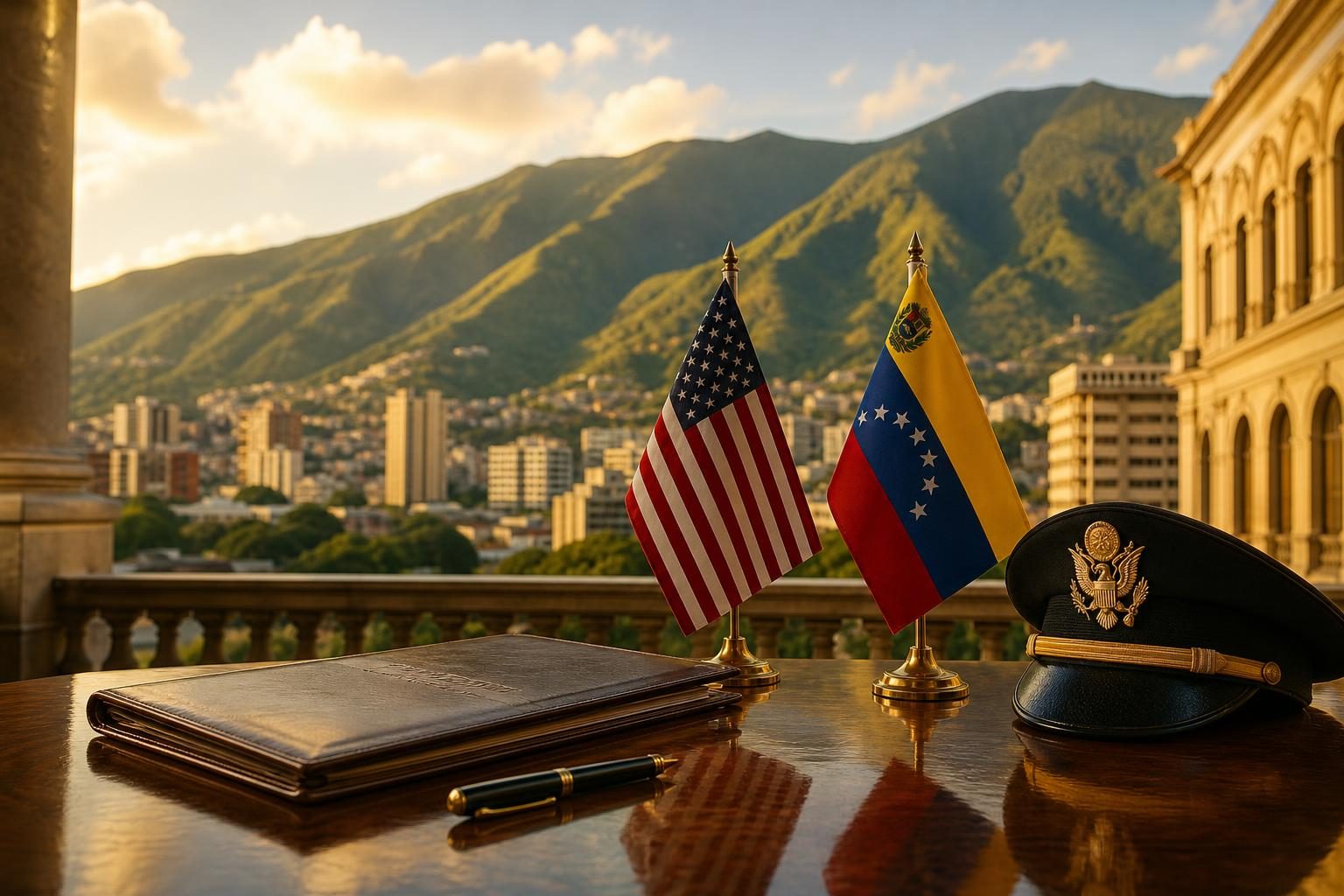
Secretary of War Pete Hegseth flew into Caracas on Wednesday without advance notice and announced that the United States and Venezuela have signed a deal to reestablish military ties, a partnership that will range from joint training to intelligence sharing, according to the Associated Press [1]. Venezuelan state television showed Hegseth at the presidential palace alongside acting President Delcy Rodríguez, and the Pentagon had not announced the visit beforehand [1][3].
Speaking to diplomats and military officers from both countries, Hegseth pointed back to January, when U.S. forces captured then-President Nicolás Maduro. Since then, he said, Venezuela "has gone from our most aggressive regional threat to a compliant security partner" [1]. He praised what he called close cooperation with Rodríguez that let officials stabilize the country and drive out narco-terrorists, the AP reported [1].
What the agreement covers
Reuters reported that Hegseth described the deal as covering joint training, intelligence sharing and other parts of military cooperation between the two nations [2]. Rodríguez, for her part, said the arrangement would help the two countries confront common threats and strengthen training for Venezuela's armed forces, according to Reuters [2]. The Washington Examiner reported that Hegseth called it a historic agreement and a renewed military partnership [4].
What the deal does not yet have is a public text. The AP noted that the Pentagon did not immediately offer further details [1], and NBC described the outcome as cooperation agreements that would let the United States help train Venezuela's armed forces [3]. Until the terms are published, Americans will have to take the broad outlines on trust: training, intelligence and a shared fight against the cartels that have poisoned American streets for years.
Hegseth also made clear the relationship is about more than security. Newsweek reported that he told Rodríguez the administration wants to work with Venezuela to unlock the country's vast natural resources [5]. Venezuela sits on the largest proven oil reserves in the world, and getting that oil flowing to friendly markets instead of to Havana, Moscow and Beijing would be a strategic win for the hemisphere.
How we got here
The AP described Rodríguez as an ally of Maduro who took over after his capture; her court-allowed term expired in July, but she continues to act as head of state [1]. That is the uncomfortable part of this story, and it deserves to be said plainly. Washington is working with a holdover from the old regime because, for now, she controls the levers of the state and has cooperated. PBS reported that the visit comes at a time of real uncertainty for Venezuelans about who will lead their country in the coming months and years [6].
The AP called Hegseth the latest Trump Cabinet member to visit since Maduro's ouster [1], part of a steady effort to deepen American influence in a country that spent a quarter century as a base for anti-American mischief. Reuters reported that the Caracas stop came as Hegseth was also expected in Colombia the same day [2], a government that, as this site has reported, has stood with the United States against the cartels.
Why it matters
For most of the last 25 years, Venezuela was the hemisphere's most dangerous problem: a regime that hosted Cuban intelligence officers, courted Russian warplanes and Iranian business, and watched as millions of its own people fled. A Venezuelan military that trains with Americans and shares intelligence with them is a very different neighbor. That is a peace-through-strength result, and the President's team deserves credit for it.
But a security deal is not a democracy. The test of this policy is whether it ends with Venezuelans choosing their own leaders in a free and fair vote, with the gangs and the drug lords on the run and the oil wealth serving the people instead of a ruling clique. Critics will argue that partnering with a Maduro-era figure risks propping up the old system under a new flag. The administration's answer is that stability comes first and elections follow. Both sides will be watching for a date.
What comes next
Watch for three things: whether the Pentagon publishes the terms of the agreement, whether joint training begins on a set timetable, and whether Caracas and Washington announce a calendar for elections. Hegseth's visit opens a new chapter. Whether it becomes a lasting alliance will depend on what happens after the cameras leave.
Sources
- [1]Associated Press via KSATUS and Venezuela sign a deal to reestablish military ties, Hegseth says on visit to interim leadersOpens in a new tab ↗
- [2]Reuters via Investing.comHegseth, in Caracas, announces new US-Venezuela military partnership agreementOpens in a new tab ↗
- [3]Opens in a new tab ↗
- [4]Washington ExaminerHegseth signs new military agreement during unannounced trip to VenezuelaOpens in a new tab ↗
- [5]Opens in a new tab ↗
- [6]PBS NewsHegseth meets with Venezuelan interim leaders in latest Trump Cabinet visit since Maduro's ousterOpens in a new tab ↗
Should U.S. military aid to Israel end early?
- Yes, Israel can afford its own weapons
- Phase it out slowly
- No, keep it while Iran is a threat
More in Military & Defense
Hung Cao Owns the Iran War's Strain on the Fleet and Points to Rising Missile Production in a Tough Navy Secretary Hearing
This morning on Command Post with Dan Whitaker
Hegseth Brings a C-130 to Bogota as Colombia Stands With America Against the Cartels
Overnight on Command Post with Dan Whitaker
U.S. Jets Hit an Iranian Missile Launch Site on Qeshm Island After Drones Target American Forces in Bahrain
Yesterday on Command Post with Dan Whitaker
Were you there?
If you were at the scene, or this story touched your life, tell us what you saw and what it was like.
Discussion 0
Sign in or create a free account to join the discussion.
No comments yet. Start the discussion.