
 Today on The Power Grid with Priya Desai
The Facts Behind 'Clean' Wind: A Federal Study Counts 18.7 Million Dead Bats, and Farmers May Pay the Price
Wind power is sold as energy without a downside. A U.S. Geological Survey study now puts a number on one of its hidden costs, and the researchers themselves say turbines can do better.
Filed November 21, 2026 · 📍 Washington, DC 20001
Were you there? Share your story
Key points
- A USGS-led study in PNAS estimates 18.7 million bats were killed at U.S. onshore wind facilities from 1981 to 2024.
- Hoary bats, eastern red bats and silver-haired bats account for most of the deaths.
- Bats provide pest control worth billions of dollars a year to American agriculture, according to research in Science.
- Pausing turbines when bats are flying sharply cuts deaths, studies show, but it costs power, an honest trade-off policymakers rarely mention.
For two decades, Americans have been told that wind power is the cleanest, kindest energy on the planet: no smokestacks, no drilling, no downside. Euronews summed up the reaction to a new federal study this fall as a warning of a shocking increase in bat deaths amid the clean energy push [1]. The study is real, the numbers are sobering, and they deserve far more attention than they have received.
What the study found
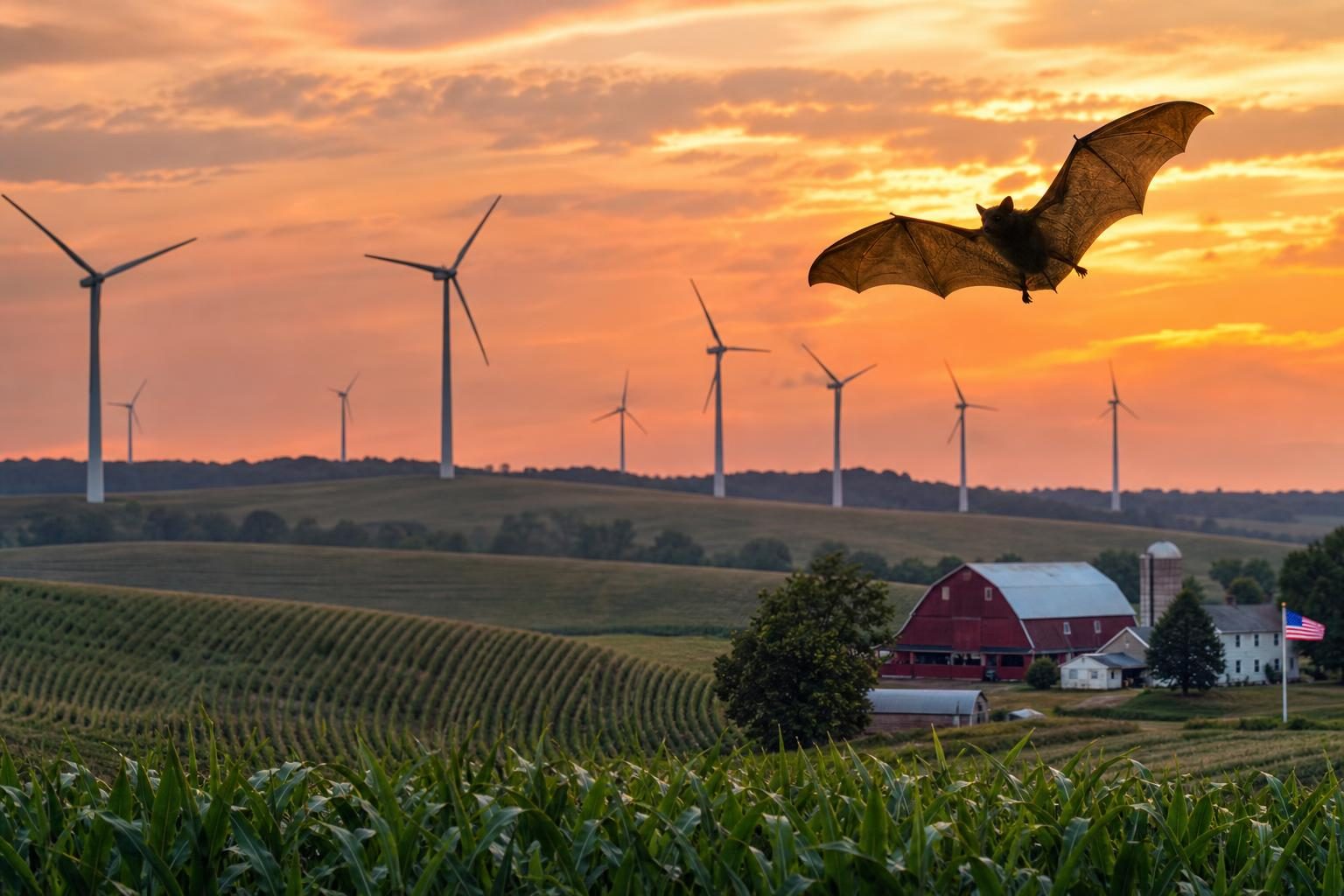
Researchers led by the U.S. Geological Survey estimate that 18.7 million bats were killed at onshore wind energy facilities in the United States between 1981 and 2024, according to the USGS [2]. The team pooled data from nearly 500 post-construction monitoring reports at 277 wind facilities, and the work was published in the Proceedings of the National Academy of Sciences [2][3].
Four species made up most of the toll, including about 6.7 million hoary bats, 5.8 million eastern red bats and 3.4 million silver-haired bats [2]. Euronews reported that annual deaths have climbed steeply as wind farms spread, from about 100,000 a year roughly two decades ago to around 1.5 million a year by 2021 [1]. The USGS team also found that turbines with less clearance between the blades and the ground were especially deadly [2].
To their credit, the scientists were careful. The study cannot show whether the deaths have caused population declines, and the authors noted that uneven monitoring across sites limited their analysis [2]. But when a single industry may be killing an estimated 1.5 million wild animals a year, not knowing the long-term effect is hardly reassuring.
Why bats matter to farm country
Bats are not just a curiosity in the night sky. They are among the most effective pest controllers in American agriculture. A widely cited analysis in the journal Science estimated that insect-eating bats save U.S. farmers billions of dollars a year by eating crop pests and reducing the need for pesticides [5]. Losing them at scale is a cost that falls on the same rural communities that are often asked to host the turbines.
That is the part of the "clean energy" story that rarely makes the brochures. Every source of power has trade-offs. Natural gas has a pipeline network, nuclear has waste storage, and wind has a footprint measured in land, transmission lines and wildlife. An honest energy policy weighs all of them. A dishonest one pretends that only fossil fuels have costs.
The fix exists, and it has a price
There is good news. Studies show that curtailment, meaning stopping or slowing turbines during the low-wind nights when bats are most active, can sharply reduce deaths. A USGS review of a decade of curtailment studies found that bat fatalities fell by about a third for every one-meter-per-second increase in the wind speed at which turbines start spinning [4]. Euronews reported that a separate European study of 141 wind farms found that idling turbines in conditions especially favorable for bat flight cut deaths by more than 80% [1].
But curtailment means turbines are not producing electricity when they otherwise could. That is a real cost to an already intermittent power source, and it is one more reason wind cannot carry the grid by itself. Policymakers who demand that America run on wind should be asked plainly whether they support curtailment, and how they plan to keep the lights on when the blades stand still.
Who is pushing back
Conservative commentators have seized on the findings. RedState argued this week that the wind push carries an ecological toll that its promoters ignore [6]. The researchers themselves point to better siting and smarter operation as the path forward [2][4]. Those are reasonable steps, and wind developers should take them without waiting for a mandate.
What comes next
Americans can support a diverse energy supply, including wind where it makes sense, while insisting on an honest accounting of its costs. Stewardship of creation is a conservative and a Christian value. It means caring for the land, the farms and the creatures God made, not just the slogans. The 18.7 million figure should be the start of a more truthful conversation about energy, not the end of it.
Sources
- [1]EuronewsHow many bats are killed by wind turbines? Study warns of shocking increase amid clean energy pushOpens in a new tab ↗
- [2]U.S. Geological SurveyUSGS study outlines scope and severity of bat fatalities at U.S. wind energy facilitiesOpens in a new tab ↗
- [3]U.S. Geological SurveyScope and severity of bat fatalities at U.S. wind energy facilities (publication)Opens in a new tab ↗
- [4]U.S. Geological SurveyA decade of curtailment studies demonstrates a consistent and effective strategy to reduce bat fatalitiesOpens in a new tab ↗
- [5]Opens in a new tab ↗
- [6]Opens in a new tab ↗
Have you ever been censored or shadow-banned on social media?
- Yes
- I think so
- No
- I'm not on social media
More in Pushback

Speech Is Not Harassment: Why the First Amendment Stands With the Colorado Shop Owners Fighting the State's Pronoun Law
Today on First Principles with Benjamin Stone

Telling Your Own Story Is Not a Crime: Why Europe's Ex-LGBT Christians Are Right to Say No to a Conversion-Practices Ban
This morning on From the Bench with Margaret Callahan

A Deal by Dec. 11 Runs Through the White House: Why Jeffries' Freeze-Out of Stephen Miller Fails the Country
This morning on The Briefing Room with Claire Donovan
Were you there?
If you were at the scene, or this story touched your life, tell us what you saw and what it was like.
Discussion 0
Sign in or create a free account to join the discussion.
No comments yet. Start the discussion.