
 This morning on The Power Grid with Priya Desai
Down 18 Cents in a Week: Why Gas Is Falling Fast Before Thanksgiving, and What Could Stop the Slide
AAA puts the national average at $3.72 and expects more relief by the holiday, as cheaper crude, calmer shipping through the Strait of Hormuz and the fall switch to winter fuel push prices down.
Filed November 21, 2026 · 📍 Honolulu, HI 96813
Were you there? Share your story
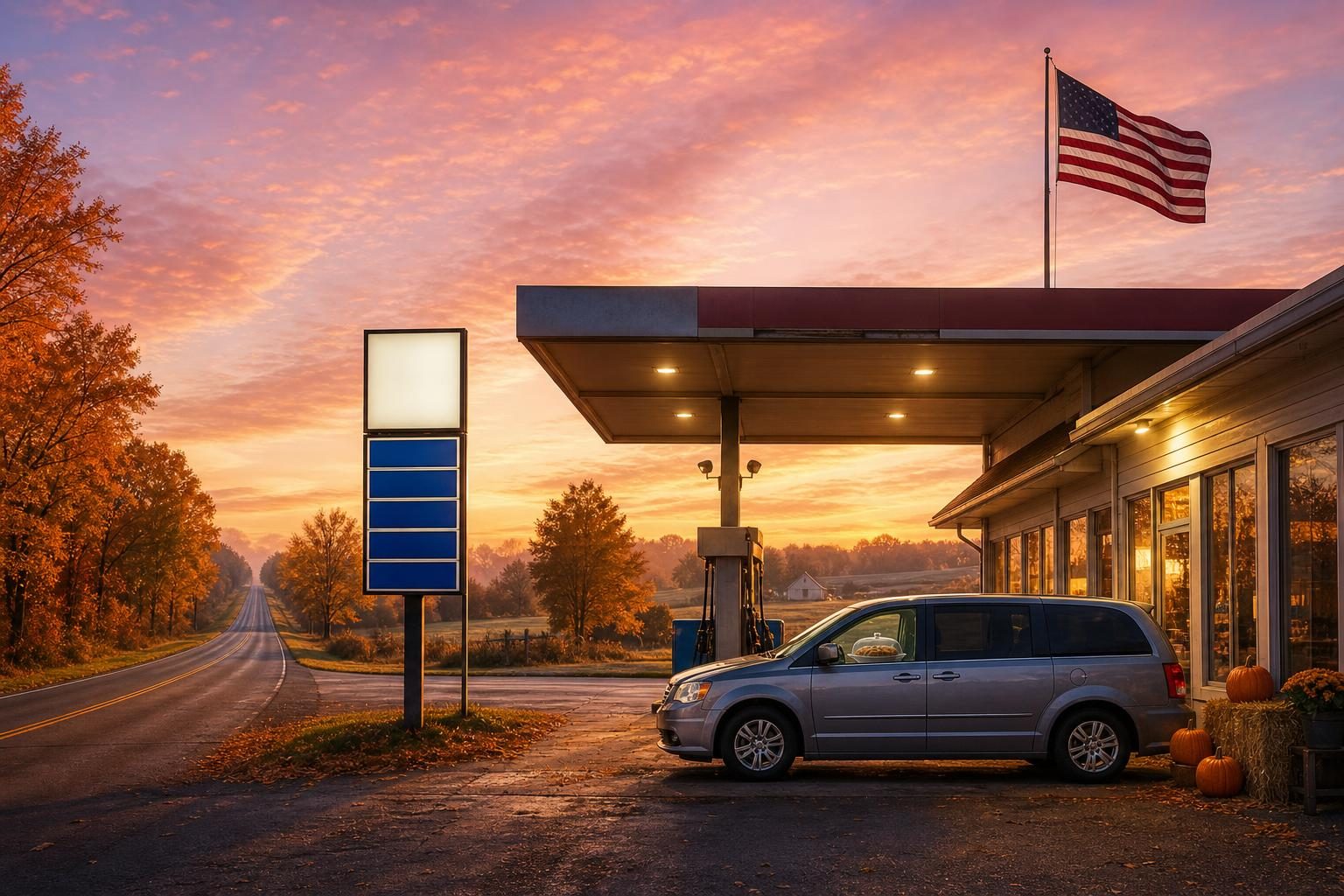
Part of our continuing coverage: 81.5 Million Americans Will Still Travel for Thanksgiving, AAA Says: When to Drive and What Gas Will Cost
Key points
- AAA says the national average fell 18 cents in a week to $3.72 and could drop about 15 cents more by Thanksgiving.
- Cheaper crude, more tanker traffic through Hormuz and seasonal winter-blend fuel are driving the decline.
- Prices are still well above last year, and AAA projects slightly fewer Americans driving for the holiday.
- A flare-up in the Middle East or a crude rebound could slow the relief.
Families heading over the river and through the woods next week are getting a gift they have not seen in months: gas prices that are falling, and falling fast. The national average for a gallon of regular dropped 18 cents in a single week to $3.72, AAA reported on Thursday, and the motor club said the average could slide roughly another 15 cents by Thanksgiving Day [1].
That is real relief. It is also a reminder of how far prices climbed this year, and how much of the decline depends on events thousands of miles from the nearest gas station. Here is what is driving the drop, what it means for your holiday budget, and what could change the picture before the turkey is carved.
Where Prices Stand Right Now
The numbers tell a story of steady improvement. AAA put the national average at $3.81 on Monday, Nov. 16, according to Money Talks News, and by Thursday it had fallen to $3.72 [1][5]. AAA said lower crude oil prices helped pull pump prices down, and it reported that the U.S. benchmark crude fell $2.75 on Wednesday to settle at $83.26 a barrel [1].
The pain is not spread evenly. Hawaii and California remain the most expensive places in the country to fill up, with California's average near $5.50 a gallon, according to AAA figures reported by the Sierra Sun Times [6]. AAA listed Hawaii as the priciest state at about $5.60 a gallon [1]. California drivers who rely on diesel are paying even more, about $7.83 a gallon on average, the Sierra Sun Times report said [6].
Diesel matters even for families who never buy a gallon of it. It powers the trucks that carry turkeys, cranberries and nearly everything else to grocery shelves, so high diesel costs ripple into the price of the holiday meal itself, and any relief there is welcome news for shoppers as well as truckers.
The year-over-year comparison is sobering. A year ago, on Nov. 16, 2025, the national average was about $3.07, Money Talks News reported, which means drivers were paying about 74 cents a gallon more on Monday than at the same point last year [5]. And according to AAA, the national average sat above $4 a gallon from April until the beginning of November, largely because of the war with Iran that began in late February [5].
Why Prices Are Falling
Several forces are pushing in the same direction at once, and understanding them helps explain why this decline may have staying power, at least in the short run.
The first is crude oil. Oil is the single biggest ingredient in the price of gasoline, and the oil market has had a dramatic few weeks. ConsumerAffairs reported that Brent, the global benchmark, posted its steepest weekly drop since the start of the COVID-19 pandemic, falling about 16 percent in a single week [3]. When crude falls that hard, pump prices tend to follow.
The second is the Strait of Hormuz. CBS News reported that easing tensions between the United States and Iran, along with more tanker traffic moving through the strait, have loosened the supply squeeze that pushed fuel prices up for much of the year [2]. Every tanker that sails safely through that narrow waterway matters to the price of a gallon in Ohio or Texas. The more steady the shipping lanes, the smaller the war premium traders build into each barrel.
The third is the calendar. GasBuddy analyst Patrick De Haan has pointed to the usual fall pattern, CBS News reported: demand drops after the summer driving season, stations switch to cheaper winter-blend gasoline, and refineries finish seasonal maintenance and ramp up output [2]. Those seasonal shifts happen every year, but this year they arrived at the same time as falling crude and calmer shipping, which is why the drop has been so sharp.
The Thanksgiving Travel Picture
Lower prices arrive just as the busiest travel week of the year begins. AAA projects that 81.5 million Americans will travel at least 50 miles from home over the holiday, including 72.9 million by car, according to Skift [4]. That driving figure is down slightly from 73.1 million last year, and Skift reported that it marks the first decline in AAA's Thanksgiving travel projection since the 2008 recession, setting aside the pandemic year of 2020 [4]. Skift tied that dip to the higher fuel prices of recent months [4].
For families, the math is simple. A minivan with an 18-gallon tank costs about $67 to fill at $3.72 a gallon. If AAA's projected decline of roughly 15 cents comes through, the same fill-up would cost a little over $64 [1]. On a long round trip to Grandma's house that requires three or four tanks, that is real money that can go toward the pumpkin pie, a Christmas gift or the collection plate.
AAA also said that if the decline continues as expected, this Thanksgiving could avoid setting a new record for the holiday's highest gas price [1]. That is not the same as cheap gas, but it is a far cry from where prices stood just weeks ago.
What Could Change the Picture
Nobody should assume the decline is guaranteed. Three things could move prices in the days ahead.
The first is the Middle East. The relief at the pump depends heavily on calmer conditions around the Strait of Hormuz [2]. Any flare-up in the conflict with Iran, any attack on tankers or any disruption to shipping could push crude prices back up quickly, and pump prices would follow.
The second is the oil market itself. After a drop as sharp as last week's, crude prices can bounce as traders reassess supply and demand [3]. A rebound in crude would slow, or even reverse, the decline at the pump.
The third is weather and refinery problems. Storms during the holiday week can disrupt fuel deliveries, and unplanned refinery outages can tighten local supply. Both tend to show up first in regional prices, which is why drivers in some areas may see smaller drops than the national numbers suggest.
How Families Can Make the Most of It
A few common-sense habits can stretch a holiday fuel budget. Compare prices before you fill up, since stations a mile apart can differ by a surprising amount. Keep tires properly inflated and lighten the load in the trunk, which helps fuel economy. And if your schedule allows, travel at off-peak times to avoid burning gas while stuck in traffic.
The Bigger Lesson
This year has been a hard reminder that energy prices are not just an economic statistic. They are a family issue, a security issue and a national strength issue. When world events threatened the flow of oil, Americans felt it in their grocery bills, their commutes and their holiday plans [5].
The current relief shows how quickly prices can improve when supply lines are safer and crude is flowing freely [2][3]. It is also a strong argument for an energy policy built on reliable American production, so that the price of a family's trip home for Thanksgiving depends a little less on the decisions of hostile regimes on the other side of the world.
For now, the news is good, and getting better by the day. Fill up, drive safely, and give thanks for a little extra room in the budget this year.
Sources
- [1]Opens in a new tab ↗
- [2]Opens in a new tab ↗
- [3]ConsumerAffairsGas prices fall below $4 a gallon for first time since August, but the election isn't the reasonOpens in a new tab ↗
- [4]Opens in a new tab ↗
- [5]Money Talks NewsGas Prices Are Falling. Why Thanksgiving Travel May Still DipOpens in a new tab ↗
- [6]Sierra Sun TimesAAA Reports Gas Prices Keep Dropping as Thanksgiving Approaches, California at $5.50 Declines 10 Cents Week-Over-WeekOpens in a new tab ↗
Should Congress speed up permits for pipelines and power plants?
- Yes, build more American energy
- Yes, but respect tribal and local input
- No, keep environmental reviews
More in Energy & Environment

U.S. Sells First Deep-Sea Mineral Leases Off American Samoa in Push to Counter China
Thursday night on The Power Grid with Priya Desai

From Drilling Platform to Fishing Hot Spot: Washington Moves to Let About 300 Retired Offshore Rigs Stay Put as Reefs
On Thursday on The Power Grid with Priya Desai
Senate Clears Last Procedural Hurdle on Bipartisan Permitting Overhaul, Setting Up Final Vote on Faster Energy Projects
On Thursday on The Power Grid with Priya Desai
Were you there?
If you were at the scene, or this story touched your life, tell us what you saw and what it was like.
Discussion 0
Sign in or create a free account to join the discussion.
No comments yet. Start the discussion.