
 On Monday on Main Street Money with Marcus Hale
Carney Says Canada Could Turn to Chinese Automakers if Trump Talks Fail, Raising the Stakes for North America's Auto Belt
Speaking on his way to the APEC summit in Shenzhen, Canada's prime minister said a U.S. deal is still his priority, but that Ottawa will 'move forward either way.' For Detroit, Windsor and Ohio, the warning is about more than tariffs.
Filed November 16, 2026 · 📍 Detroit, MI 48226
Were you there? Share your story
Part of our continuing coverage: Carney Says a U.S.-Canada Trade Deal Is Getting Closer, but Autos Remain the Sticking Point
Story tracker
Key points
- Carney said Canada could turn to Chinese automakers if U.S. talks fail to protect an integrated North American auto industry.
- He said any Chinese investment must mean substantial manufacturing in Canada, and that Canada will 'move forward either way.'
- Carney said Saturday that talks with Trump and USTR Jamieson Greer are making progress, though autos remain the hardest issue.
- A 2025 U.S. Commerce rule already bars cars with certain Chinese-linked connected-vehicle software and hardware.
Canadian Prime Minister Mark Carney said Canada could turn to Chinese automakers if trade talks with President Trump fail to preserve an integrated North American auto industry, the Associated Press reported [1].
Carney said the negotiations with Washington remain his priority, but that their outcome could decide whether Canada pursues European, Chinese or Japanese automakers instead, according to the AP [1]. Asked whether the prospect of Chinese investment was a bargaining chip in the U.S. talks, he rejected the idea, saying "Canada is going to move forward either way," the Guardian reported [2].
He also set a condition. Any Chinese investment, Carney said, would have to involve substantial manufacturing in Canada rather than simply assembling parts made elsewhere, the AP reported [1].
The remarks came as Carney traveled through Southeast Asia ahead of the Asia-Pacific Economic Cooperation summit in Shenzhen, China, where he is expected to meet Chinese President Xi Jinping this week, according to the AP [1].
Talks with Washington are still alive
The comments follow a more upbeat message just days earlier. On Saturday, Carney told reporters in Manila that he had spoken with President Trump, U.S. Trade Representative Jamieson Greer and other senior officials, and that the two countries were making progress toward a possible agreement, The Hill reported [3]. Differences remain, and the future of the auto industry is one of the hardest issues on the table, Newsweek reported [4].
Canada has already opened the door to Chinese vehicles once this year. Under an agreement reached in January, Canada cut its 100% tariff on Chinese electric vehicles to 6.1% for a limited number of cars each year, starting at up to 49,000 vehicles and rising over time, according to Reuters [6].
Why this matters on our side of the border
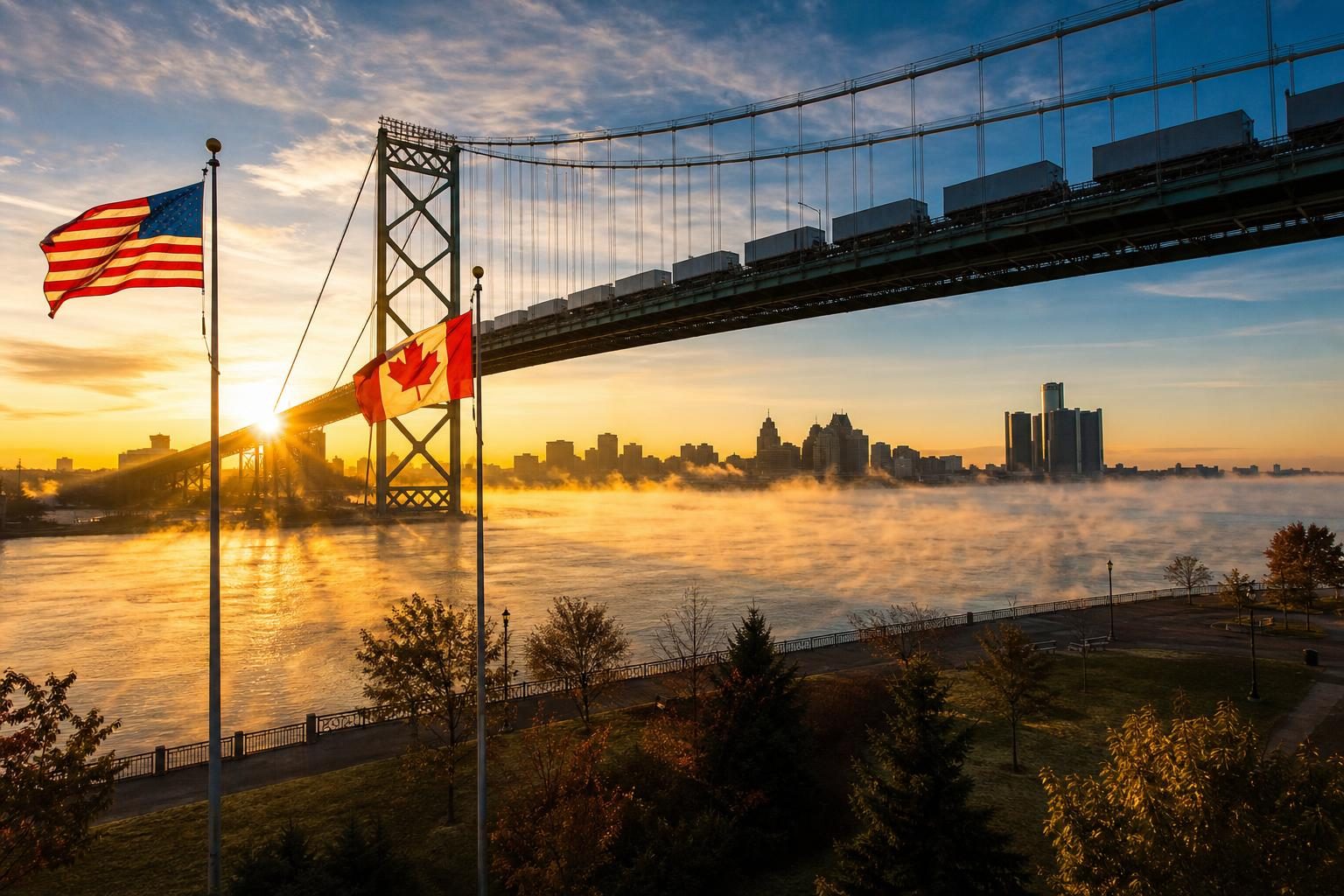
For decades, the auto industry on both sides of the Detroit River has worked as one machine. Parts cross the border several times before a finished car rolls off the line, and towns from Windsor to Toledo depend on that rhythm. A Chinese automaker building cars at scale in Ontario would not just compete with Canadian plants. It would put Chinese-owned factories inside the North American supply chain, a stone's throw from American assembly lines.
Washington has already decided that Chinese automotive technology raises real security concerns. In January 2025, the Commerce Department finalized a rule barring the import and sale of connected vehicles that use certain Chinese- or Russian-linked software and hardware, covering the systems that let cars talk to networks and drive themselves [5]. The rule applies even to cars assembled in the United States if they contain that technology [5].
That rule reflects a simple reality: modern cars are rolling computers that collect location data, camera feeds and driving habits. Letting a strategic rival's companies build those computers next door is a decision with consequences far beyond the price of a sedan.
Leverage, or a real pivot?
Carney insists this is not a negotiating tactic, and Canada has every right to look after its own workers. But it is hard to read the timing, days before he sits down with Xi, as anything other than a signal aimed at Washington.
The better path for both countries is the one Carney himself calls his priority: a deal that keeps North American cars built by North American workers, with rules that keep Chinese state-backed manufacturers from using Canada as a side door into the American market. A strong agreement protects autoworkers in Ontario and Michigan alike.
What comes next
All eyes now turn to Shenzhen, where Carney's expected meeting with Xi could show whether Chinese auto investment is a real plan or a pressure point [1]. Back home, negotiators on both sides are still working through the auto chapter, the piece that will decide whether the continent's most important manufacturing partnership holds together.
Sources
- [1]Opens in a new tab ↗
- [2]Opens in a new tab ↗
- [3]Opens in a new tab ↗
- [4]Opens in a new tab ↗
- [5]U.S. Commerce Department (BIS)Commerce Finalizes Rule to Secure Connected Vehicle Supply Chains from Foreign Adversary ThreatsOpens in a new tab ↗
- [6]Reuters via Yahoo NewsCanada ready to turn to Chinese carmakers if US trade talks fail to protect auto sector, PM Carney saysOpens in a new tab ↗
Should towns welcome AI data centers?
- Yes, they bring jobs and tax money
- Only if they pay their own power costs
- No, they strain water and the grid
More in Business & Economy

Shoppers Come Back to Target: The Best Sales Growth in Five Years, a Raised Outlook and Tariff Refunds Behind Part of the Profit
This morning on Kitchen Table with Megan O’Brien
Trump Sets a 10-Month Goal to Catch China on Rare Earths. Here's Where America Stands and What It Will Take
Overnight on Main Street Money with Marcus Hale
Trump and Thailand Sign a Trade Statement in Manila, With Zero Tariffs on American Goods and New Sales for U.S. Farmers in View
Last night on Main Street Money with Marcus Hale
Were you there?
If you were at the scene, or this story touched your life, tell us what you saw and what it was like.
Discussion 0
Sign in or create a free account to join the discussion.
No comments yet. Start the discussion.