
 Overnight on Main Street Money with Marcus Hale
Trump Sets a 10-Month Goal to Catch China on Rare Earths. Here's Where America Stands and What It Will Take
The President told reporters in Manila that U.S. production is at record levels. Closing the gap with China, especially in refining, is the real test, and new American plants are racing to meet it.
Filed November 18, 2026 · 📍 Pentagon, VA 22202
Were you there? Share your story
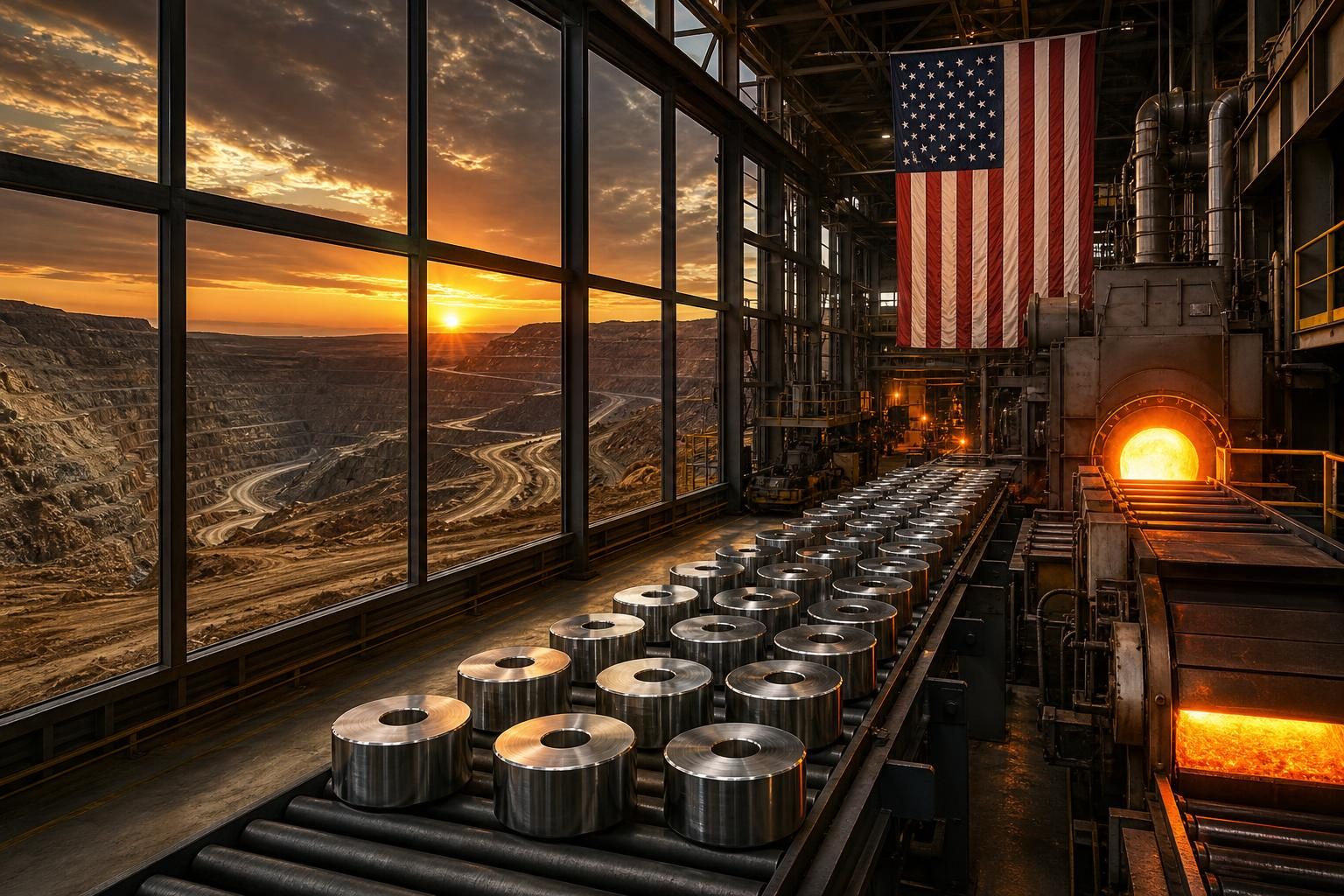
Key points
- Trump said in Manila the U.S. will catch China in rare-earth production within 10 months.
- USGS figures cited by Korean media put China's output at 270,000 tonnes versus 50,000 for the U.S.
- A 2025 Pentagon deal guarantees purchases and a price floor for MP Materials' new Texas magnet plant.
- The U.S., Australia, India and Japan signed critical-minerals agreements at the Quad summit.
President Trump set an ambitious target this week in the race for the minerals that power modern life. Speaking in Manila on Tuesday, the President said the United States would catch China in rare-earth production within 10 months, Yahoo News reported [1]. "We're going to catch them within 10 months," he said, adding that America is producing rare earths at a level it has never reached before [1].
The President did not lay out production figures or explain how the goal would be measured [1]. But the message, delivered on the eve of his meeting with Chinese President Xi Jinping, was unmistakable: America intends to break Beijing's grip on a supply chain that touches everything from fighter jets to smartphones.
Why rare earths matter
Rare earth elements are used to make the powerful permanent magnets found in electric motors, wind turbines, missile guidance systems, hard drives and medical equipment. For years, China has dominated both the mining and the processing of these materials, and Beijing has shown it is willing to use that dominance as leverage in trade fights.
That is why rare earths have become a national security issue, not just an economic one. A country that cannot build its own magnets cannot be sure it can build its own weapons.
Where the numbers stand
The gap is real. China produced about 270,000 tonnes of rare earths last year, compared with about 50,000 tonnes in the United States, according to U.S. Geological Survey figures cited by South Korea's Kyunghyang Shinmun [2]. The International Energy Agency has estimated that, as of 2024, China accounted for about 60% of global mining of rare earths used in permanent magnets and about 91% of refining output, the newspaper reported [2].
Refining is the harder part. Digging ore out of the ground is only the first step; separating and processing it into usable metals and magnets is where China's lead is greatest. Industry experts cited by CNN have said it could take the United States about a decade to substantially reduce its dependence on China, according to Kyunghyang Shinmun [2].
What America is building
The administration and American industry have been moving fast. In July 2025, the Pentagon struck a 10-year partnership with MP Materials, the company that runs the Mountain Pass rare-earth mine in California, Mining Weekly reported [5]. The deal includes long-term purchase commitments for 100% of the magnets from a planned new plant and a price floor of $110 per kilogram for a key rare-earth oxide, protecting American producers from Chinese price dumping [5].
In February, MP Materials chose a 120-acre site in Northlake, Texas, for that plant, known as 10X, a project representing more than $1.25 billion in investment, Manufacturing Dive reported [4]. The company's existing Independence facility in Fort Worth began producing metal in 2024 and finished magnets in 2025, and the new campus is expected to start up in 2028 [4].
Allies are joining the effort. At the Quad summit in Manila, the United States, Australia, India and Japan signed several agreements on critical minerals and rare earths, Gulf News reported [3]. Working with trusted partners that have their own deposits and processing know-how can help close the gap faster than any one country could alone.
Ambitious, and worth chasing
Ten months is a tight timeline, and skeptics will point to the size of China's lead [2]. But ambitious goals have a way of moving markets and governments. Price floors, purchase guarantees and allied agreements all send investors the same signal: America is serious about building this industry at home, and it will not let Beijing undercut it out of existence.
The President's approach also reflects a lesson learned the hard way. For decades, Washington let critical supply chains drift overseas in the name of cheap prices. The bill for that choice came due when China began restricting exports of the very materials American factories and defense contractors need.
What comes next
The President heads from Manila to China this week for talks with Xi [1] [6]. Back home, the work goes on at mines, refineries and magnet plants from California to Texas [4] [5]. Whether or not the 10-month goal is met, every new American magnet plant is one more step toward a country that can supply its own factories, power its own grid and arm its own military without asking Beijing's permission.
Sources
- [1]Opens in a new tab ↗
- [2]The Kyunghyang ShinmunTrump: We will catch up with China in rare earth production within 10 monthsOpens in a new tab ↗
- [3]Opens in a new tab ↗
- [4]Manufacturing DiveMP Materials picks Northlake, Texas, for 10X rare earth magnet campusOpens in a new tab ↗
- [5]Mining WeeklyMP Materials lands multibillion-dollar Pentagon deal to bolster US rare earth magnet supplyOpens in a new tab ↗
- [6]Opens in a new tab ↗
Should towns welcome AI data centers?
- Yes, they bring jobs and tax money
- Only if they pay their own power costs
- No, they strain water and the grid
More in Business & Economy

Shoppers Come Back to Target: The Best Sales Growth in Five Years, a Raised Outlook and Tariff Refunds Behind Part of the Profit
This morning on Kitchen Table with Megan O’Brien
Trump and Thailand Sign a Trade Statement in Manila, With Zero Tariffs on American Goods and New Sales for U.S. Farmers in View
Last night on Main Street Money with Marcus Hale
Regulators Order Kalshi to Pull Markets on the President's Words, Citing the Risk of Manipulation
Last night on Code & Coin with Kendall Price
Were you there?
If you were at the scene, or this story touched your life, tell us what you saw and what it was like.
Discussion 0
Sign in or create a free account to join the discussion.
No comments yet. Start the discussion.