
 This morning on The Briefing Room with Claire Donovan
Four Pledges and a Nuclear Opening: What the First Summit of America, China and Russia Produced, and What It Left Out
The first-ever meeting of the three leaders ends with a four-point declaration on U.N. reform, fuel supplies, international courts and nuclear talks, while Ukraine and Iran stay unresolved.
Filed November 19, 2026 · 📍 Washington, DC 20001
Were you there? Share your story
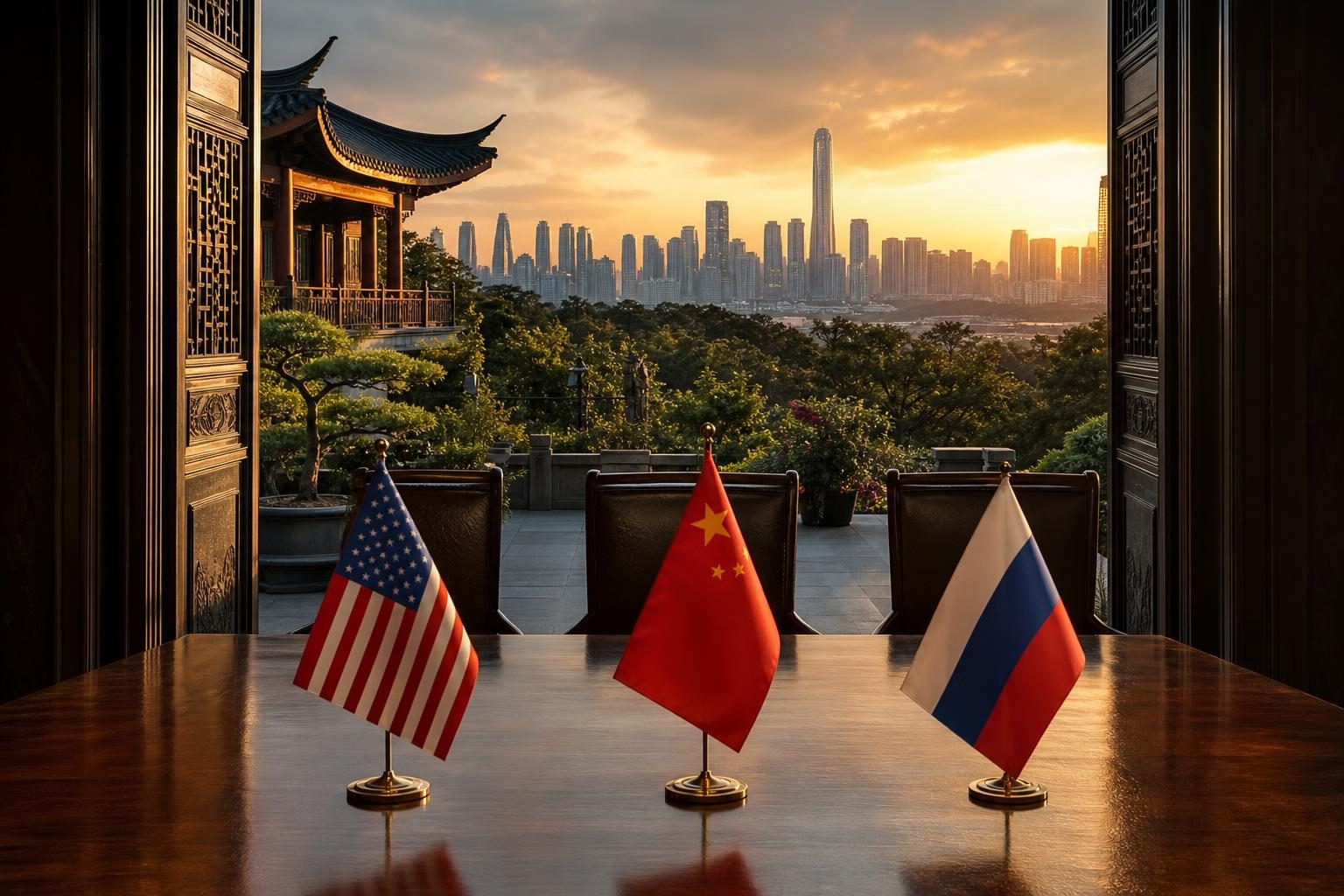
Part of our continuing coverage: Trump Wants Nuclear Arms at the Top of a Possible Shenzhen Summit With Xi and Putin. What Would a Deal Take?
Key points
- Trump, Xi and Putin issued a four-point peace declaration after their first three-way meeting
- The three agreed to a dialogue on reducing nuclear risks and preventing proliferation
- The text pushes back on ICC overreach and pledges more refined fuel supplies
- Ukraine was left out of the declaration, and Iran barely came up
President Trump sat down with China's Xi Jinping and Russia's Vladimir Putin in Shenzhen on Thursday for the first three-way meeting the leaders of the three nuclear powers have ever held, and the session ended with a four-point peace declaration covering United Nations reform, fuel supplies, international courts and nuclear danger, The Hill reported [1]. The talks took place behind closed doors on the sidelines of the Asia-Pacific Economic Cooperation summit, and The Hill described the meeting as lasting about 90 minutes [1], while CNN put the sit-down at 81 minutes [2].
That is a short window to settle the world's hardest problems, and nobody pretended otherwise. CNN noted the time was not enough to resolve the major differences between the three governments [2]. But the President walked out with something his earlier efforts could not produce: a commitment, made by the leaders themselves, that Beijing and Moscow will hold a three-way dialogue with Washington on nuclear risk, and a shared statement that puts the world's three biggest military powers on record on several questions at once.
Here is what was agreed, what was left out, and why it matters to American families.
What the Three Leaders Agreed
According to The Hill's account of the text, the declaration has four parts [1].
First, the three permanent members of the U.N. Security Council said they are committed to reforming the United Nations so it can respond more effectively to global challenges [1].
Second, they stated an intent to increase the production and supply of refined petroleum products for the benefit of all nations [1]. With a war involving Iran still threatening tanker traffic in the Persian Gulf, that line speaks directly to the price Americans pay for diesel and gasoline.
Third, they agreed that the International Criminal Court and similar bodies must not overreach their jurisdiction [1]. CNN reported that the declaration described immunity for state officials as "of fundamental importance" [2].
Fourth, they reaffirmed that a nuclear war must never be fought, and they pledged that the three countries will hold "a dialogue on reducing nuclear risks and preventing the proliferation of nuclear weapons" [1].
Xi, the host, called the meeting "groundbreaking" and warned that rivalry between the major powers breeds instability around the world, Bloomberg reported [4].
The Nuclear Door Opens a Crack
For anyone who has followed arms control, the fourth point is the one to watch. China has resisted any checks on its growing nuclear arsenal, The Hill noted [1], and for years Beijing treated three-way talks as a non-starter. Getting China to agree, at the leaders' level, to a three-way dialogue on nuclear risk with Russia and the United States is a notable shift in posture, even if no numbers, limits or timelines were attached.
There are reasons for caution. In a separate meeting with the President, Xi said nuclear weapons should be comprehensively banned and destroyed, according to China's state news agency Xinhua as cited by The Hill [1]. Lofty talk of a nuclear-free world from a government that is still building warheads is easy. The test is whether Chinese negotiators show up at a table with real proposals.
Still, the President's approach has been consistent. He has argued for years that any serious deal to reduce nuclear dangers must include China, not just Washington and Moscow. On Thursday he got both rivals to put their names to that conversation in a joint statement. That is the starting line, not the finish line, and the administration has been careful not to oversell it.
Iran, Ukraine and the Courts
What the declaration did not say matters as much as what it did.
The Iran war barely came up, Al Jazeera reported, with the President restating that Tehran cannot have a nuclear weapon [3]. Al Jazeera also reported that the President said Xi agreed on keeping the Strait of Hormuz open [3], the narrow waterway through which a large share of the world's oil moves. If Beijing, one of the biggest buyers of Gulf crude, is willing to say that out loud, it puts quiet pressure on Tehran.
On Ukraine, the declaration was silent. Before the three-way session, the President met Xi and Putin separately and urged Xi to help bring the war in Ukraine to an end, GB News reported [5]. GB News also reported that the President greeted the Russian leader as a "friend" [5]. Critics will seize on that word. The President's supporters see a negotiator who believes personal rapport is what moves stubborn leaders, and who uses it alongside pressure. Either way, the absence of Ukraine from the final text shows how far apart Moscow and the West remain.
The court language will draw the sharpest reaction in Europe. Al Jazeera described the declaration as containing a pointed critique of the International Criminal Court [3], and CNN noted that the stress on immunity for state officials matters for Putin, who faces an ICC arrest warrant [2].
Here, conservatives should be precise. The United States has never joined the ICC, and American leaders of both parties have long objected to the idea that an international court can sit in judgment of American soldiers and officials without the consent of the American people. Defending that principle of national sovereignty is a long-standing American position, not a favor to Moscow. At the same time, Americans can hold that view and still insist that Russia answer for its conduct in Ukraine. Those two positions are not in conflict, and the White House will need to make that case clearly to allies.
How Critics and Supporters Read the Day
The Los Angeles Times called the meeting the culmination of a decade of the President's foreign policy thinking, and its report argued that it elevated authoritarian leaders over democratic allies [6]. The President, for his part, framed the gathering as historic, telling the other leaders that they were making history, the Times reported [6].
The fairer reading sits between the extremes. Talking with adversaries is not the same as agreeing with them. Ronald Reagan called the Soviet Union an evil empire and still negotiated arms control with Moscow; the talks did not weaken America, they reflected confidence. The President's wager is similar: that America's strength, economic and military, gives him the standing to sit across from rivals and press for terms that make American families safer.
What Americans should watch is the follow-through, not the photo. A summit statement with no deadlines can fade quickly. Bloomberg's account of Xi's remarks [4] made clear that Beijing sees itself as a co-equal power broker, and China will use the declaration to burnish that image at home and abroad.
What Comes Next
Three markers will show whether Thursday mattered.
The first is the nuclear dialogue. If working-level talks among the three governments are scheduled in the coming months, the declaration will have produced something concrete. If not, it will join a long list of hopeful communiques.
The second is fuel. The pledge to boost refined petroleum supplies [1] could ease pressure on prices if it is matched by action, especially with the Strait of Hormuz at risk [3].
The third is Ukraine. The President pressed Xi to help end the war [5], and Putin left Shenzhen without committing to anything new in writing. Whether Moscow's actions in the weeks ahead match the warm words in Shenzhen will decide how history judges this meeting.
For now, the President leaves China with a three-way opening on nuclear risk that Beijing long refused, a shared statement on energy, and a reminder to the world that the United States intends to negotiate from strength. The hard part, as always, comes after the cameras leave.
Sources
Israel's new parliament is sworn in. Who would you rather see lead Israel?
- Benjamin Netanyahu
- Gadi Eisenkot
- Someone new
- That's for Israelis to decide
More in World News
Somalia Gives the UAE's Ambassador 72 Hours to Leave, Accusing Abu Dhabi of Violating Its Sovereignty
Tonight on World Watch with Grace Whitfield
Netanyahu's Office Defends Aide Who Relayed Election-Day Tip
Tonight on World Watch with Grace Whitfield
Tories Tap James Cleverly to Take On Sadiq Khan, Promising Safer Streets and Renewed Pride in London
Today on World Watch with Grace Whitfield
Were you there?
If you were at the scene, or this story touched your life, tell us what you saw and what it was like.
Discussion 0
Sign in or create a free account to join the discussion.
No comments yet. Start the discussion.