
 Overnight on Main Street Money with Marcus Hale
Five Saturdays of Anger: Why France Keeps Marching Over Prices, Schools and Police, and What Americans Should Take From It
About 106,000 people marched across France on Saturday by the government's count, fewer than a week earlier. Energy-driven inflation, a student revolt and a fight over a police bill have merged into a movement that unions want to widen with a strike on Tuesday.
Filed November 15, 2026 · 📍 World desk · Washington, DC
Were you there? Share your story
Key points
- France's Interior Ministry counted about 106,000 protesters nationwide on Saturday, including 24,000 in Paris, down from 146,000 a week earlier.
- The movement began in September with students protesting teacher shortages and run-down schools, then widened to living costs and a police use-of-force bill.
- French inflation hit an estimated 3.4% in October, driven mainly by energy prices that rose more than 24% in a year, according to INSEE.
- Unions have called nationwide strikes and marches for Tuesday, Nov. 17, and retirees plan a Paris march on Nov. 19.
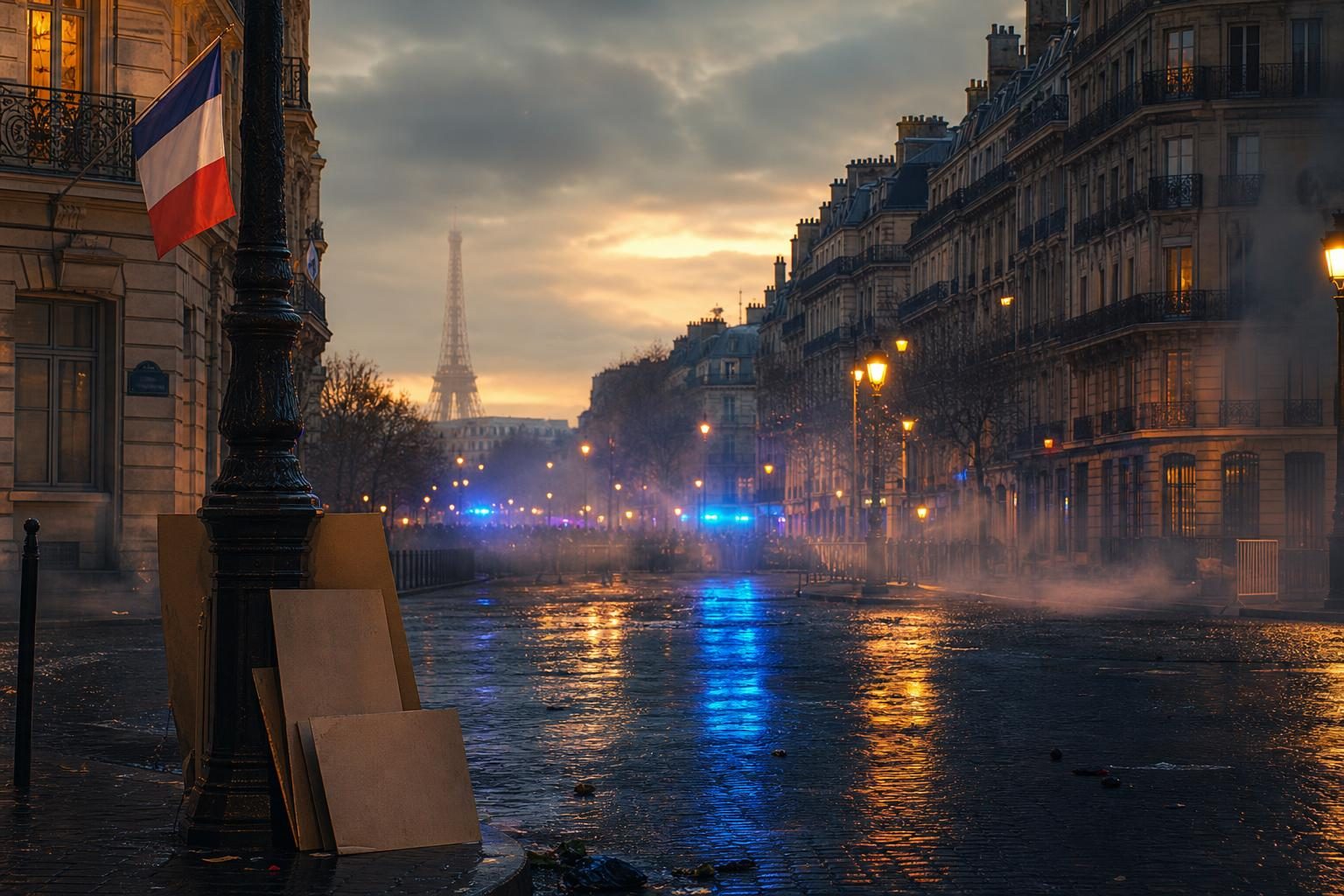
France marched again on Saturday, for the fifth weekend in a row. The Interior Ministry counted about 106,000 demonstrators nationwide, including roughly 24,000 in Paris, France 24 reported [1]. That was down from about 146,000 the Saturday before [1]. Police fired tear gas in Paris, Bordeaux and Nantes, but most of the marches passed off peacefully, and authorities deployed some 70,000 police officers and gendarmes to keep order [1].
The smaller count is real, but it would be a mistake to read it as the end of the story. What began as a student revolt over run-down schools has become something broader: a rolling protest about prices, public spending and the power of the police, with unions now calling workers, students and retirees back into the streets this week [2][5].
How a school protest became a national movement
The movement did not start with prices. According to Outlook India's account of the unrest, students began protesting in September over teacher shortages and crumbling school buildings, and the demonstrations spread from city to city [2]. As the weeks went on, the grievances widened to include the rising cost of living and government spending cuts [2].
The turning point came on Oct. 5 in the northern city of Lens, where a 15-year-old boy lost a hand in a confrontation with riot police [2]. Two days later, Interior Minister Laurent Nuñez suspended the use of stun grenades at student protests while the incident was investigated [2]. By Oct. 17 the protests had tipped into nationwide unrest, with clashes, looting and accusations of excessive force [2]. One count put arrests at about 2,400 and injured officers at about 1,000 in those days, though the figures vary from source to source [2].
The government has rejected the charge that it ordered a crackdown. Prime Minister Sébastien Lecornu denied that police were told to repress the protests, and Nuñez has said the response was proportionate in almost every case and that some marches had turned into riots [2].
Since then, the Saturday marches have become the movement's heartbeat. This weekend's crowd was smaller than the one a week earlier [1], but the mix of causes on the placards has stayed the same: classrooms, paychecks and policing [1][2].
The police bill at the center of the fight
Running alongside the student anger is a fight over a bill on police use of force. France's National Assembly approved it in July, and it now awaits a vote in the Senate, Al Jazeera reported [3]. Critics have branded it a "licence to kill" and argue it would make officers harder to hold to account [3]. Its supporters, including Nuñez, say officers working in dangerous conditions need the protection it offers [3].
That is a debate Americans will recognize. Every free country has to strike a balance between giving police the tools and the legal confidence to keep order and holding them accountable when they cross a line. The injury in Lens is a reminder that the second half of that bargain matters. The looted shops and injured officers of October are a reminder that the first half matters just as much [2]. A government that cannot keep its streets safe does not protect anyone's rights, including the rights of the peaceful protesters who make up most of these crowds.
Prices are the fuel
If the police bill is the spark, prices are the fuel. Consumer prices in France rose an estimated 3.4% in the year to October, up from 3.1% in September, according to INSEE, the national statistics office [4]. INSEE said the increase came mainly from energy, with energy prices up more than 24% from a year earlier [4]. Strip out the most volatile items and the picture is calmer: core inflation was about 1.7%, and food price growth slowed to about 1.2% [4].
That breakdown tells the real story. French families are not facing a broad wage-price spiral; they are being squeezed at the pump and on the heating bill. When energy prices jump by roughly a quarter in a single year, every commute, every delivery and every winter evening costs more, and the households with the least room in their budgets feel it first.
It also explains why a movement that started over school buildings found such a wide audience. Parents who were already angry about missing teachers were also paying more to fill the tank and heat the house. Public-sector workers who were told to tighten their belts were watching their own bills climb [2][4]. Grievances that might have stayed separate ran together.
What comes next
The unions intend to keep the pressure on. A public-sector alliance of six unions, including the CGT, the FSU and Solidaires, has called a day of strikes and demonstrations for Tuesday, Nov. 17, and civil servants, private-sector workers, university students and high schoolers have all been urged to join, according to Sortir à Paris [5]. The CGT wants workers in every company and sector to hold meetings and decide whether to walk out [5]. Retirees plan their own march in Paris on Thursday, Nov. 19, from Montparnasse station to Les Invalides, aimed at the 2027 budget and the pension increases now being debated in the Senate [5].
All of this is unfolding as France looks toward its 2027 presidential election. Last week the five-time Olympic judo champion Teddy Riner entered the race, pledging to bring a divided country together, and President Emmanuel Macron welcomed his candidacy [6]. A nation that has spent five straight weekends in the streets is plainly hungry for someone who can unite it. Whether a sports hero or a seasoned politician can do that is a question French voters will settle at the ballot box, which is exactly where it belongs.
What Americans should take from it
There are lessons here that cross the Atlantic.
First, energy is not a side issue. France's own statistics show that the biggest single driver of its inflation jump is the cost of energy [4]. Policies that make energy scarcer or more expensive land hardest on working families, and when the bill comes due, the anger can show up far from any power plant.
Second, schools are a flashpoint for a reason. This movement began with students upset about missing teachers and crumbling classrooms [2]. Parents everywhere expect the basic promise of a decent school to be kept before governments spend on anything else, and they notice quickly when it is not.
Third, order and accountability are not enemies. France is now arguing about both at once: how to protect officers who face violent crowds, and how to answer for a teenager who lost a hand [2][3]. A healthy republic insists on both. Peaceful protest is protected, rioting and looting are stopped, and every use of force answers to the law.
Finally, the size of a crowd on one Saturday is not the measure of a movement's staying power. The official count fell from about 146,000 to about 106,000 this week [1]. But the grievances behind those numbers, from the heating bill to the classroom, have not gone anywhere. Tuesday's strike will show whether the unions can turn shrinking street crowds into a broader shutdown, or whether France's weary public is ready for its arguments to move from the boulevards to the ballot box [5].
Liberty Bell Report will follow Tuesday's strikes and the Senate's handling of the police bill.
Sources
- [1]Opens in a new tab ↗
- [2]Opens in a new tab ↗
- [3]Opens in a new tab ↗
- [4]Opens in a new tab ↗
- [5]Sortir à ParisStrike and protest on November 17: the movement is growing, and here's what's planned in ParisOpens in a new tab ↗
- [6]South China Morning PostFrench judo star Teddy Riner announces 2027 presidential runOpens in a new tab ↗
Israel's new parliament is sworn in. Who would you rather see lead Israel?
- Benjamin Netanyahu
- Gadi Eisenkot
- Someone new
- That's for Israelis to decide
More in World News

Follow the Oil: Iraq Fires Nine Officials Over Smuggling in a Militia Stronghold, but Baghdad Still Won't Name Kataib Hezbollah
Overnight on Deep Dive with Kevin Nakamura
Hamas Confirms Its Rafah Brigade Commander, Tied to October 7 Planning, Was Killed in an Israeli Strike
Overnight on Breaking Now with Nathan Brooks

South Sudan Delays Its First Election Again: The Hard Questions Behind the New February Date
Last night on Cross-Examination with Dominic Kane
Were you there?
If you were at the scene, or this story touched your life, tell us what you saw and what it was like.
Discussion 0
Sign in or create a free account to join the discussion.
No comments yet. Start the discussion.