
 Overnight on First Principles with Benjamin Stone
Prop 50's Architect Now Wants to End Gerrymandering Nationwide. California Already Had the Fix He Is Selling
The consultant behind California's mid-decade map, which helped Democrats flip five GOP seats, wants Congress to set national redistricting standards. The Constitution, the Supreme Court and California's own voter-approved commission point to a better place to start.
Filed November 15, 2026 · 📍 Supreme Court, DC 20543
Were you there? Share your story
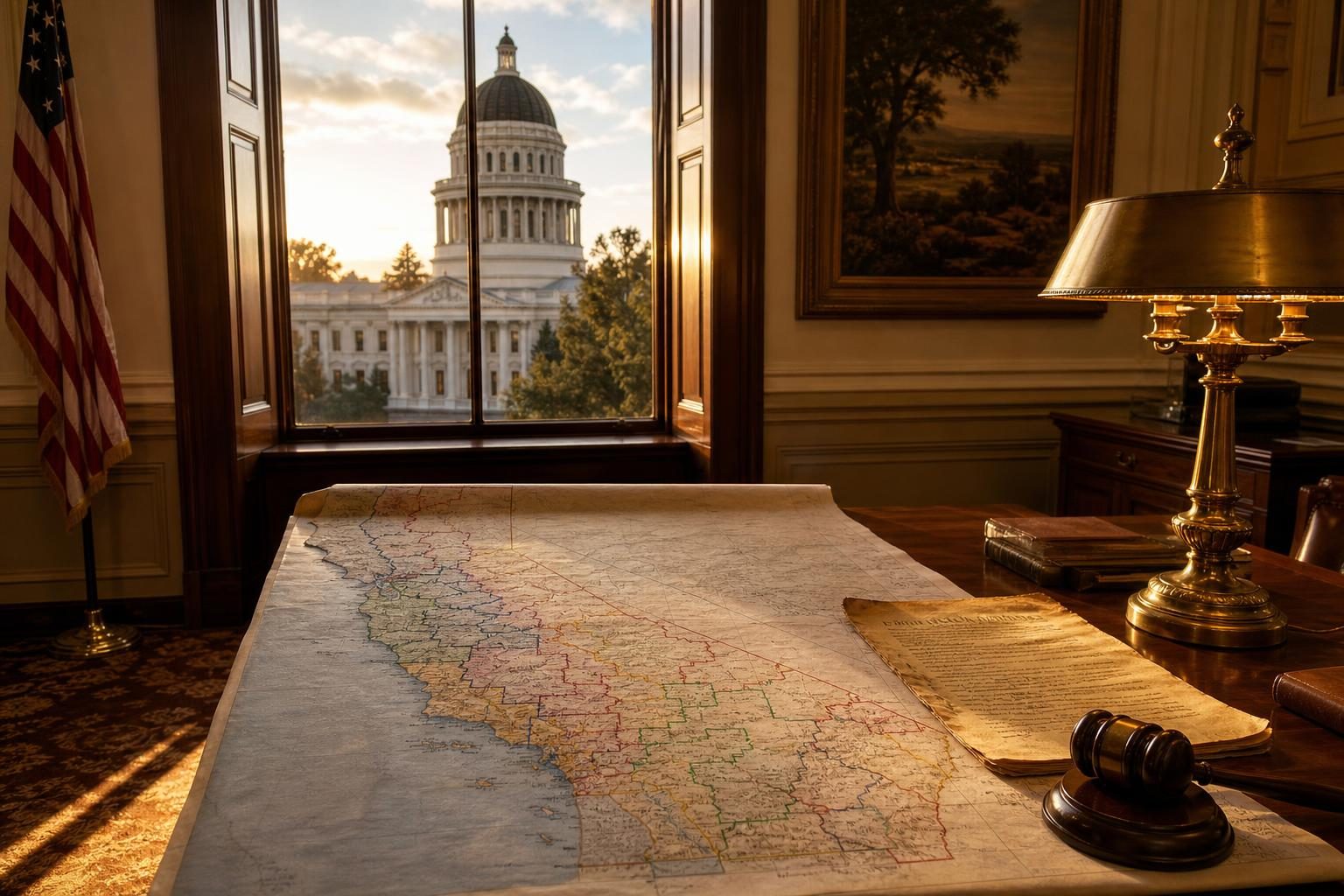
Key points
- Paul Mitchell, architect of California's Prop 50, now urges Congress to set national redistricting standards and independent commissions in every state.
- Prop 50 suspended the congressional map drawn by California's voter-created independent commission for the 2026, 2028 and 2030 elections.
- A federal panel upheld the map 2-1 while finding it was a political gerrymander designed to flip five seats; California Republicans vowed a Supreme Court appeal.
- The Elections Clause puts state legislatures first with Congress as a check, and Rucho v. Common Cause left partisan map fights to states and Congress.
Paul Mitchell knows how to draw a map that wins. The California redistricting consultant was the architect of California's Proposition 50, the mid-decade redistricting plan that helped his party flip five Republican-held House seats, Fox News reported [1]. Now he says it is time to end partisan gerrymandering across the country.
In an op-ed in the San Francisco Chronicle, Mitchell urged the incoming Congress to make national redistricting a priority and set minimum standards for how every state draws its districts [2]. The headline put his goal plainly: "kill partisan gerrymandering for good" [2]. He told Fox News Digital that the best solution would be independent commissions in every state, and he acknowledged that Prop 50 was designed to benefit Democrats while defending it as a temporary answer to Republican redistricting in Texas [1]. He also said he would have backed a congressional ban on mid-decade redistricting if one had come sooner [1].
Ending partisan map-rigging is a worthy goal. But before Americans hand that job to Washington, they deserve the full record, starting with California's own.
California already had the reform he is selling
The irony is hard to miss. California voters created an independent Citizens Redistricting Commission in 2008 and gave it the power to draw congressional lines in 2010, according to Ballotpedia [4]. Prop 50, approved in November 2025, set aside the commission's congressional map and replaced it with one drawn by the Legislature for the 2026, 2028 and 2030 elections [4].
In other words, the very reform Mitchell now wants imposed on all 50 states was working in California until his measure suspended it. When a federal panel upheld the new map against a racial-gerrymandering challenge, the court still found that Prop 50 was what its backers advertised: a political gerrymander designed to flip five seats, CBS News reported [3]. A national standard written by the people who just used a gerrymander to win would look less like reform than like locking in the gains.
What the Constitution actually says
The Framers did not leave this question unanswered. The Elections Clause in Article I, Section 4 says the times, places and manner of House elections "shall be prescribed in each State by the Legislature thereof," while Congress may by law make or alter those rules [5]. The Framers chose a layered system: states first, with Congress as a check.
The Supreme Court confirmed that design in Rucho v. Common Cause in 2019. Chief Justice John Roberts, writing for a 5-4 majority, held that claims of partisan gerrymandering are political questions beyond the reach of federal courts, because judges have no clear, neutral standard for deciding how much partisanship is too much [6]. Roberts stressed that the ruling did not condone excessive partisan gerrymandering and pointed to the states, which were addressing the problem through their own constitutions, laws and voter-approved commissions, as well as to Congress's power under the Elections Clause [6].
So Mitchell is right that Congress has authority here. But the Constitution's first answer is self-government in the states, and California shows why that answer deserves respect. Its voters fixed the problem themselves through the ballot box. The problem returned only when partisans asked them to undo their own reform.
Who is pushing back, and what comes next
California Republicans have not accepted Prop 50 quietly. They argued in court that the map was an unconstitutional racial gerrymander, and the federal panel split 2-1 before ruling for the state [3].
In Washington, Mitchell points to legislation from Rep. Zoe Lofgren, the Redistricting Reform Act, which would require independent commissions in every state and prohibit mid-decade redistricting [2]. He argues that Republicans, after their midterm losses, may now be more open to that kind of reform than they were in the past [1].
Here is a fair test for anyone who means it. If national standards are truly about fairness rather than advantage, their champions can start at home by returning California's congressional lines to the independent commission its voters created before the 2028 election, instead of waiting until after 2030 [4]. Reform that begins only after one side has banked its five seats is not reform. It is a victory lap.
Conservatives have every reason to want honest maps. Gerrymanders by either party leave voters feeling that elections are decided before a single ballot is cast. The better path is the one the Constitution already lays out: voters and legislatures in each state set fair rules, courts enforce the clear commands of law, and Congress acts with restraint as a check rather than as a national mapmaker. Mitchell's change of heart is welcome. The record of Prop 50 is the reason Americans should insist that his reform begins in California.
Sources
- [1]Opens in a new tab ↗
- [2]San Francisco ChronicleI crafted California's redistricting plan. Now let's kill partisan gerrymandering for goodOpens in a new tab ↗
- [3]Opens in a new tab ↗
- [4]BallotpediaCalifornia Proposition 50, Use of Legislative Congressional Redistricting Map Amendment (2025)Opens in a new tab ↗
- [5]Constitution Annotated (Congress.gov)Article I, Section 4, Clause 1: Elections ClauseOpens in a new tab ↗
- [6]Supreme Court of the United StatesRucho v. Common Cause, No. 18-422 (2019)Opens in a new tab ↗
Have you ever been censored or shadow-banned on social media?
- Yes
- I think so
- No
- I'm not on social media
More in Pushback
Democrats Read the Midterms as a Mandate to Rein In ICE. The Polls Point to the Grocery Bill
Overnight on Border Watch with Cole Brennan

The U.N. Now Admits 1.5 Degrees Is Slipping Away. The Answer Isn't More of the Plan That Got Us Here
Overnight on The Power Grid with Priya Desai

Fetterman Won't Bend on Israel, and the Facts Are on His Side
Last night on The Vance Edge with Sienna Vance
Were you there?
If you were at the scene, or this story touched your life, tell us what you saw and what it was like.
Discussion 0
Sign in or create a free account to join the discussion.
No comments yet. Start the discussion.