
 This morning on World Watch with Grace Whitfield
Closer to Taiwan, Stronger Together: Philippines Will Upgrade a Batanes Airport for U.S. Military Planes
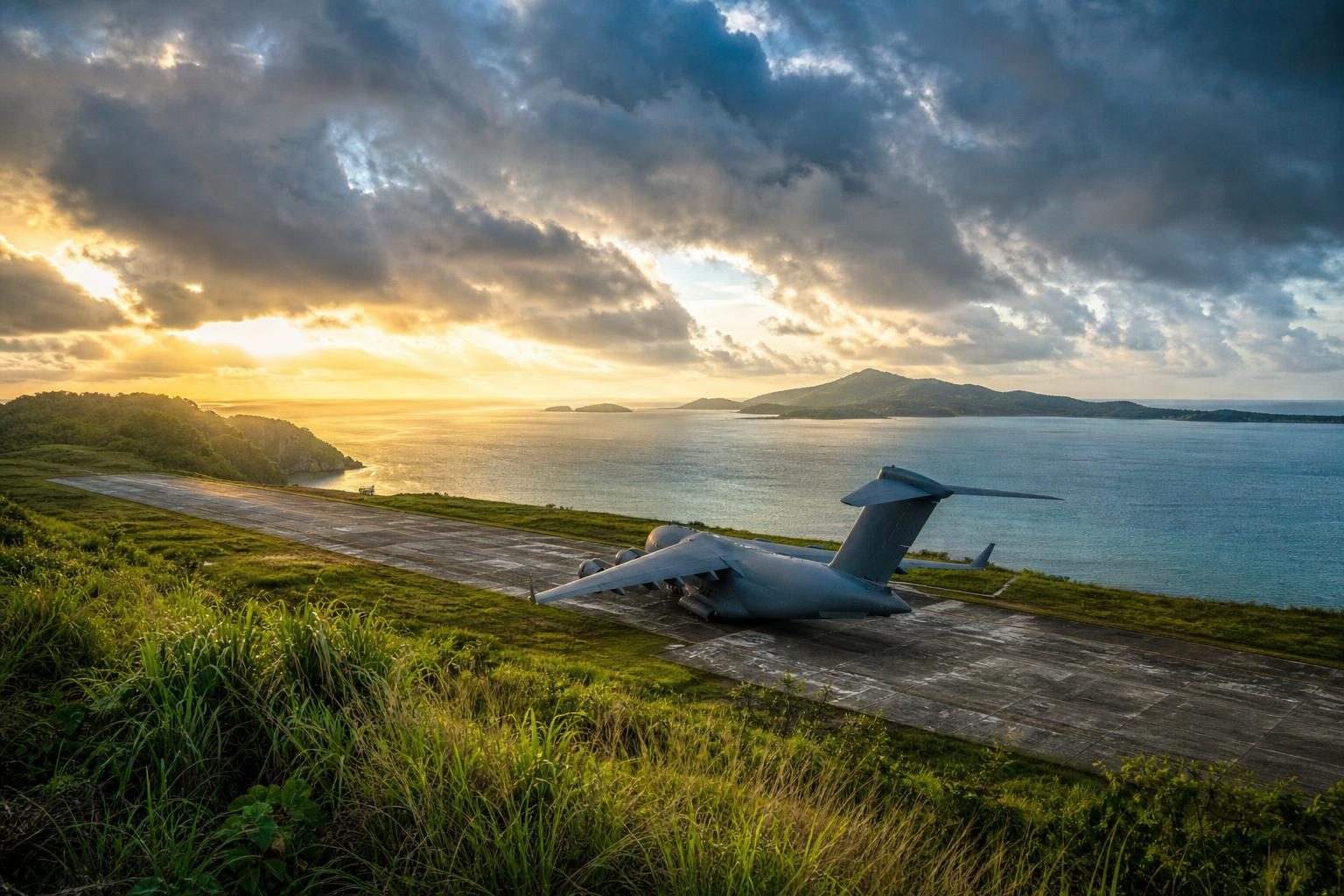
Manila's defense chief says Basco Airport, on the islands closest to Taiwan, will be rebuilt to handle larger aircraft, including American military planes, a week after President Trump's visit produced a $2 billion defense loan plan.
Filed November 24, 2026 · 📍 White House, DC 20500
Were you there? Share your story
Part of our continuing coverage: Trump Opens Asia Trip in Manila With Allies, Trade Progress and Nuclear Talks Ahead
Key points
- Philippine Defense Secretary Gilberto Teodoro says Basco Airport in Batanes will be upgraded for larger aircraft, including U.S. military planes.
- The islands are the Philippines' closest territory to Taiwan, across the Luzon Strait.
- A White House fact sheet from President Trump's Manila visit cited the airport's modernization.
- Washington is seeking a $2 billion-plus defense loan and pledged $400 million in military aid for Manila.
America's treaty ally in Manila is making room for U.S. forces on the front line of the Taiwan Strait. Philippine Defense Secretary Gilberto Teodoro said Basco Airport on Batan Island, in the northern province of Batanes, will be upgraded to handle larger aircraft, including U.S. military planes, Bloomberg reported Tuesday [1]. The airport sits about 650 kilometers north of Manila, in the chain of islands that faces Taiwan across the Luzon Strait [1].
Built on the President's Visit
The announcement follows President Trump's state visit to Manila last week, the first stop on an Asia trip that took him on to Shenzhen. A White House fact sheet released during the visit cited the modernization of Basco as a way to improve operational access, disaster response and commercial supply chains in the country's northernmost islands, BusinessWorld reported [2].
The visit also produced money. Washington is seeking a foreign military financing loan of more than $2 billion for the Philippines and pledged $400 million in military aid, according to BusinessWorld [3]. Those funds are meant to help Manila modernize forces that have long relied on aging equipment, at a time when Chinese coast guard and maritime militia ships push into Philippine waters in the South China Sea.
Why Batanes Matters
Geography explains the stakes. The Batanes islands are the Philippines' closest territory to Taiwan, and the waters around them, the Luzon Strait and Bashi Channel, are one of the main routes between the Pacific and the South China Sea. Any vessel, submarine or aircraft moving between those waters has to pass nearby. The two governments describe the upgrade as expanding their operational reach in the strait, World Today News reported [4].
U.S. Marines have used Batanes in recent years for maritime sensing teams and anti-ship missile systems during exercises with Filipino troops, according to the same report [4]. A longer, stronger runway would let larger cargo planes land with supplies and equipment, and it would let the two allies respond faster when typhoons, which batter the islands nearly every year, cut them off from the rest of the country.
That disaster-response role is real and important. The White House fact sheet listed it among the goals [2], and for a remote province whose residents depend on flights and ships that storms often interrupt, an airport that can take larger planes is a lifeline for civilians as much as a military asset.
The Strategy Behind It
For Americans, the upgrade is a picture of peace through strength. Deterrence works when an adversary can see that allies are ready and that aggression would be costly. Beijing has spent years pressuring Taiwan with drills and warplanes, and a capable American and Filipino presence on the islands nearest Taiwan complicates any plan to blockade or seize it.
The move also shows burden-sharing in action. Rather than asking Washington to carry the whole load, Manila is investing in its own territory and offering access to its ally, the kind of partnership the President has pressed allies to deliver.
China is likely to object. Beijing has protested previous U.S. access agreements in the Philippines as provocations, and it views any American military footprint near Taiwan as interference. Filipino officials have answered that defending their own islands and preparing for disasters is a sovereign decision.
There is a human side to the alliance as well. The people of Batanes live closer to Taiwan than to much of their own country, and they have watched tensions in the strait rise for years. A stronger airport means faster help after storms, more reliable supplies and, if the worst ever came, a quicker way to move families out of harm's way [2]. Strength and security for allies' families is part of what peace through strength is meant to protect.
The upgrade also fits a broader pattern in which Washington and Manila have been expanding the places where American forces can train and stage alongside Filipino troops, a trend the two governments describe as growing operational reach in the Luzon Strait [4].
What Comes Next
The initial reports did not include a cost or a construction timeline for the upgrade [1]. The larger defense loan package and the $400 million in aid will shape how quickly Manila can modernize the rest of its forces [3]. Liberty Bell Report will follow the project as details emerge, and as the alliance takes its next steps in the waters closest to Taiwan.
Sources
Israel's new parliament is sworn in. Who would you rather see lead Israel?
- Benjamin Netanyahu
- Gadi Eisenkot
- Someone new
- That's for Israelis to decide
More in World News

Teen Opens Fire in Serbian School; Two Workers Hurt
This morning on Breaking Now with Nathan Brooks

GAS BLAST LEVELS HANOI HOTPOT EATERY, KILLING SIX
This morning on World Watch with Grace Whitfield

Gunfire Erupts at Nigerian Senate Hopeful's Rally; Up to 6 Dead
Overnight on Cross-Examination with Dominic Kane
Were you there?
If you were at the scene, or this story touched your life, tell us what you saw and what it was like.
Discussion 0
Sign in or create a free account to join the discussion.
No comments yet. Start the discussion.