
 Overnight on Launch Pad with Hannah Lindgren
Back-to-Back Nevada Quakes Offer a Window Into a Land Slowly Pulling Apart
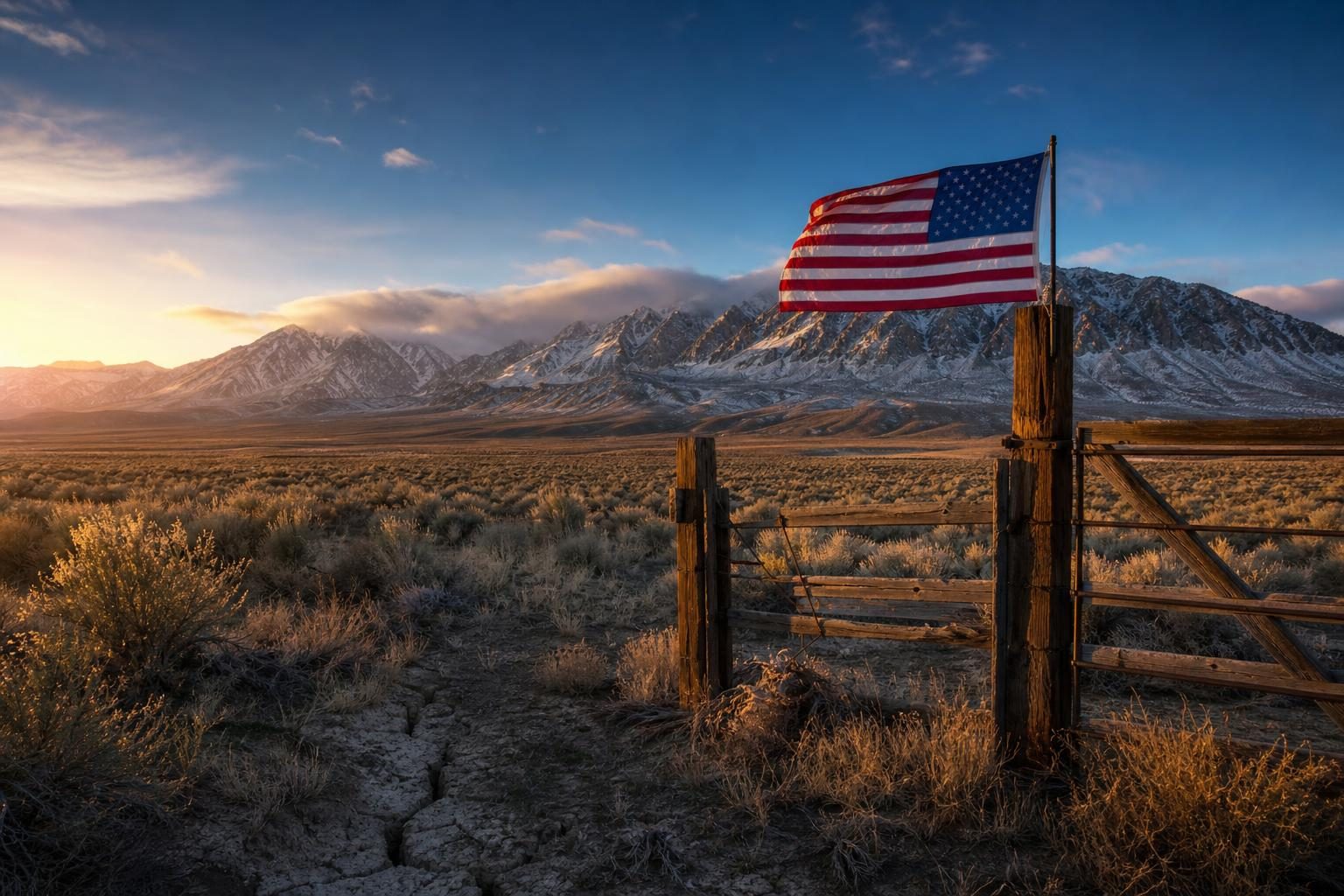
Two small earthquakes shook the high desert near Preston, Nevada, on Friday morning, a reminder that the Basin and Range is stretching and that wise households prepare.
Filed November 14, 2026 · 📍 Carson City, NV 89701
Were you there? Share your story
Key points
- USGS recorded a magnitude 3.6 and a magnitude 3.4 quake near Preston, Nevada, on Friday morning; no damage was reported.
- The Daily Mail described the pair as seconds apart; the USGS catalog times them about 24 minutes apart.
- The Basin and Range crust is slowly stretching and breaking along hundreds of faults.
- USGS puts the chance of a larger quake following within a week at about 5 percent; Drop, Cover and Hold On.
Friday morning brought a jolt, and then another, to the remote high desert of eastern Nevada. The Daily Mail reported that two earthquakes struck within seconds of each other near the small community of Preston, in a part of the country where, as the outlet put it, the ground is "slowly ripping apart." [1] Authorities had reported no damage, according to the same report. [1]
The shaking was modest by any measure. But it landed in geologically restless country, and it offers a good moment to understand the ground beneath the Silver State and to think about how ordinary families can be ready if a far larger quake ever comes.
What happened on Friday
According to the Daily Mail, the U.S. Geological Survey measured the two quakes at magnitudes 3.6 and 3.5, with the first striking at 10:10 a.m. Eastern time and the second following 24 seconds later just outside Preston. [1] The outlet also said a resident of Ely, roughly 32 miles northeast of Preston, reported feeling the shaking. [1]
The federal record confirms that the ground moved Friday morning, though its timeline differs from that account. The USGS event page for the larger quake lists a magnitude 3.6 at 15:10:28 Coordinated Universal Time, which was 7:10 a.m. in Nevada and 10:10 a.m. on the East Coast. [2] It was centered about 16 kilometers, or roughly 10 miles, west of Preston at a very shallow depth of about one kilometer. [2] The agency marks the event as reviewed and credits the Nevada Seismological Laboratory as the network that supplied the data. [2]
A second USGS entry records a magnitude 3.4 quake about 22 kilometers, or nearly 14 miles, west-northwest of Preston at 15:34:33 UTC, which was 7:34 a.m. local time. [3] That one began deeper, at about 5.7 kilometers, and it too carries the Nevada Seismological Laboratory's reviewed stamp. [3] In the federal catalog, then, the second quake of that size near Preston came about 24 minutes after the first, not 24 seconds, and it was one-tenth of a magnitude unit smaller than the figure the Daily Mail cited. [1][3] Whatever the precise spacing, two small jolts within half an hour in the same patch of desert are worth noticing.
Both quakes were small. Shocks of this size are often felt by people living nearby but seldom harm buildings, the Daily Mail noted. [1] The magnitude scale is logarithmic, so a 3.6 releases far less energy than the magnitude 6 and 7 quakes that have shaped Nevada's history.
Friday's activity was also not a bolt from the blue. The Daily Mail reported that the country west of Preston has rumbled repeatedly in recent months, including a pair of magnitude 4.1 quakes on Sept. 27. [1] Friday's two epicenters, as plotted by the USGS, lie only about six miles apart in that same stretch of valley and range. [2][3]
A land being slowly pulled apart
Preston lies within what geologists call the Basin and Range Province. The Daily Mail described the region as sprawling across more than 300,000 square miles of Nevada, Utah, eastern California, southern Idaho, Oregon, Arizona and New Mexico. [1]
The name describes what any traveler crossing Nevada sees: long, narrow mountain ranges marching across the map, separated by broad, flat valleys. According to the Daily Mail's report, the crust beneath this landscape is gradually stretching and thinning, and as it does so it cracks into hundreds of faults. [1]
Here is the basic mechanism in plain terms. When the crust is pulled apart, it does not stretch like taffy near the surface. It is brittle, so it breaks. Blocks of rock slide past one another along those faults, with some blocks dropping to form valleys and their neighbors standing tall as ranges. Stress builds slowly until a fault suddenly slips, and the stored energy races outward as seismic waves. That sudden slip is what people feel as an earthquake.
Friday's quakes fit that brittle-crust picture. Both began within about six kilometers of the surface, according to the USGS, with the larger one starting only about a kilometer down. [2][3]
Nevada's history of big shakes
Small quakes like Friday's are common in Nevada. Big ones are not. The Las Vegas Review-Journal has counted only eight Nevada earthquakes of magnitude 6.0 or stronger over the past century, and it reported that the state has no known deaths from an earthquake. [4]
A vivid reminder of what a strong quake can do came on Feb. 21, 2008, when a magnitude 6.0 shock struck near Wells, a small city in Elko County, according to the Review-Journal. [4] The paper reported that the quake caused about $10.5 million in damage and that damage touched every one of the town's 700 residential structures. [4]
The Review-Journal's list also includes a magnitude 6.6 quake near Fallon in 1954. [4] That same year closed with the December 1954 double earthquake near Fairview Peak and Dixie Valley, which the Nevada Appeal recalled in a preparedness report. [6] That pair is a well-known Nevada example of what seismologists call a doublet: two strong quakes arriving close together in time and place.
That no Nevadan is known to have died in an earthquake is a blessing, but it is no reason for complacency. [4] Every one of those historic quakes struck within the same stretching Basin and Range country that produced Friday's far smaller tremors. [1][4]
What rapid-fire quakes do and do not mean
When two quakes strike close together, the natural question is whether a bigger one is on the way. The U.S. Geological Survey's answer is measured. Worldwide, the agency says, the chance that any given earthquake will be followed within a week by a larger one nearby is about 5 percent. [5] That figure can rise or fall depending on how lively the aftershock sequence is. [5]
Just as important, the USGS cautions that no one can label an earthquake a foreshock in real time. A quake earns that title only after a larger one in the same area actually follows. [5] For mainshocks larger than magnitude 5 in the United States and its territories, the agency issues formal aftershock forecasts to help the public and emergency managers gauge the odds. [5] Friday's quakes fell well below that threshold. [2][3]
By those numbers, the odds strongly favor Friday's activity passing without a larger quake. [5] The repeated small quakes near Preston since at least late September, as the Daily Mail described them, show an active area, not proof that a big one is imminent. [1][5] But a 5 percent chance is not zero, and the state's history shows that Nevada's ground can deliver serious surprises. [4][6]
How Nevada families can be ready
The best preparation is simple, and it costs almost nothing. The Nevada Appeal reported that organizers of the Great Nevada ShakeOut drill recommend the Drop, Cover and Hold On method. [6] In practice, that means getting down on your knees, shielding your head and neck, and taking shelter beneath a table or desk. [6]
The final step matters more than many people realize. The Appeal explained that gripping something sturdy keeps your shelter from sliding away from you while the ground moves. [6] If no sturdy furniture is nearby, the guidance is to get down beside an interior wall and protect your head and neck. [6] People who use a wheelchair or walker are advised to lock their wheels and cover their head and neck. [6]
Common sense fills in the rest. In rural Nevada, where help can be a long drive away, keeping supplies on hand and checking on neighbors after any emergency is simple wisdom. That habit of self-reliance and neighborly care is exactly what a serious earthquake would demand.
For people of faith, there is one more source of steadiness. The psalmist wrote that God is a refuge and strength, so His people need not fear even when the earth gives way and the mountains shake. The ranges of the Basin and Range have been rising and the valleys sinking for ages, on a timescale that dwarfs any human life. Friday's tremors were a gentle reminder of that grand, patient work, and a nudge for every household to be prepared.
Sources
- [1]Opens in a new tab ↗
- [2]U.S. Geological SurveyM 3.6 - 16 km W of Preston, NevadaOpens in a new tab ↗
- [3]U.S. Geological SurveyM 3.4 - 22 km WNW of Preston, NevadaOpens in a new tab ↗
- [4]Las Vegas Review-JournalEarthquakes not uncommon in Nevada, but powerful ones far, few betweenOpens in a new tab ↗
- [5]U.S. Geological SurveyWhat is the probability that an earthquake is a foreshock to a larger earthquake?Opens in a new tab ↗
- [6]Opens in a new tab ↗
Do you trust scientific experts more or less than five years ago?
- More
- Less
- About the same
More in Science & Space
Starship Reaches Orbit on Flight 15, but a Booster Abort Ends SpaceX's Double-Catch Bid; Ship Catch Still Set for Saturday
Last night on Launch Pad with Hannah Lindgren
Under the Leonids: Next Week's Meteor Shower, a Comet's 33-Year Rhythm and the 1833 Night Americans Believed the Stars Were Falling
Yesterday on Launch Pad with Hannah Lindgren
Launch Day at Starbase: Starship Flight 15's Minute-by-Minute Plan, Its Path Over South Texas and What a Double Catch Would Mean
Yesterday on Launch Pad with Hannah Lindgren
Were you there?
If you were at the scene, or this story touched your life, tell us what you saw and what it was like.
Discussion 0
Sign in or create a free account to join the discussion.
No comments yet. Start the discussion.