
 Today on Launch Pad with Hannah Lindgren
Under the Leonids: Next Week's Meteor Shower, a Comet's 33-Year Rhythm and the 1833 Night Americans Believed the Stars Were Falling
The Leonids peak around Monday night, Nov. 17. The show will be modest this year, but the shower's history, from a famous 1833 storm to 1966's deluge, makes it worth an hour under the sky.
Filed November 13, 2026 · 📍 Washington, DC 20001
Were you there? Share your story
Key points
- The Leonid meteor shower runs Nov. 6-30 and peaks around Nov. 17, with roughly 10 to 15 meteors an hour under dark skies.
- A first-quarter moon washes out fainter meteors early, but it sets around midnight, so the best viewing is after midnight.
- Leonids come from comet Tempel-Tuttle and hit the atmosphere at about 44 miles per second.
- The 1833 storm, during the Second Great Awakening, led many Americans to read the sky through Scripture; the 1966 storm reached an estimated 40 meteors a second.
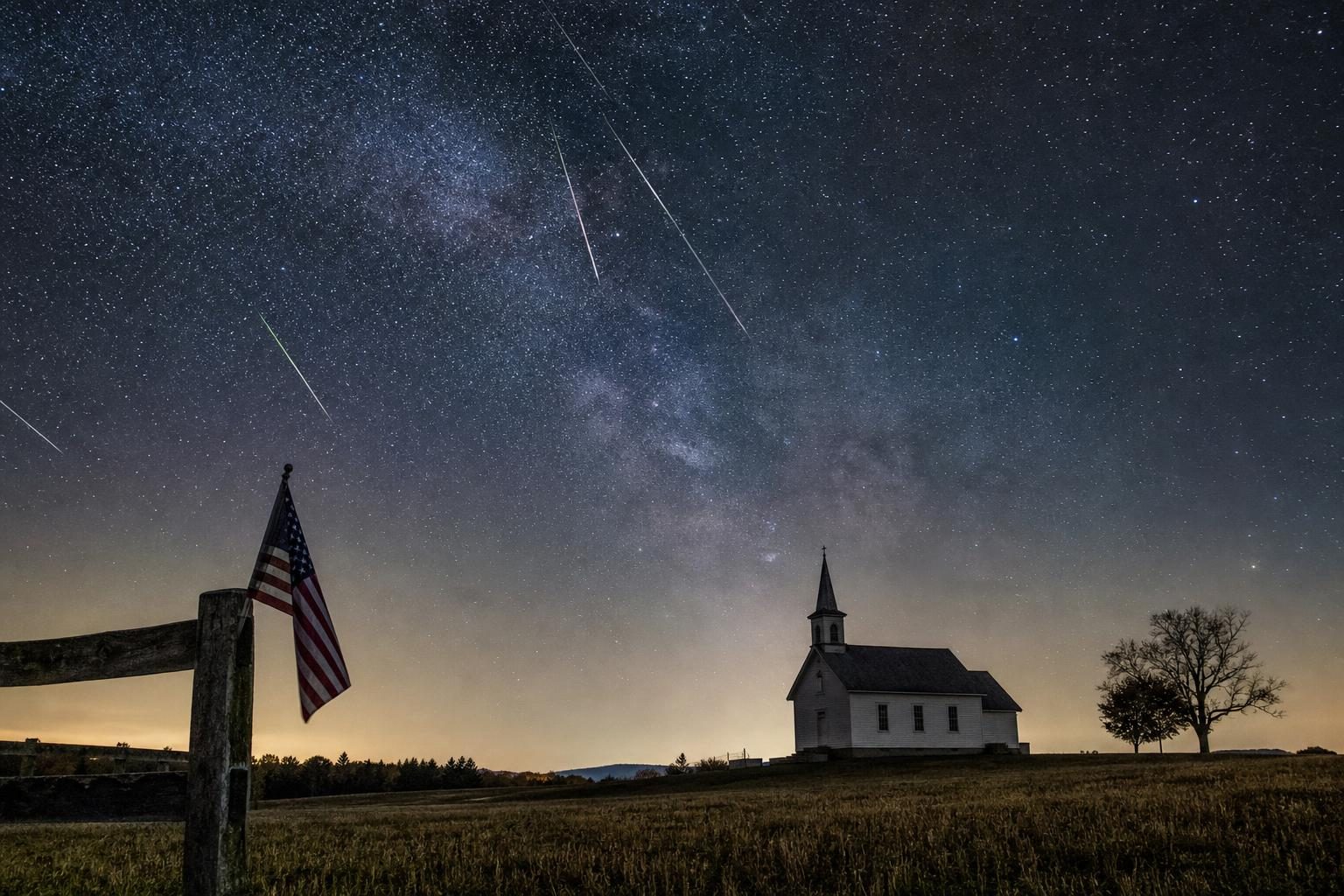
Some of the best shows of the year cost nothing and require no ticket. Next week, one of them returns. The Leonid meteor shower, one of the most storied displays in the night sky, reaches its peak around Monday night, Nov. 17, giving families a reason to bundle up, step outside and look up [1].
This year's Leonids will not rival the legendary storms that made the shower famous. But the shower is a reliable autumn tradition, it is easy to watch with nothing more than your own eyes, and its history includes one of the most remarkable nights in American memory, a night when many believed the heavens themselves were speaking.
When to watch, and what to expect
The Leonids are active for most of November. According to Space.com, citing the International Meteor Organization's 2026 calendar, the shower runs from Nov. 6 to Nov. 30 and peaks on Nov. 17 [1]. Under dark skies away from city lights, observers can expect roughly 10 to 15 Leonid meteors an hour at the peak, and fewer where moonlight brightens the sky [1].
The moon is the main complication this year. EarthSky notes that the first-quarter moon arrives on Nov. 17, which means a half-lit moon will hang in the evening sky during peak week [2]. That moonlight will wash out fainter meteors early in the night. The good news, as BBC Sky at Night Magazine points out, is that the moon sets around midnight, leaving darker skies for the hours when the Leonids are at their best [3].
Those hours come late. Meteors in this shower appear to radiate from the constellation Leo, which gives the Leonids their name, and that part of the sky climbs higher after midnight [2]. The higher the radiant, the more meteors streak across the sky. So the best plan for most Americans is to watch in the dark hours after midnight and before dawn on Monday night into Tuesday morning, or on the nights just before and after [1][3].
A comet's crumbs, moving at 44 miles a second
Every meteor shower is a kind of cosmic leftovers. The Leonids come from comet 55P/Tempel-Tuttle, which circles the sun about once every 33 years and sheds a trail of dust and grit along its path, according to EarthSky [2]. Each November, Earth plows through that debris. The tiny particles, many no bigger than a grain of sand, burn up high in the atmosphere [2] and leave the bright streaks we call shooting stars.
What sets the Leonids apart is speed. EarthSky describes them as among the fastest meteors, hitting the atmosphere at about 44 miles (71 kilometers) per second [2]. That speed can produce bright meteors and fireballs, and some leave glowing trails that linger for a moment after the flash [2].
The comet's 33-year rhythm explains the shower's famous history. When Tempel-Tuttle swings through the inner solar system, it lays down fresh, dense streams of debris. If Earth crosses one of those streams in the right year, an ordinary shower can become a storm, with meteors falling not by the dozen but by the thousands [2].
The night the stars fell
The most famous of those storms came on the night of Nov. 12 to 13, 1833. Across much of North America, people looked up to a sky filled with meteors, and newspapers across the young country carried accounts of the spectacle in the days that followed, according to a collection of those reports [4].
For many who saw it, the meaning was not only scientific. The storm came during the Second Great Awakening, a season of Protestant revival that stressed personal faith and the return of Christ, and many religious-minded Americans took the falling stars as a fulfillment of biblical prophecy, Grunge reported in a history of the event [5]. Some feared the end of the world had come [5].
The same night also pushed scientists toward a better understanding of what meteors are and where they come from, Grunge noted in its history of the storm [5]. A night that sent many Americans to their knees in prayer also sent others to their notebooks.
There is no conflict in that. For the believer, studying how the heavens work has never been a threat to faith. As the Psalmist wrote, "The heavens declare the glory of God." The people who prayed in 1833 and the people who measured the meteors were looking at the same handiwork.
1966 and the storms since
The Leonids roared again a century and a third later. On the night of Nov. 16 to 17, 1966, observers in central and western North America saw one of the greatest meteor storms ever recorded, the American Meteor Society recalled on the event's 50th anniversary [6]. At its height, rates were estimated at roughly 40 meteors per second, or about 144,000 an hour [6].
The comet's most recent pass brought another round of strong displays around the turn of the century, when skywatchers around the world again saw outbursts far above the usual rate, EarthSky reported [2]. This year, by contrast, the Earth is not expected to cross a dense, fresh stream, which is why forecasters are calling for a modest show of about 10 to 15 meteors an hour [1].
How to see the Leonids for yourself
The beauty of a meteor shower is that it requires no special equipment. A telescope or binoculars actually work against you, because they narrow your view to a tiny patch of sky. Your eyes are the best tool, BBC Sky at Night Magazine advises in its tips for beginners [3].
Here is how to make the most of it:
Get away from the lights. Even a short drive out of town to a park, a field or a dark country road can multiply the number of meteors you see [3]. Moonlight and streetlights both hide the fainter streaks.
Give your eyes time. It takes a while for your eyes to adjust fully to the dark, so put the phone away and resist checking it; its bright screen resets your night vision [3].
Get comfortable and look up. A reclining lawn chair or a blanket on the ground lets you take in as much of the sky as possible. You do not need to stare at Leo itself, since meteors can appear anywhere overhead [3].
Dress for the cold. Mid-November nights are chilly across much of the country, and meteor watching means sitting still for a long time. Warm layers, a hat and a thermos of something hot will keep the family happy.
Be patient. Give it at least an hour, and remember that this year's rate is modest [1].
A reason to step outside together
In a season when so much of life happens on screens, a meteor shower is an invitation to do something old-fashioned: go outside with the people you love, lie back under the sky and wait. Children remember those nights. So do grandparents.
This year's Leonids will not be a storm like 1833 or 1966. But every streak overhead is a fleeting reminder of a vast and orderly creation, of a comet that has been looping around the sun since long before any of us were born, and of the wonder that has drawn people to look up for as long as there have been people. If the skies are clear on Monday night, it is worth an hour of lost sleep.
Sources
- [1]Opens in a new tab ↗
- [2]Opens in a new tab ↗
- [3]BBC Sky at Night MagazineSee the Leonid meteor shower tonight. Top tips for complete beginners catching autumn shooting starsOpens in a new tab ↗
- [4]Newspapers.comNovember 12-13, 1833: The Night the Stars FellOpens in a new tab ↗
- [5]Opens in a new tab ↗
- [6]American Meteor Society50th anniversary of the famous 1966 Leonid stormOpens in a new tab ↗
Do you trust scientific experts more or less than five years ago?
- More
- Less
- About the same
More in Science & Space
Launch Day at Starbase: Starship Flight 15's Minute-by-Minute Plan, Its Path Over South Texas and What a Double Catch Would Mean
This morning on Launch Pad with Hannah Lindgren

Global Fossil Emissions Set to Dip in 2026, but Scientists Credit a Costly Oil Shock
Last night on Launch Pad with Hannah Lindgren
Europe's Hera Spacecraft Arrives to Investigate the Asteroid NASA Knocked Off Course
Yesterday on Launch Pad with Hannah Lindgren
Were you there?
If you were at the scene, or this story touched your life, tell us what you saw and what it was like.
Discussion 0
Sign in or create a free account to join the discussion.
No comments yet. Start the discussion.