
 Today on The Bottom Line with Douglas Park
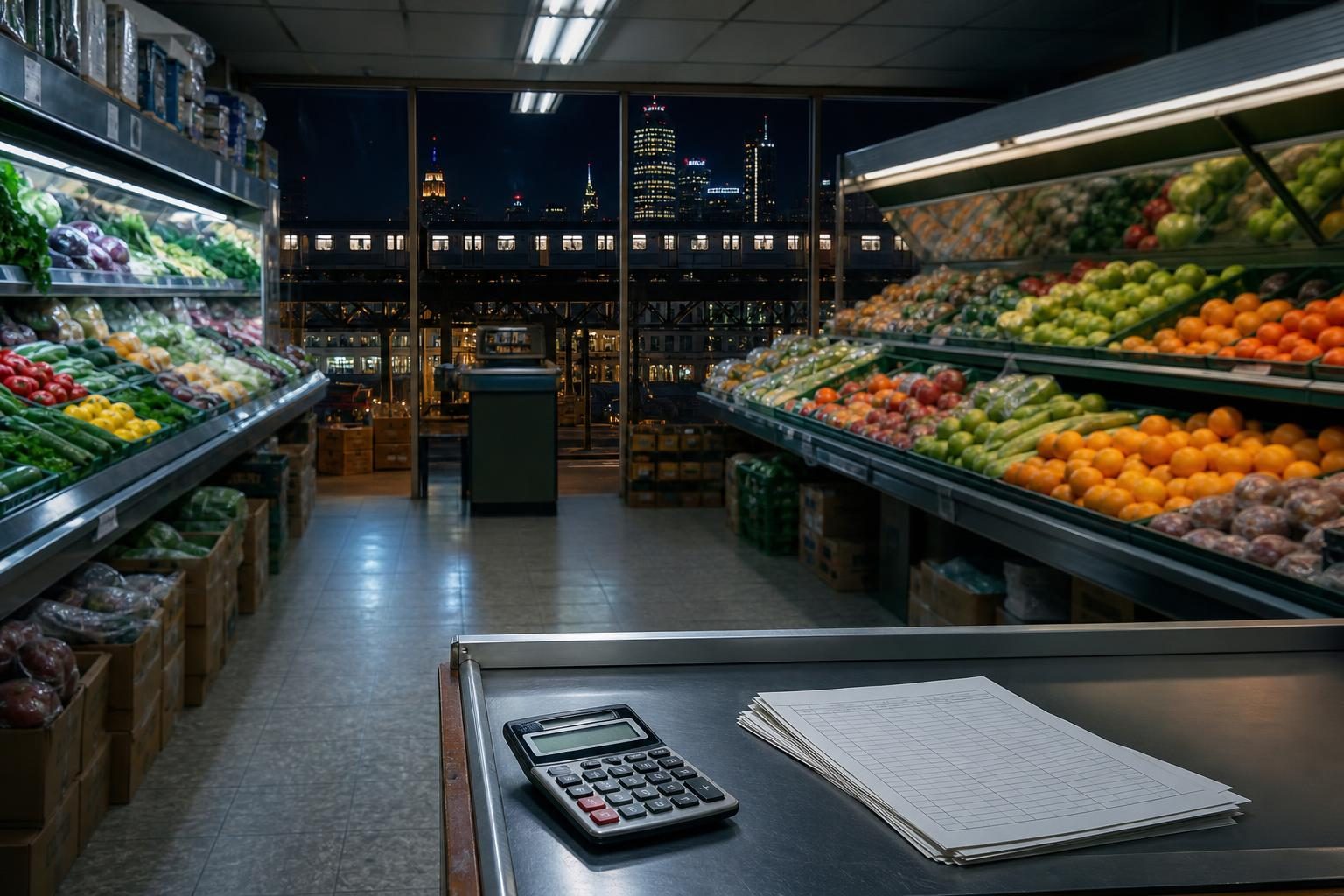
The Math Doesn't Add Up on Mamdani's City-Run Grocery Stores
Pressed on how stores can sell food 30 percent below market in a business with razor-thin margins, Mayor Zohran Mamdani's answer was simple: taxpayers will subsidize it.
Filed November 19, 2026 · 📍 New York City, NY 10007
Were you there? Share your story
Key points
- Pressed at the DealBook Summit, Mamdani said his discount grocery stores will be subsidized.
- Food retailers' net margins were about 1.6 percent in 2023, according to FMI.
- The city plans $70 million for five stores; one East Harlem site alone may cost $30 million.
- Kansas City's city-backed Sun Fresh store and an Illinois grant-funded co-op both closed.
New York City Mayor Zohran Mamdani was asked this week to show how his city-run grocery stores can sell food at deep discounts without losing money, and his answer amounted to an admission that taxpayers will cover the gap, according to Townhall's account of his appearance at The New York Times' DealBook Summit [1].
Interviewer Andrew Ross Sorkin pointed out that grocers typically operate on margins of roughly 1 to 4 percent and asked how a store could offer 30 percent discounts on major food items, and what the subsidies would mean for competing supermarkets, Townhall reported [1]. Mamdani replied that the stores would be subsidized, comparing them to other services the public decides are necessary and then pays to build and run, and said the real math that matters is the struggle of ordinary New Yorkers at the checkout line [1].
That concern is real. Food prices have strained families across the country, and no one should dismiss a mother working to stretch a paycheck. But good intentions do not change arithmetic, and the numbers behind this plan deserve a closer look.
Under the plan, five city-owned stores, one per borough, would price a monthly core basket of meat, seafood and fresh produce at about 30 percent below other retailers, Gothamist reported [2]. City officials told the outlet the discounts should save families about 15 percent on their grocery bills, or roughly $90 a month, and that the city plans to spend $70 million in capital funds on the five stores [2]. The first store is not expected to open until 2027 [2].
The price tag for a single store is steep. The New York Sun reported that the East Harlem location at La Marqueta, a city-owned marketplace, would cost about $30 million, close to half of the $70 million the mayor sought for all five [3]. That is the cost of building a store; how the city will cover the losses of running it year after year is a separate and larger question.
The Margin Problem
Sorkin's question goes to the heart of the matter. FMI, the food industry's main trade association, reported that food retailers' net profit margins fell from 2.3 percent in 2022 to 1.6 percent in 2023, back to pre-pandemic levels [4]. In plain terms, a typical grocer keeps less than two cents of every dollar a shopper spends.
Simple arithmetic follows. If an ordinary store clears about 1.6 cents per dollar, then marking discounted items down by 30 cents leaves a hole of roughly 28 cents on every dollar of those sales, before rent, wages, spoilage or security. There is no efficiency trick that closes a gap that size. As the mayor himself acknowledged, the only answer is a permanent subsidy from the city treasury [1][4].
That money does not appear from nowhere. It comes from the same New Yorkers the plan promises to help, including bodega and supermarket owners, who have opposed the plan and warned that city-backed stores could put them out of business, according to Gothamist [2]. A government that taxes a family-owned corner store in order to fund its own discount competitor down the block is not leveling the playing field. It is tilting it.
Where Public Groceries Have Gone Before
The track record is not encouraging. In Kansas City, the city bought the Linwood Shopping Center in 2016 and spent nearly $18 million revitalizing the site and its Sun Fresh grocery store, KCUR reported [5]. The nonprofit that operated the store ran it until August 2025, when it closed, and that operator is now suing the city, blaming it for neglecting crime around the shopping center [5]. A council member told the station the city's financial help came too slowly to save the store [5].
This month brought another warning, though the model was different. The Prairie Food Co-op in Lombard, Illinois, west of Chicago, closed after about 16 months despite receiving roughly $1.5 million in federal and state grants, the Washington Times reported [6]. The store was member-owned rather than city-run, but its sales ran at about half of what it needed to survive, a reminder that public money cannot make a store viable when shoppers do not show up in sufficient numbers [6].
Neither case proves that every public venture fails. Both show that grocery retailing is a brutally thin-margin business in which experienced operators struggle, and that government backing does not repeal those realities [4][5][6].
What Comes Next
The coming months will test whether City Council members, small business owners and budget watchers press for clear answers before the first store opens. New Yorkers deserve to know the expected annual operating loss for each location, how long the subsidies will last, and what happens to nearby shops when a taxpayer-funded competitor sells below cost [1][2][3].
There are proven ways to lower food costs: easing the regulations and zoning rules that make it expensive to open stores, cutting the taxes and fees that grocers pass on to customers, and encouraging private competition in underserved neighborhoods. Those approaches put more food on more shelves without asking working families to underwrite a city-run business. Compassion for struggling shoppers is a virtue. Promising them a deal the math cannot support is not.
Sources
- [1]TownhallZohran Mamdani Was Pressed on the Math Behind His City-Run Grocery Stores. It Did Not Go Well.Opens in a new tab ↗
- [2]Opens in a new tab ↗
- [3]Opens in a new tab ↗
- [4]Opens in a new tab ↗
- [5]Opens in a new tab ↗
- [6]The Washington TimesFailure of government-funded grocery store offers a warning for DemocratsOpens in a new tab ↗
Have you ever been censored or shadow-banned on social media?
- Yes
- I think so
- No
- I'm not on social media
More in Pushback
Washington State Fined Meta $35 Million Over Political-Ad Paperwork. The First Amendment Deserves the Last Word
Tonight on Rule of Law with Lauren Pierce
Oversight Has Limits: The Constitution Won't Let Jeffries Investigate 'Everyone' in MAGA
Tonight on First Principles with Benjamin Stone
Why Federal Law Says No to Keeping 'Gender Support Plans' From Parents
Today on Faith & Family with Ethan Calloway
Were you there?
If you were at the scene, or this story touched your life, tell us what you saw and what it was like.
Discussion 0
Sign in or create a free account to join the discussion.
No comments yet. Start the discussion.