
 Tonight on First Principles with Benjamin Stone
Newsom Wants California to Hold America's AI Off Switch. The Constitution, and His Own Veto, Say Otherwise
In Washington, California's governor pitched state power to shut down dangerous AI systems and called the issue 'table stakes' for 2028. The Commerce Clause points to one national standard set by Congress.
Filed November 18, 2026 · 📍 Los Angeles, CA 90012
Were you there? Share your story
Key points
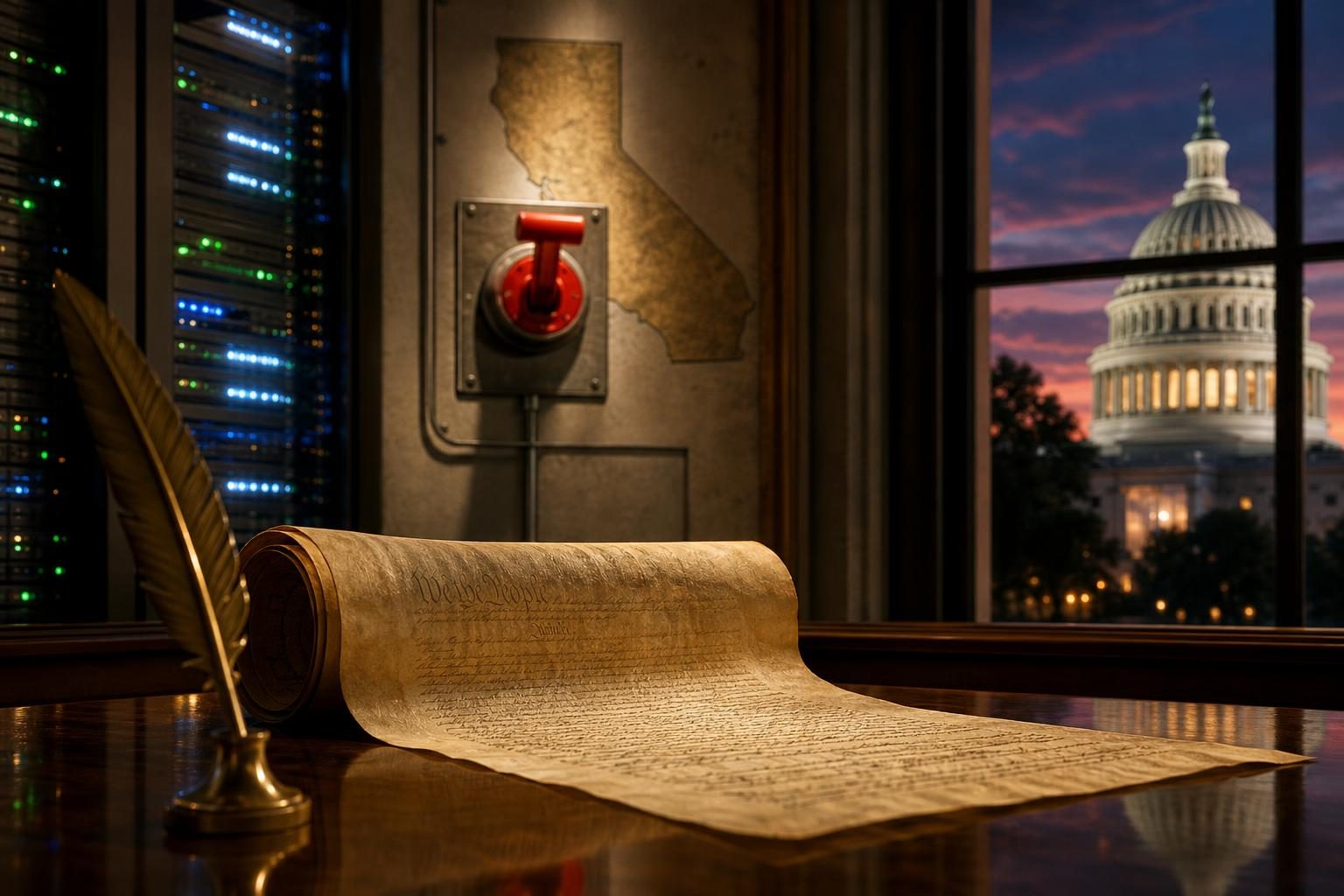
- Newsom released a report calling for California to have power to shut down dangerous AI systems.
- He told reporters AI regulation should be 'table stakes' for any serious 2028 candidate.
- In 2024, Newsom vetoed a sweeping AI safety bill, warning it could hinder innovation.
- The Constitution gives Congress power over interstate commerce, and a December 2025 executive order calls for one federal AI standard.
Gov. Gavin Newsom came to Washington this week with a plan for artificial intelligence and a message for the 2028 field. The plan deserves a serious answer, because the question underneath it is one the Constitution already speaks to: who should write the rules for a technology that crosses every state line at the speed of light?
What Newsom Proposed
On Wednesday, Newsom released a report calling for California to have the power to shut down dangerous AI systems and to restrict companies from developing AI that could slip beyond human control, the New York Post reported [1]. He unveiled the plan in the nation's capital while accusing President Trump and his administration of failing to lead on the technology, the Los Angeles Times reported [2].
Newsom, who is term-limited, told reporters he has not decided whether to run for president, but he said AI regulation should be "table stakes" for any serious 2028 candidate, the Washington Examiner reported [3].
The concerns behind the plan are not imaginary. Powerful AI systems raise real questions about safety, security and accountability, and Americans of every political stripe want them answered. The problem is not that Newsom is asking those questions. The problem is his answer: that Sacramento should hold the switch.
Newsom Already Made the Case Against It
The most persuasive critic of this plan may be Newsom himself. In 2024, he vetoed a sweeping California AI safety bill, warning that it could hinder innovation in the state, PBS reported [4]. Nothing about that concern has changed. If anything, the stakes are higher now, with American companies racing to stay ahead of China in a technology that will shape economic and military power for decades.
What has changed is the calendar. A governor finishing his last term, with an eye on a national campaign, now wants a power he once judged too risky to grant.
The Constitution Points to Congress
The founders gave Congress, not individual states, the power to regulate commerce among the several states. That is Article I, Section 8, and it exists for exactly this kind of problem. AI models are trained in one state, run on servers in another and used by customers in all fifty. A single state claiming the authority to pull the plug on a system used nationwide is a state setting policy for every American, including the millions who never voted for its governor.
The Trump administration has already acted on that principle. In December 2025, the President signed an executive order to build a national policy framework for AI, directing the attorney general to set up a task force to challenge state AI laws that unconstitutionally burden interstate commerce, and calling for Congress to pass a single federal standard, according to the White House [5].
Who Is Pushing Back, and What Comes Next
That does not mean the debate is settled. Congress has been wary of simply wiping out state laws without a federal standard to replace them: the Senate voted 99-1 in July 2025 to strip a proposed 10-year moratorium on state AI rules from the President's big budget bill, States Newsroom reported [6]. Lawmakers in both parties want safety rules. The question is whether those rules come from one Congress accountable to all Americans or from fifty capitals pulling in fifty directions.
The better path is clear. Congress should write a national standard that protects Americans from real dangers, keeps bad actors accountable and lets American innovators keep building here instead of overseas. California is free to make its case in that debate, as every state is. What it should not do is appoint itself the nation's off switch.
Newsom's report now heads into a crowded fight in Sacramento and in Washington, and his visit made clear he plans to carry the issue onto the national stage [2][3]. Conservatives should welcome that debate, and win it, with the Constitution in hand.
Sources
- [1]New York PostGavin Newsom releases rogue AI report, calls for giving California the power to pull the plugOpens in a new tab ↗
- [2]Opens in a new tab ↗
- [3]Washington ExaminerNewsom says AI regulation should be 'table stakes' for any serious 2028 candidateOpens in a new tab ↗
- [4]PBS NewsNewsom vetoes bill to create AI safety measures, saying it could hinder innovation in CaliforniaOpens in a new tab ↗
- [5]The White HouseFact Sheet: President Donald J. Trump Ensures a National Policy Framework for Artificial IntelligenceOpens in a new tab ↗
- [6]States NewsroomSenate votes 99-1 to remove AI moratorium from megabillOpens in a new tab ↗
Have you ever been censored or shadow-banned on social media?
- Yes
- I think so
- No
- I'm not on social media
More in Pushback
A Pause, Not a Verdict: What the Arch Ruling Really Says, and Why the Case for the Gateway at Arlington Is Still Alive
Tonight on Order in the Court with Harold Whitmore
No Seat Is Guaranteed in the Oval Office: Why the Law Backs the White House in the Press-Pool Fight
Tonight on Rule of Law with Lauren Pierce

Tax the Oil Companies, and Families Pay at the Pump: The Facts Behind COP31's 'Make Polluters Pay' Push
Tonight on The Vance Edge with Sienna Vance
Were you there?
If you were at the scene, or this story touched your life, tell us what you saw and what it was like.
Discussion 0
Sign in or create a free account to join the discussion.
No comments yet. Start the discussion.