
 Last night on First Principles with Benjamin Stone
Every Generation Has Remade the People's House. Trump's New Walkway and Park Work Follow a Long American Tradition
As critics tie new White House walkway and park projects to the midterm results, the record shows presidents from Theodore Roosevelt to Truman reshaped the mansion, and courts have let construction continue.
Filed November 17, 2026 · 📍 White House, DC 20500
Were you there? Share your story
Part of our continuing coverage: Trump Asks Supreme Court to Close the Book on the White House Ballroom Case: What to Know
Key points
- The Washington Post reported new work on a West Wing walkway and about $3 million in Lafayette Square brick repairs, which the Park Service will cover.
- Theodore Roosevelt built the West Wing in 1902, Taft added the first Oval Office in 1909, FDR built the East Wing in 1942 and Truman rebuilt the mansion starting in 1948.
- The Supreme Court let ballroom construction proceed in a 5-4 order on Aug. 31, finding the preservation group likely lacked standing.
- The National Trust's response to the administration's Supreme Court petition is due Dec. 7.
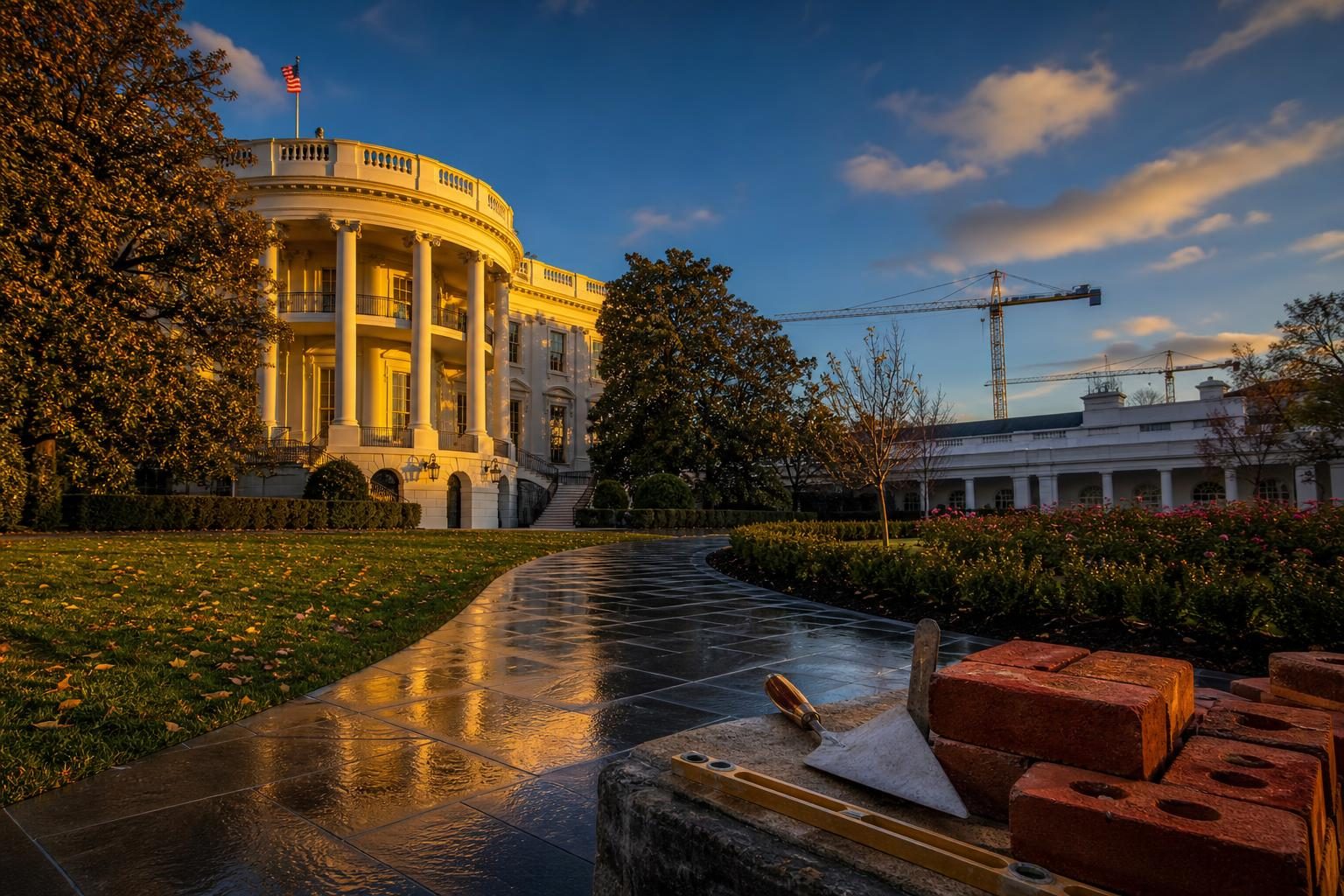
The Washington Post reported Tuesday that President Trump is moving ahead with another round of work on the White House grounds, even after Republicans suffered heavy losses in this month's midterm elections [1]. Citing two officials and documents it reviewed, the Post said the administration is spending millions of dollars to reset the stones in Lafayette Square, the public park across from the executive mansion, and to remake walkways around the Rose Garden [1].
According to the Post, the black granite path the president had laid outside the West Wing earlier this year is being extended past the Rose Garden toward a road south of the White House [1]. The Lafayette Square brickwork is expected to cost about $3 million, and officials told the paper the National Park Service will cover it [1]. Officials said the goal is to make the park "safe and beautiful," and argued that loose bricks could be pried up and used during protests [1]. The Post also noted that while President Trump has said he is paying for the makeover himself, the Park Service is set to pay for much of it [1].
The Independent cast the new plans as a reaction to the election defeat and wrote that polling shows the president's construction projects are unpopular with the public [2]. Citing the Post's earlier reporting, the British paper said the administration plans to spend at least $900 million on White House construction, including more than $330 million in private donations for the planned ballroom [2].
Those facts deserve a fair hearing, and the polling is real. But the notion that remaking the White House is an odd or self-indulgent break from presidential tradition does not survive a look at the history.
A House That Has Never Stood Still
The White House Historical Association records that Theodore Roosevelt's 1902 renovation produced a new office building for the president's staff, the structure Americans now know as the West Wing, along with a new entrance for social guests [3]. Just seven years later, William Howard Taft enlarged it to the south, building over a tennis court, and put the first Oval Office in the middle of the new addition [3]. In 1942, at Franklin D. Roosevelt's request, government architect Lorenzo Winslow designed and supervised a new East Wing that included office space and an underground shelter [3]. NPR, drawing on the association's history, noted that the wartime project was considered highly controversial in its day [4].
Harry Truman went further than any of them. NPR recounted that his top-to-bottom renovation began in 1948 and ran for four years, with the first family living elsewhere while the work was done [4]. Truman's balcony, now a fixture of official events, was contested when built, and NPR reported that he paid for it out of his household account [4].
In fairness, NPR also quoted a historian who said Truman went through the proper channels to win approval, and an architectural historian who called the ballroom the largest addition since the 1940s [4]. Those are fair points for debate. They are also a reminder that nearly every major change to the White House drew objections before it became cherished.
Who Pays, and What the Courts Have Said
Private generosity has an honored place here, too. When Jacqueline Kennedy set out in 1961 to restore the mansion's historic character, she formed a Fine Arts Committee and created the White House Historical Association so the effort would not depend on public money, according to the John F. Kennedy Presidential Library [5]. Proceeds from the association's official guidebook, first published in 1962, helped pay for the restoration and for new acquisitions [5].
The ballroom draws heavily on that same kind of private support, with more than $330 million in donations reported [2]. Taxpayers are covering part of the wider work, including the Lafayette Square repairs [1]. Americans can reasonably argue over those line items. Still, the park and grounds being repaired belong to every citizen and will serve presidents of both parties.
On the law, the Supreme Court voted 5-4 on Aug. 31 to let ballroom construction proceed, with the majority finding that the National Trust for Historic Preservation likely lacked legal standing to sue, according to SCOTUSblog [6]. The justices did not decide whether the president needs Congress's approval to build, a question a divided appeals court panel had answered in the Trust's favor [6]. Earlier this month, the administration asked the high court to take up the full case [6].
The Defense and the Road Ahead
The Independent reported that the Interior Department, which oversees the Park Service, praised the president for "restoring the grounds to greatness for future presidents to enjoy" [2]. Pressed on whether the projects are a distraction, the president said looking after the country's great symbol takes him about 10 minutes a day [2].
The National Trust's response to the government's petition is due Dec. 7, SCOTUSblog reported, and construction can continue while the justices weigh whether to hear the case [6].
The midterms were a genuine setback. But a granite walkway, a repaired public square and a ballroom backed by hundreds of millions in private gifts are not a betrayal of the White House tradition. From Roosevelt's offices to Truman's balcony, faithful stewardship of the people's house is that tradition, carried forward by each generation.
Sources
- [1]The Washington PostPresident pushes more White House renovations in wake of midterm lossOpens in a new tab ↗
- [2]The IndependentTrump has new White House renovation projects planned as he seethes from midterm lossesOpens in a new tab ↗
- [3]White House Historical AssociationArchitecture: 1900s-1940sOpens in a new tab ↗
- [4]Opens in a new tab ↗
- [5]John F. Kennedy Presidential Library and MuseumThe White House RestorationOpens in a new tab ↗
- [6]Opens in a new tab ↗
Have you ever been censored or shadow-banned on social media?
- Yes
- I think so
- No
- I'm not on social media
More in Pushback

Sanders Puts Medicare for All on a Four-Year Clock. The 154 Million Americans With Job-Based Coverage Deserve Answers First
Today on The Bottom Line with Douglas Park
Hochul Wants Answers on an ICE Site in Batavia. New York's Own Law Is Why It's Being Built
Today on Border Watch with Cole Brennan

A 25-Year-Old Network Isn't a Bargain: The Facts Behind the Fight Over Duffy's $50 Billion Air Traffic Plan
Today on Open Road with Frank Kowalski
Were you there?
If you were at the scene, or this story touched your life, tell us what you saw and what it was like.
Discussion 0
Sign in or create a free account to join the discussion.
No comments yet. Start the discussion.