
 Today on Rule of Law with Lauren Pierce
Trump Asks Supreme Court to Close the Book on the White House Ballroom Case: What to Know
The administration wants the justices to make their August ruling permanent and end a preservation group's lawsuit, as the ballroom rises and a Senate donor probe draws a Justice Department warning.
Filed November 12, 2026 · 📍 Supreme Court, DC 20543
Were you there? Share your story
Key points
- Solicitor General D. John Sauer filed a petition on Nov. 5 asking the Supreme Court to reverse the order against the ballroom, ideally without oral argument.
- The Court ruled 5-4 on Aug. 31 that the National Trust for Historic Preservation likely lacks standing, pausing a lower-court injunction; Chief Justice Roberts dissented.
- Past presidents from Theodore Roosevelt to Truman remade the White House, though critics note Congress authorized Truman's rebuild.
- A Justice Department official told Sen. Richard Blumenthal to preserve records from his ballroom donor probe; the Trust's court response is due Dec. 7.
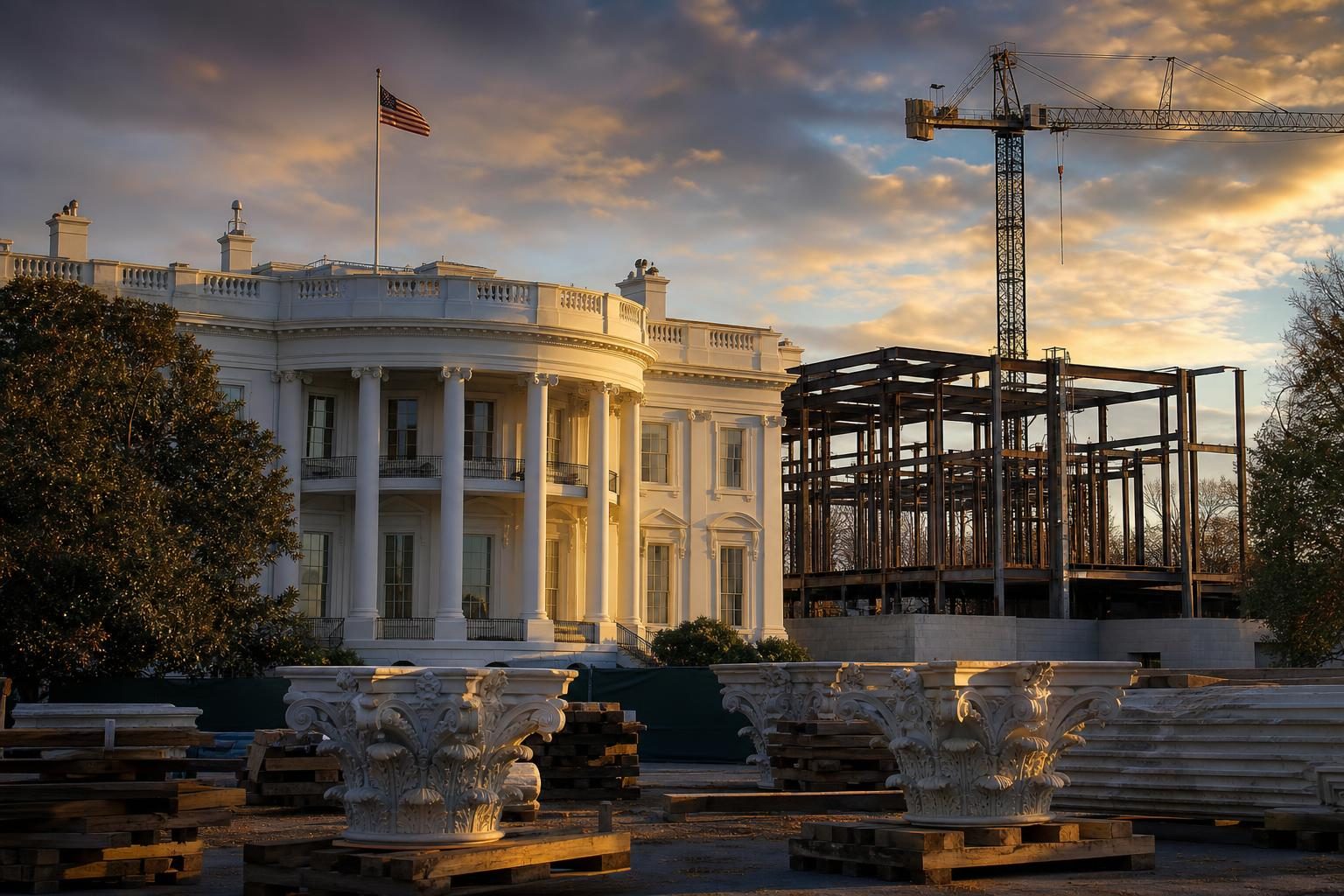
The Trump administration has asked the Supreme Court to end the legal fight over the new White House ballroom for good, the Washington Examiner reported [1]. The justices let construction continue in August; now the government wants that temporary win made final [2].
What the Administration Is Asking For
This is not another emergency request. Solicitor General D. John Sauer filed a petition for certiorari on Nov. 5 in National Park Service v. National Trust for Historic Preservation in the United States, No. 26-599, SCOTUSblog reported [2]. The petition asks the justices to take the dispute onto their regular merits docket and reverse the lower-court ruling they had already put on hold [1].
Sauer's first choice is a summary reversal, setting aside the district judge's decision without new briefing or argument; at a minimum, he asks for full review and argument [2]. His reasoning is that the court did the heavy lifting in its unsigned Aug. 31 opinion, leaving "nothing further or new that this Court needs to decide" [1]. He conceded that the summer ruling came on the interim docket and was only a preliminary look at the merits [2].
The August order paused the lower-court injunction; it did not erase it [1]. The National Trust's response is due Dec. 7 [2].
Who Sued, and Why
The plaintiff is the National Trust for Historic Preservation, a private nonprofit. It sued in December 2025, two months after the East Wing was demolished to make room for the ballroom [2]. Reuters has described the project as a 90,000-square-foot, $400 million ballroom, part of a broader effort that includes an extensive underground complex with bomb shelters, medical facilities and security features [3].
The Trust asked a federal court to halt construction until the National Capital Planning Commission and the Commission of Fine Arts reviewed the plans, the planning commission approved them, and Congress authorized the work [2]. To show it had the legal right to sue, known as standing, the group relied on a declaration from one member who visits the area about once a month and objects to the building's scale, height and massing [2]. That single declaration became the hinge of the case.
How the Courts Have Ruled
In late March 2026, Senior U.S. District Judge Richard Leon temporarily barred above-ground construction while allowing underground work, such as shelters and bunkers, and any above-ground work needed for safety and security [2]. The D.C. Circuit froze his order while it weighed the appeal [2].
On Aug. 7, a divided appeals panel upheld Leon's order 2-1, Reuters reported [3]. Judges Patricia Millett and Bradley Garcia wrote that only Congress may regulate construction of White House structures and that lawmakers had not appropriated money for the ballroom; Judge Neomi Rao dissented, arguing that the Trust lacked standing [2]. The majority declared that "Each President is a temporary tenant, not the owner, of the White House" [3].
The administration then filed an emergency application, and Chief Justice John Roberts briefly paused Leon's order on Aug. 21 [2]. On Aug. 31, the court granted the application 5-4 [2], with five of its six conservative justices in the majority [3]. The unsigned opinion stressed that it was not deciding whether the project is lawful. It found the Trust likely lacks standing because its member's objections were not concrete and particularized, and that the government would suffer irreparable harm on security grounds [2].
Roberts dissented, joined by Justices Sonia Sotomayor, Elena Kagan and Ketanji Brown Jackson. He wrote that the construction is likely unlawful and that the Trust does have standing, likening a preservationist's attachment to a beloved building to an environmentalist's attachment to a favorite river or forest [2].
The Arguments on Each Side
The government's case rests on two pillars. The first is standing. Federal courts may hear only real cases brought by people with real injuries, and the administration argues that a member's dislike of a design is not that kind of injury [2]. In Sauer's telling, a judge stopped a national-security project on the complaint of one passerby [2]. The second pillar is security: officials say the above-ground building is integral to protecting the facility below it [2][3]. The Justice Department said in an Aug. 14 filing that the project was 65% complete [3].
That standing principle is familiar ground for conservatives. It is the same doctrine that keeps courts from becoming a forum for every policy disagreement, and a majority of the justices found it decisive here [2]. Trump praised the August decision and called the challenge baseless, Reuters reported [3].
The Trust answers that the injury is real, because a person who regularly enjoys a historic place is harmed when it is altered, and that the deeper problem is authority: Congress controls construction on federal property and has neither approved nor funded this addition [2][3]. After the August ruling, Trust chief executive Brent Leggs said the dissent supported the group's position and called for a fast-tracked appeal [3].
Presidents Have Always Remodeled the People's House
The White House has never been a museum frozen in time. Theodore Roosevelt launched a major renovation in 1901 and 1902, moving the presidential offices into what became the West Wing, and William Howard Taft remodeled that wing in 1909 to create the Oval Office, NPR reported [4].
Franklin Roosevelt installed an indoor pool for polio therapy, paid for by private donations, and in 1942 built out the East Wing, largely to cover a wartime bunker. Republicans called it wasteful [4]. The East Wing torn down in 2025 was thus, in its modern form, built largely to shield a shelter, much the same justification the administration now gives for the ballroom and the complex beneath it [2][4].
The most dramatic precedent is Harry Truman's. With the old mansion structurally failing, architects gutted the interior between 1948 and 1952, leaving only the exterior walls, while the Trumans lived elsewhere for nearly four years. The work cost the equivalent of about $60 million and drew heavy scrutiny, as did Truman's new South Portico balcony [4]. Gerald Ford later built a privately funded outdoor pool [4].
Critics read the same history differently. Congress authorized and funded Truman's rebuild, and author Kate Andersen Brower told NPR that Truman went "through the channels," something she said Trump has not done [4]. Architectural historian Priya Jain called the ballroom the largest addition in scope and size since the 1940s [4]. Both observations can be true: presidents have reshaped the house for more than a century, and this project is unusually large.
Donors, Congress and What Comes Next
The White House has described the ballroom as privately funded [4]. Trump has said he would make the donors' names public but has released only a partial list, NBC News reported, and earlier reporting has pointed to a $330 million fundraising campaign [5].
The money has drawn a congressional inquiry. Sen. Richard Blumenthal of Connecticut, the top Democrat on the Senate Permanent Subcommittee on Investigations, sent letters in October to people identified as ballroom donors, and his office calls the effort an inquiry into waste, fraud and abuse [5].
On Wednesday, Aaron Reitz, the U.S. attorney for the Southern District of Texas, demanded in a letter that Blumenthal preserve records from the probe. Reitz argued the senator's letters amounted to harassing citizens for associating with the president and warned of significant legal consequences, NBC News reported [5]. Acting Deputy Attorney General Trent McCotter backed him, writing that the First Amendment "expressly prohibits Congress from infringing the speech and association rights of Americans" [5]. A department spokesperson said such preservation requests are routine [5].
Blumenthal said he will not be intimidated, accused the administration of turning the Justice Department against Congress, and sent Reitz a preservation demand of his own [5]. Both sides have a point: donors keep their rights of association when they give, and taxpayers have a fair interest in knowing who pays for changes to the nation's most famous home.
On Nov. 4, Trump called reporters to a ceremony as crews hoisted what he said was the structure's final steel beam, and he described Corinthian columns being carved from limestone, Reuters reported [6]. Politics are shifting too: Democrats won control of both the House and the Senate in last week's midterm elections [6], so the body the Trust says must sign off on the project will soon be led by the president's opponents.
In court, the next marker is the Trust's Dec. 7 filing [2]. The justices can then act without argument, as the government prefers, or schedule full briefing and argument [2]. Stewardship of the people's house is a value conservatives and preservationists share. The legal question, though, is narrower than the noise: whether one objecting visitor can halt a presidential building project. Five justices have already signaled their answer [2]. The administration is asking them to make it final.
Sources
Should the death penalty stay on the books for the worst crimes?
- Yes, for the worst murders
- Only with absolute proof like DNA
- No, life without parole is enough
More in Crime & Justice
D.C. Gym Gunman Identified as Matt Lambert and Found Dead; Police Look at a Condo Dispute as a Possible Motive
Today on Breaking Now with Nathan Brooks
One Killed, at Least Four Wounded as Gunman Opens Fire at a D.C. Gym a Mile From the White House; Suspect Barricaded
This morning on Breaking Now with Nathan Brooks
Texas and Oklahoma Set to Carry Out Two Executions Thursday, More Than Two Decades After the Crimes
This morning on Street Watch with Elijah Carter
Were you there?
If you were at the scene, or this story touched your life, tell us what you saw and what it was like.
Discussion 0
Sign in or create a free account to join the discussion.
No comments yet. Start the discussion.