
 Tonight on Kitchen Table with Megan O’Brien
Bird Flu Hits the Nation's Biggest Egg Producer in Florida a Week Before Thanksgiving: What It Means for Your Holiday Table
Cal-Maine Foods will cull about 1.8 million birds and pause production at a Florida site. One outbreak is not a shortage, but the winter bears watching.
Filed November 18, 2026 · 📍 Tallahassee, FL 32301
Were you there? Share your story
Key points
- Cal-Maine Foods will cull about 1.8 million birds at a Florida facility after bird flu was detected.
- The loss covers about 1.4 million laying hens and 360,000 pullets, roughly 2.7% of its flock.
- Egg prices had already fallen back from last year's record highs as farms rebuilt.
- More large outbreaks this winter could tighten supplies again; shoppers should compare prices rather than stock up.
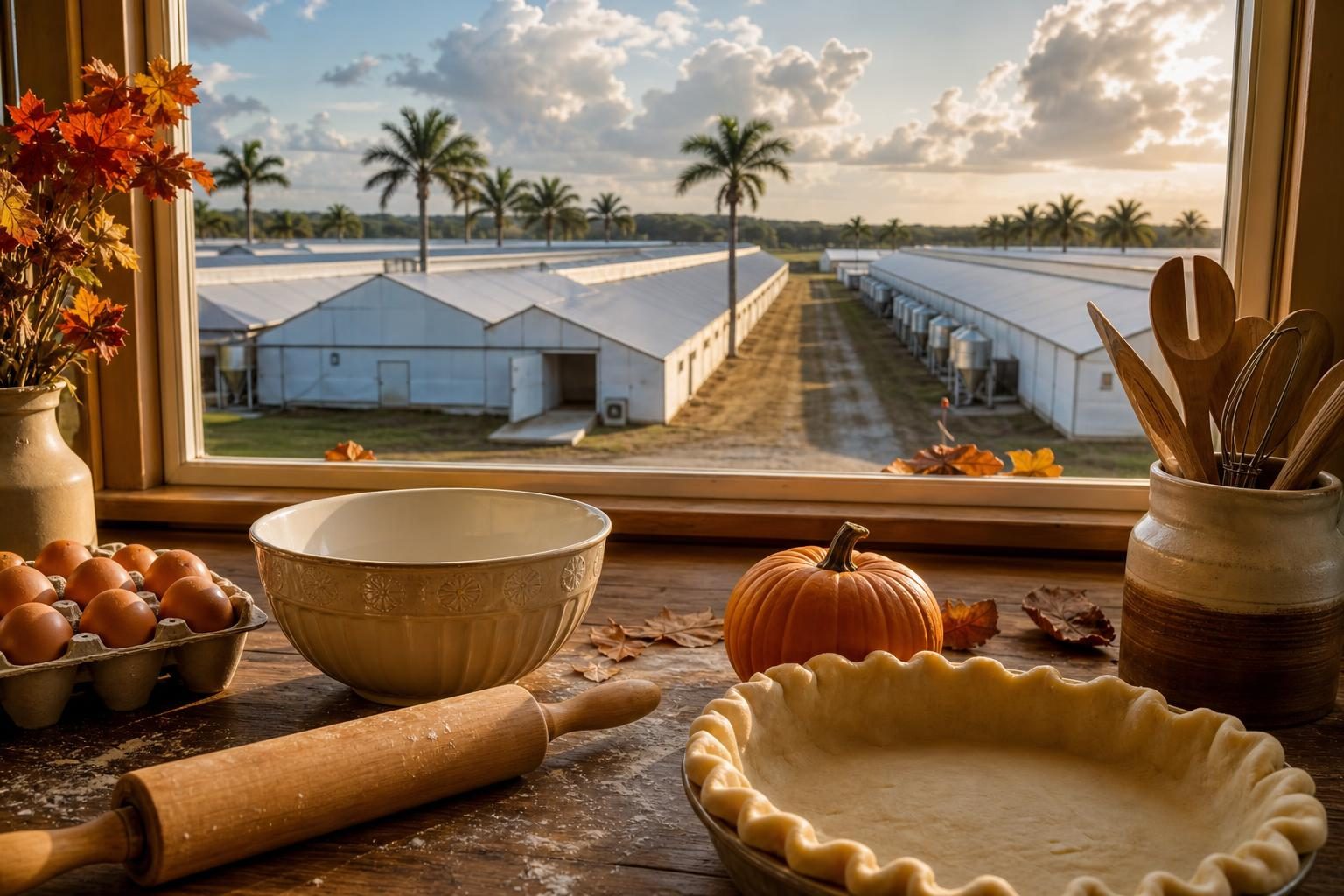
Just a week before Thanksgiving, the country's biggest egg producer is dealing with a fresh outbreak of bird flu, this time in Florida. For families planning holiday baking, the natural question is what it means for the price of a dozen eggs. The short answer: one outbreak is not a crisis, but it is worth watching.
What Happened
Cal-Maine Foods, the largest egg producer in the United States, said Wednesday it will cull about 1.8 million birds at a Florida facility after avian influenza was detected there, Reuters reported in a story carried by U.S. News & World Report [1]. The company is halting production at the site while it follows the protocols set by the U.S. Department of Agriculture [1][3].
The birds affected include about 1.4 million egg-laying hens and roughly 360,000 pullets, the young hens that have not yet started laying [1]. Altogether, that amounts to about 2.7 percent of Cal-Maine's total flock, Al Jazeera reported [2].
Why Whole Flocks Are Destroyed
When highly pathogenic bird flu turns up at a poultry farm, federal guidance calls for the infected flock to be destroyed to keep the virus from spreading to other farms [6]. Cal-Maine went through the same painful process in April 2024, when bird flu at its facility in Farwell, Texas, led to the loss of about 1.6 million laying hens and 337,000 pullets, NPR reported at the time [6]. Production at that plant stopped as the company followed USDA guidance [6].
It is hard work for farmers and their employees, and a heavy loss for any operation. Behind every one of these numbers are farm families and workers who care for those birds every day, and who now face a long cleanup before the barns can be filled again. But the approach exists for a reason: a fast, firm response at one farm protects the rest of the nation's flocks, and with them the food supply.
What It Means for Your Grocery Bill
Americans remember the egg shock of the last bird flu wave, when outbreaks sent prices to record highs [5]. Those prices have since come back down. In April, Cal-Maine's profits slumped as egg prices fell from those record levels, ThePoultrySite reported [5], a reminder that the market recovered as farms rebuilt their flocks.
That recovery is why a single outbreak, even a large one, does not automatically mean a return to empty shelves. Losing 2.7 percent of one company's birds is a setback, not a collapse [2]. The bigger risk is what happens over the winter. In January, Cal-Maine said the virus still had an "extremely strong" presence, Bloomberg reported [4]. Several more large outbreaks in the coming months could tighten supplies again.
For now, shoppers should not panic-buy. The best advice is simple: compare prices across stores, consider store brands, and buy what your family needs for the holiday rather than stocking up.
The Bigger Picture
The outbreak is also a reminder of how much America depends on a small number of very large producers for basic staples. When a single facility goes down, the effects can ripple across a region. Supporting a wide range of farms, from large operations to family producers, makes the food supply sturdier. So does steady federal and state work on biosecurity, so that farmers have the tools to keep the virus out of their barns in the first place.
The first reports did not say when production at the Florida site will resume [1][3]. Repopulating a facility after an outbreak takes time, as the company's earlier outbreaks have shown [6].
What Comes Next
Watch for two things: whether bird flu turns up at other large egg farms in the months ahead, and how wholesale egg prices move in the weeks after Thanksgiving. If outbreaks stay limited, families may barely notice. If they spread, the price of breakfast could become a story again in the new year.
For this holiday, though, the eggs for Grandma's pie should still be there on the shelf.
Sources
- [1]U.S. News & World Report (Reuters)Cal-Maine to Cull 1.8 Million Birds, Halt Production at Florida Facility After Bird Flu DetectedOpens in a new tab ↗
- [2]Opens in a new tab ↗
- [3]Insurance JournalCal-Maine Foods Shuts Production at Florida Facility Due to Bird FluOpens in a new tab ↗
- [4]Opens in a new tab ↗
- [5]Opens in a new tab ↗
- [6]Opens in a new tab ↗
What bill squeezes your budget most?
- Groceries
- Gas and energy
- Rent or mortgage
- Insurance and health care
More in Consumer News
Farm Bureau Prices Thanksgiving for 10 at $58.63, Up 6%, as the Turkey Leads the Way but a Third of the Menu Gets Cheaper
Today on Kitchen Table with Megan O’Brien
Shoppers Tap the Brakes in October: Retail Sales Rise Just 0.2% as High Prices Shadow the Holiday Season
Yesterday on Kitchen Table with Megan O’Brien
Why Americans Are Eating Less Turkey, and What Thanksgiving Dinner Will Cost Your Family This Year
On Monday on Kitchen Table with Megan O’Brien
Were you there?
If you were at the scene, or this story touched your life, tell us what you saw and what it was like.
Discussion 0
Sign in or create a free account to join the discussion.
No comments yet. Start the discussion.