
 Monday night on Order in the Court with Harold Whitmore
A Court Tossed One Expired Order. The Grid Still Needs Michigan's Campbell Plant This Winter
Critics say the Energy Department is defying judges by keeping a West Michigan coal plant running. The ruling itself, the grid's own warnings and last winter's storm tell a fuller story.
Filed November 16, 2026 · 📍 Lansing, MI 48933
Were you there? Share your story
Key points
- The Energy Department issued a seventh 90-day emergency order keeping the J.H. Campbell coal plant available.
- The September appeals ruling vacated the first, already-expired order, and the department has asked the full court to rehear it.
- NERC rates the Midwest grid at elevated risk in 2027, with shortfall risk concentrated in February.
- Consumers Energy says it will follow the law and run the plant under the new order.
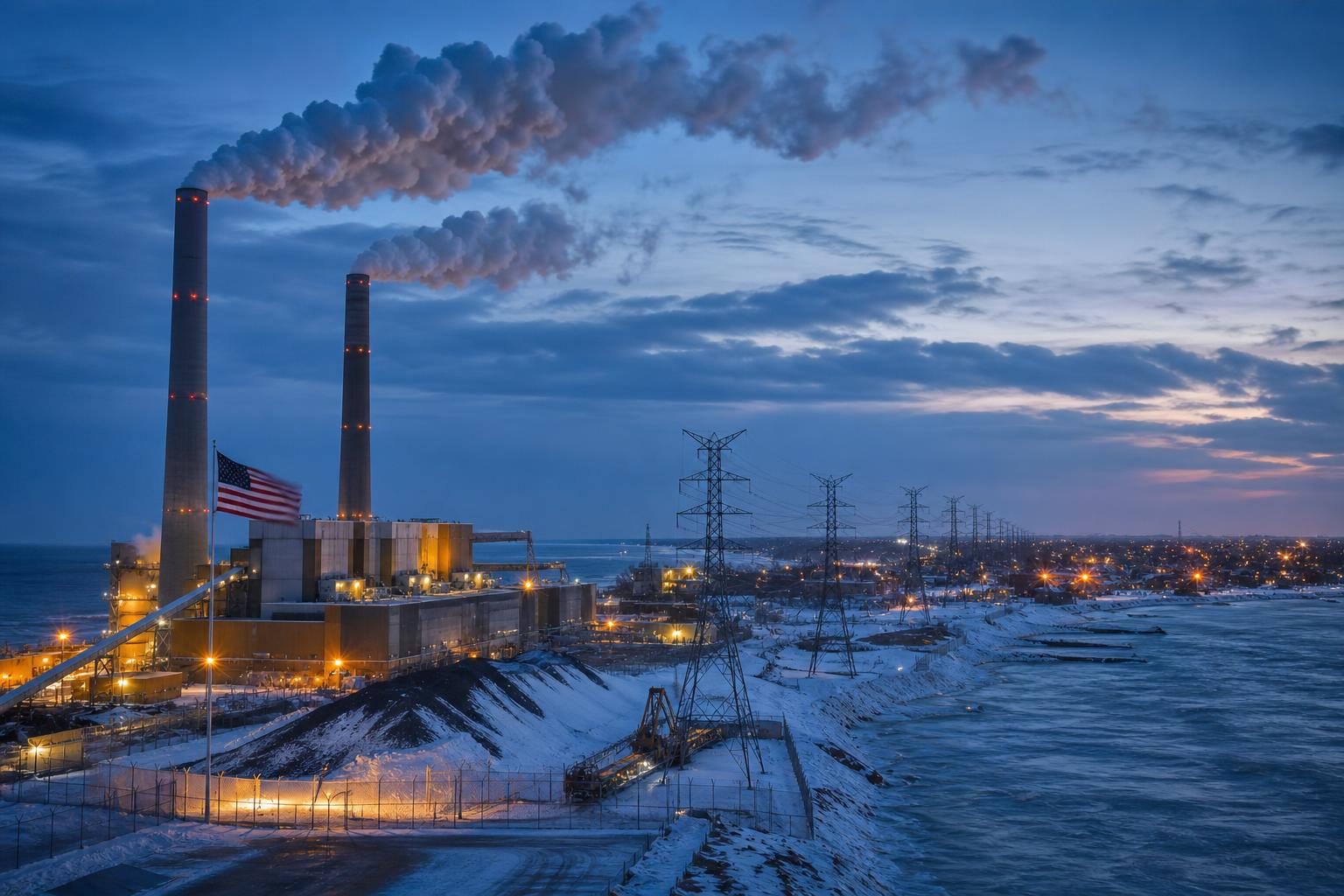
The Energy Department has ordered Consumers Energy's J.H. Campbell coal plant in West Michigan to stay available for another 90 days, its seventh emergency order since the plant was due to retire in May 2025 [2]. The Associated Press reported the move as defying a three-judge federal appeals panel that had set aside the department's earlier action as unlawful [1].
Critics have piled on. Environmental groups dispute that the plant is needed to keep the lights on [1]. Utility Dive reported that Consumers spent $303 million through the end of September running Campbell under the orders, after counting $344 million in market revenue, according to its quarterly filing [2].
Those are fair questions to raise, and ratepayers deserve straight answers. But the charge that Washington is thumbing its nose at the courts does not hold up, and the grid's own warnings point the other way.
What the Court Actually Did
On Sept. 11, a panel of the U.S. Court of Appeals for the D.C. Circuit vacated the department's first Campbell order, issued May 23, 2025 [3]. Writing for the court, Judge Cornelia Pillard said the emergency power in Section 202(c) of the Federal Power Act applies when the department identifies a risk of substantial harm from inadequate electricity supply that calls for its own immediate action, and that it cannot serve as a partial substitute for the states' planning processes [3].
That is a real setback for the department, and it deserves to be taken seriously. But the order the court threw out had already expired, and the panel did not rule on the orders that followed it [3]. The department disagrees with the decision and has asked the full D.C. Circuit to rehear the case, a request that is still pending [2].
Asking the whole court to take a second look is not defiance. It is how the appeals process works, and parties on every side of major cases use it. Until the courts finish their work, the department is acting under emergency authority that Congress wrote into federal law.
What the Grid Is Telling Us
Start with the nation's grid reliability watchdog. In its long-term assessment released in January, the North American Electric Reliability Corporation rated the Midcontinent grid, which serves Michigan, at normal risk for 2026, elevated risk for 2027 and high risk from 2028 on, citing soaring demand forecasts and uncertainty over when new resources will come online [5]. NERC's analysis showed elevated levels of unserved energy in February 2027, the region's peak winter month [5]. A 90-day order issued Nov. 13 runs into that same February [2].
Then look at last winter. The department says that during Winter Storm Fern, Campbell ran at more than 650 megawatts every day from Jan. 21 through Feb. 1 [4]. The new order cites a joint review by federal regulators and NERC of the Arctic cold period that included Fern, Michigan Public reported [6]. Energy Secretary Chris Wright said keeping plants like Campbell available has "prevented blackouts and likely saved lives" [6].
Families across the Upper Midwest know what a February cold snap means. When temperatures plunge and demand spikes, the power that matters is the power that shows up, from a plant with its fuel on site and ready to run whatever the weather.
The Cost Question
The $303 million figure is real, and every dollar should be accounted for [2]. But the same filing shows Campbell earned $344 million selling power into the regional market, a sign the grid was using what it produced [2]. And the price of a blackout in a deep freeze is measured in more than dollars: in frozen pipes, shuttered businesses and, too often, lives.
Conservatives rightly respect the states' role in planning their own power supply, as the court emphasized [3]. But electricity on a multistate grid is about as interstate as commerce gets, and the Constitution gives Congress the power to regulate commerce among the states. Congress used that power when it gave the Energy Department emergency authority in the Federal Power Act.
Who Is Standing Firm, and What Comes Next
Consumers Energy has said it will continue to follow the law and operate the plant under the new order [1]. Environmental groups that oppose the orders say they are evaluating their legal options [1].
The full D.C. Circuit will decide whether to rehear the case [2]. If the courts ultimately draw the line where the panel did, Congress can write a clearer emergency standard for a grid whose own overseers are warning of shortfalls ahead. Until then, keeping heat and power flowing to Midwestern families through the coldest weeks of the year is not lawlessness. It is the job.
Sources
- [1]WRAL (AP)Defying court order, Energy Department again forces Michigan coal plant to stay open past retirementOpens in a new tab ↗
- [2]Opens in a new tab ↗
- [3]Opens in a new tab ↗
- [4]U.S. Department of EnergyEnergy Secretary Prevents Closure of Coal Plant That Provided Essential Power During Winter StormOpens in a new tab ↗
- [5]Opens in a new tab ↗
- [6]Opens in a new tab ↗
Have you ever been censored or shadow-banned on social media?
- Yes
- I think so
- No
- I'm not on social media
More in Pushback

Sanders Puts Medicare for All on a Four-Year Clock. The 154 Million Americans With Job-Based Coverage Deserve Answers First
Today on The Bottom Line with Douglas Park
Hochul Wants Answers on an ICE Site in Batavia. New York's Own Law Is Why It's Being Built
Today on Border Watch with Cole Brennan

A 25-Year-Old Network Isn't a Bargain: The Facts Behind the Fight Over Duffy's $50 Billion Air Traffic Plan
Today on Open Road with Frank Kowalski
Were you there?
If you were at the scene, or this story touched your life, tell us what you saw and what it was like.
Discussion 0
Sign in or create a free account to join the discussion.
No comments yet. Start the discussion.