
 On Monday on Command Post with Dan Whitaker
Why Washington Is Saying No to a 'Killer Robot' Treaty as Geneva Talks Open
Most treaty members want binding rules on autonomous weapons. The U.S. says the laws of war already demand human judgment, and that a treaty China ignores would only weaken the side that keeps its word.
Filed November 16, 2026 · 📍 Pentagon, VA 22202
Were you there? Share your story
Key points
- A U.N.-backed weapons conference in Geneva is deciding this week whether to open talks on binding rules for lethal autonomous weapons.
- The U.S. proposes a five-year path to a non-binding agreement, saying existing international law already governs warfare; Russia and Israel also resist a treaty.
- Pentagon policy requires appropriate levels of human judgment over the use of force by autonomous weapons.
- Treaty backers cite moral and accountability concerns; with decisions made by consensus, a binding deal this week looks unlikely.
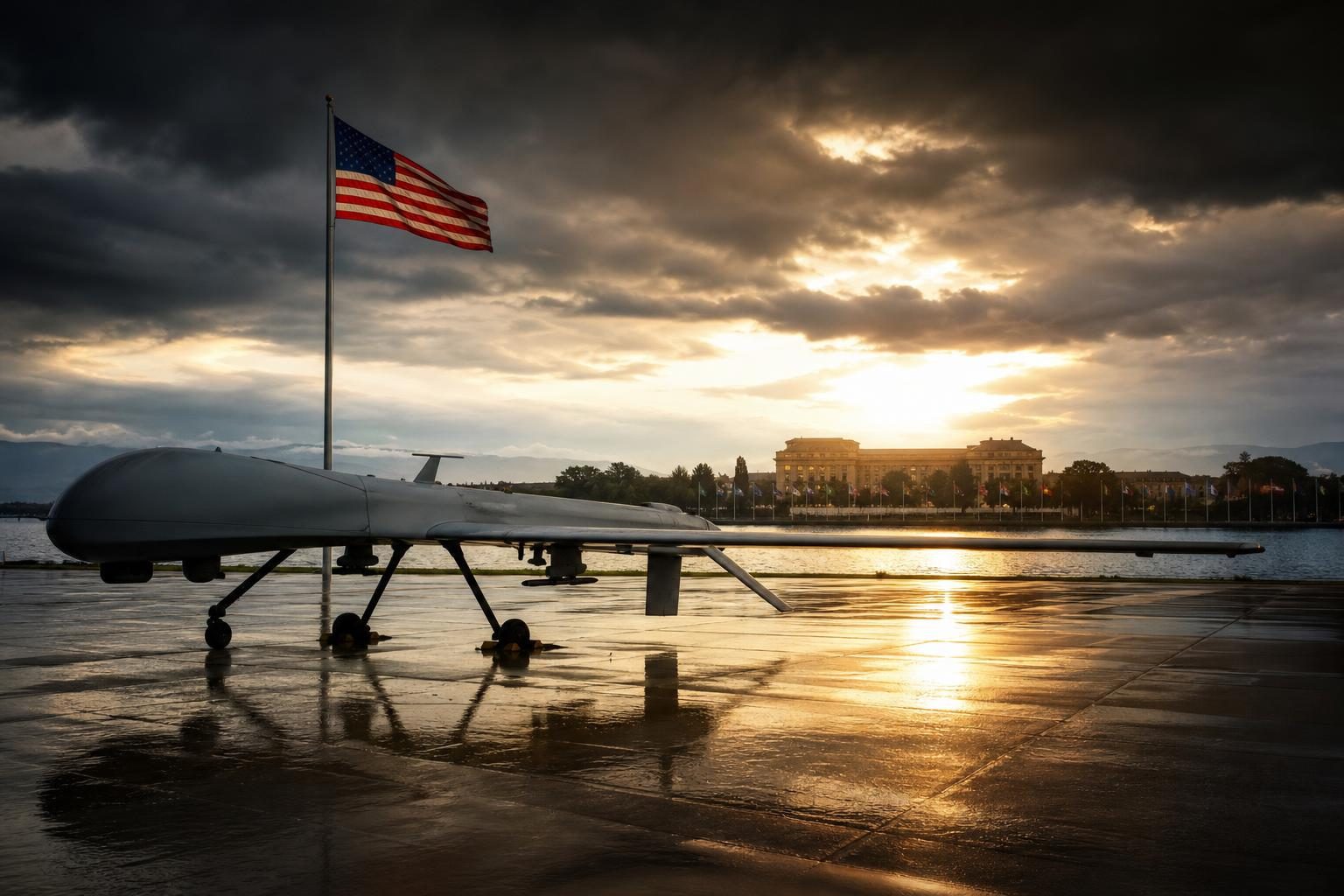
Diplomats from around the world opened a week of talks in Geneva on Monday to decide whether to begin negotiating binding international rules for lethal autonomous weapons, the drones and other systems critics call "killer robots" [1][3]. The United States is expected to say no to a new treaty, arguing that the laws of war already on the books are the right framework, and it is not alone: Russia and Israel are also resisting the push [2].
The setting is the review conference of the Convention on Certain Conventional Weapons, a U.N.-backed treaty that has 128 member states [2][3]. Previous rounds of talks there have produced no international limits on these weapons [3], and the forum works by consensus, which means any one country can stop an agreement [1].
What is on the table
Several competing plans are before the delegates. Last month, seven countries, Austria, Belgium, Brazil, Ireland, Mexico, New Zealand and Panama, submitted a proposal to open negotiations on a new legally binding agreement [1][3]. The chair of this week's conference has proposed a two-year mandate to negotiate a binding protocol [2]. Britain, Germany and France have offered a middle path: negotiations on an instrument that leaves open whether the final product would be legally binding [2].
Washington has put forward a different plan, a five-year process aimed at a non-binding agreement [2][3]. U.S. officials favor guidelines over hard treaty rules and argue that international law already provides a framework to govern warfare [2].
Pressure for a treaty has been building. U.N. Secretary-General Antonio Guterres set this year as his deadline for launching talks toward regulation [1]. Last month, 163 countries backed a U.N. General Assembly resolution calling for negotiations on rules for these weapons [3]. The advocacy group Stop Killer Robots says 130 countries support new international rules [1][3].
Russia, for its part, has called tighter restrictions premature. Foreign Ministry spokeswoman Maria Zakharova said Moscow wants organizational matters settled first [1][3]. Two diplomats told Reuters the week looked set to be challenging, though they said a compromise could still be built by Friday [2].
The case for not tying America's hands
The American position is easy to caricature but worth understanding. The U.S. has long told the Geneva talks that the existing law of armed conflict already does the essential work: it requires any attack to distinguish between combatants and civilians, to be proportionate and to take precautions to spare innocent life, and those rules apply to every weapon, old or new [4]. Pentagon policy, set out in Defense Department Directive 3000.09 and kept in its 2023 update, requires that autonomous weapons be designed so that commanders and operators can exercise appropriate levels of human judgment over the use of force [4]. In the U.S. view, responsibility for a lethal decision stays with people, not machines [4].
There is also a hard strategic reality. A report carried by Business Standard in April said Pentagon officials had concluded that America's unmanned combat drone program was lagging China's, after a Beijing military parade showcased autonomous drones, and that China is developing systems for large groups of drones to coordinate attacks without human input [5]. The Washington Times reported last week that China's military is shifting its forces toward advanced drone warfare [6].
That is the heart of Washington's argument. A treaty that free nations honor and authoritarian rivals quietly ignore would not make the world safer; it would simply hand the advantage to the side least troubled by conscience. Arms control works best when it can be verified, and software inside a drone is far harder to inspect than a missile silo. For the men and women in uniform who would face swarms of enemy drones, the question is not abstract.
What the other side says
Supporters of a treaty make a serious moral argument that deserves a fair hearing. They warn that machines should never be allowed to select and kill human beings on their own, that it can be unclear who answers for a mistake made by software, and that the technology is moving faster than the law. U.N. human rights chief Volker Türk has urged nations to agree on binding rules urgently [3]. Treaty backers also point out that governments have regulated a new weapon before, striking a deal on blinding lasers [3].
Those are concerns that Christians and people of conscience should take seriously. The just war tradition has always insisted that a human being bears moral responsibility for taking a life in war, and the U.S. position, at least on paper, agrees: it keeps human judgment and human accountability at the center [4]. The real disagreement is over whether a new treaty is the best way to protect that principle, or whether it would bind the nations most likely to respect it while leaving the most dangerous actors free.
What comes next
With the forum running on consensus and the United States and Russia opposed, observers say a deal this week to start talks on binding rules looks unlikely [3], though diplomats say a compromise is still possible [2]. Either way, the debate over who controls the weapons of the next war is only beginning, and America's ability to defend itself should not be negotiated away in Geneva.
Sources
- [1]Opens in a new tab ↗
- [2]The Jerusalem PostUS, Russia to oppose talks on limiting autonomous weaponsOpens in a new tab ↗
- [3]Opens in a new tab ↗
- [4]Lieber Institute West PointHuman Responsibility Retained: U.S. Positions on Judgment and Oversight for LAWSOpens in a new tab ↗
- [5]Opens in a new tab ↗
- [6]The Washington TimesChina shifting military forces to advanced drone warfareOpens in a new tab ↗
Should U.S. military aid to Israel end early?
- Yes, Israel can afford its own weapons
- Phase it out slowly
- No, keep it while Iran is a threat
More in Military & Defense

From Threat to Partner: Hegseth Lands in Caracas and Signs a Deal to Rebuild U.S.-Venezuela Military Ties
Tonight on Command Post with Dan Whitaker
Hung Cao Owns the Iran War's Strain on the Fleet and Points to Rising Missile Production in a Tough Navy Secretary Hearing
This morning on Command Post with Dan Whitaker
Hegseth Brings a C-130 to Bogota as Colombia Stands With America Against the Cartels
Overnight on Command Post with Dan Whitaker
Were you there?
If you were at the scene, or this story touched your life, tell us what you saw and what it was like.
Discussion 0
Sign in or create a free account to join the discussion.
No comments yet. Start the discussion.