
 Sunday night on Command Post with Dan Whitaker
217 Days Beneath the Waves: HMS Vengeance Comes Home From a Record Patrol as Britain's Aging Sub Fleet Shows the Strain
America's closest ally kept its nuclear deterrent at sea for more than seven months on a single boat. The crew earned a hero's welcome, and the voyage also exposed how thin the Royal Navy's submarine force has worn.
Filed November 15, 2026 · 📍 Atlanta, GA 30303
Were you there? Share your story
Key points
- HMS Vengeance returned to Faslane on Sunday after an estimated 217-day patrol, a reported Royal Navy record.
- The previous mark of about 205 days was set by HMS Vanguard; the Ministry of Defence does not confirm patrol lengths.
- The Guardian ties the longer patrols to slow maintenance; replacement Dreadnought boats are not due until about 2032.
- British Trident missiles come from a stockpile shared with the U.S. Navy at Kings Bay, Georgia.
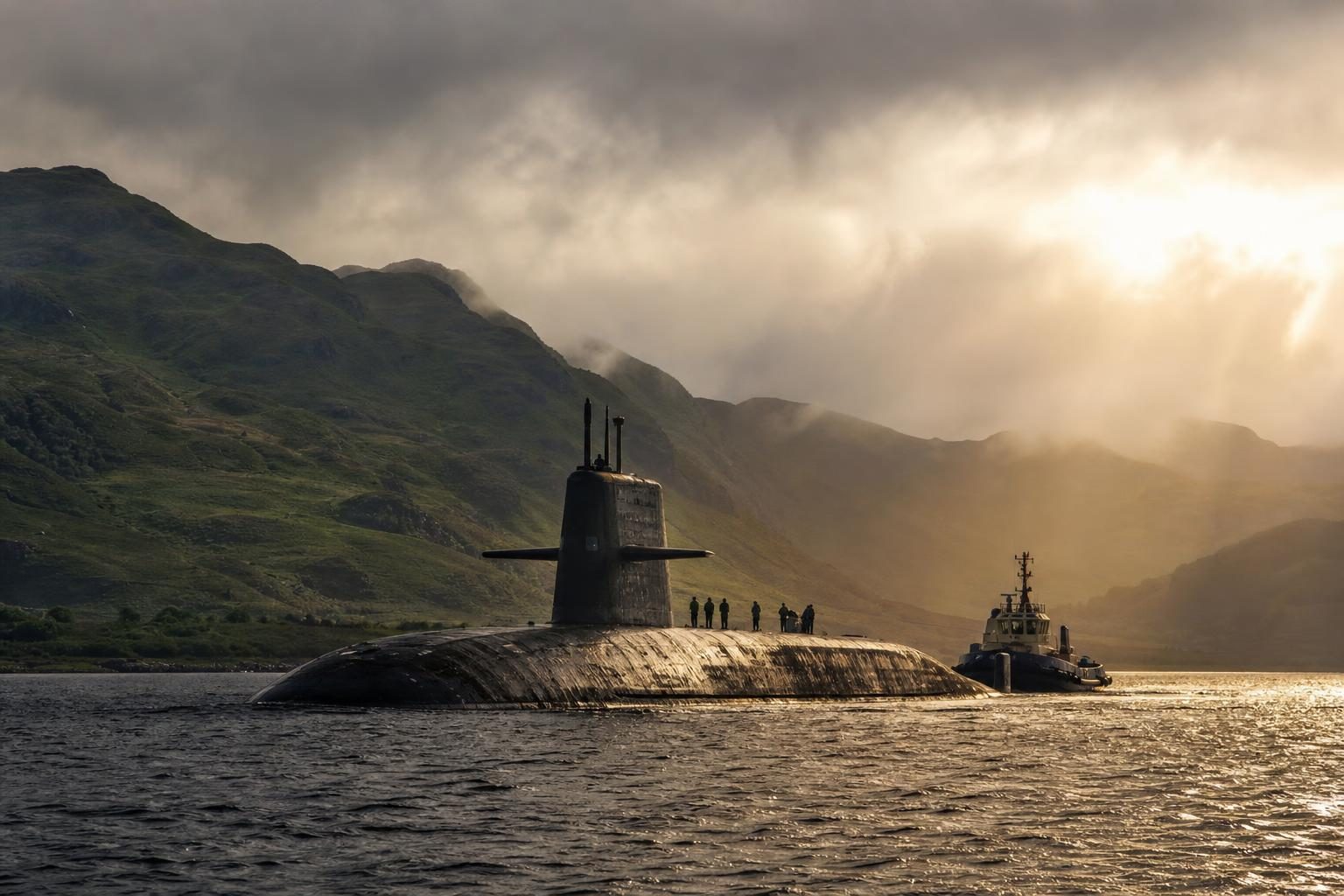
The sailors of HMS Vengeance came home to Scotland on Sunday after what British outlets are calling the longest deterrent patrol in Royal Navy history: roughly 217 days hidden beneath the sea with Britain's Trident nuclear missiles [1][2][3].
The Vanguard-class ballistic missile submarine returned to HM Naval Base Clyde at Faslane, where Defence Secretary Wes Streeting was on hand to welcome the crew, the BBC reported [1]. The BBC described the voyage as the longest deployment at sea for a British vessel [1], and the Guardian said the boat had been away for more than seven months [2].
Think about what that asks of a crew. They slipped out in early spring and surfaced at home in mid-November, cut off from the world above, on a mission that works only if no one knows where they are. That is service of a rare and demanding kind, and it deserves to be honored on both sides of the Atlantic.
A Record the Navy Won't Confirm
The Ministry of Defence does not confirm how long its deterrent patrols last, so the 217-day figure rests on open-source tracking by defense watchers, UK Defence Journal noted [4]. Those estimates put Vengeance's departure from Faslane on April 12, when a Vanguard-class boat was seen leaving the base, the publication reported [4]. A return on Nov. 15 works out to about 217 days, beating the previous mark of 205 days set by HMS Vanguard, which came home in April [4].
GB News went further, calling it a record-breaking 217-day patrol and describing the homecoming as triumphant [3]. Whatever the official books eventually say, no one disputes that this crew did something extraordinary.
The Strain Behind the Record
There is a hard truth behind the celebration. The Guardian reported that the lengthening patrols are linked to the slow pace of maintenance on Britain's aging submarines, and it raised concerns about the psychological toll of seven months underwater at a time when the Navy is struggling to recruit [2].
The head of the Royal Navy, Gen. Sir Gwyn Jenkins, said last week that he has tremendous respect for the Trident sailors but that Britain needs to improve its submarine maintenance so boats can be turned around faster, the Guardian reported [2]. Streeting, for his part, acknowledged during the homecoming that the Vanguard boats are being asked to serve longer than originally intended, according to coverage of his visit [1][2].
Relief is not around the corner. The first of the new Dreadnought-class submarines that will replace the four Vanguard boats is not expected to be ready until about 2032, the Guardian reported [2]. Until then, the old boats, and the families who wait for them, will carry the load.
Why Americans Should Care
Britain's deterrent and America's are tied together. The Trident II D5 missiles carried by British submarines come from a stockpile shared with the U.S. Navy at Kings Bay, Georgia, according to the Federation of American Scientists [5]. When a British boat leaves Faslane, it carries a piece of one of the closest defense partnerships in the world.
Britain has kept at least one nuclear-armed submarine on patrol at all times since 1969, a mission it calls Operation Relentless [4]. In an age when Russia rattles its nuclear saber at Europe, that quiet, unbroken watch is one of the most important contributions any ally makes to the defense of the free world.
There is a lesson here for Washington as well. The United States is building its own next generation of ballistic missile submarines, and Britain's experience shows what happens when replacements run late and maintenance falls behind: the burden lands on the sailors. Paying for shipyards, spare parts and repair crews is not a line item to trim. It is how a nation keeps faith with the people who stand watch on its behalf.
What Comes Next
Britain's policy of continuous patrols means another boat must take up the watch, though the Navy does not discuss its submarines' movements [4]. For the crew of Vengeance, the next mission is simpler and sweeter: time with the families who waited seven months to see them come up the gangway.
Sources
- [1]Opens in a new tab ↗
- [2]Opens in a new tab ↗
- [3]Opens in a new tab ↗
- [4]UK Defence JournalHMS Vengeance returns after likely longest ever patrolOpens in a new tab ↗
- [5]Federation of American ScientistsTrident II D-5 (United Kingdom)Opens in a new tab ↗
Should U.S. military aid to Israel end early?
- Yes, Israel can afford its own weapons
- Phase it out slowly
- No, keep it while Iran is a threat
More in Military & Defense

From Threat to Partner: Hegseth Lands in Caracas and Signs a Deal to Rebuild U.S.-Venezuela Military Ties
Tonight on Command Post with Dan Whitaker
Hung Cao Owns the Iran War's Strain on the Fleet and Points to Rising Missile Production in a Tough Navy Secretary Hearing
This morning on Command Post with Dan Whitaker

Hegseth Brings a C-130 to Bogota as Colombia Stands With America Against the Cartels
Overnight on Command Post with Dan Whitaker
Were you there?
If you were at the scene, or this story touched your life, tell us what you saw and what it was like.
Discussion 0
Sign in or create a free account to join the discussion.
No comments yet. Start the discussion.