
 On Monday on Launch Pad with Hannah Lindgren
Archaeologists Reach the Lost Floor of Sudan's 'Great Church of Jesus,' Likely Medieval Nubia's Largest Cathedral
A Polish-Sudanese team dug down a towering staircase at Old Dongola to reach a church bigger than the White House, a witness to Africa's ancient Christian heritage.
Filed November 16, 2026 · 📍 White House, DC 20500
Were you there? Share your story
Key points
- A Polish-Sudanese team reached the original floor of Old Dongola's Great Church of Jesus via a 36-foot-high staircase.
- Roughly 154 by 187 feet, it was probably medieval Nubia's largest church and likely a bishop's seat.
- Christian Makuria embraced the faith in the sixth century, a reminder of Africa's ancient church.
- The find comes as Sudan's civil war drives the world's largest humanitarian crisis.
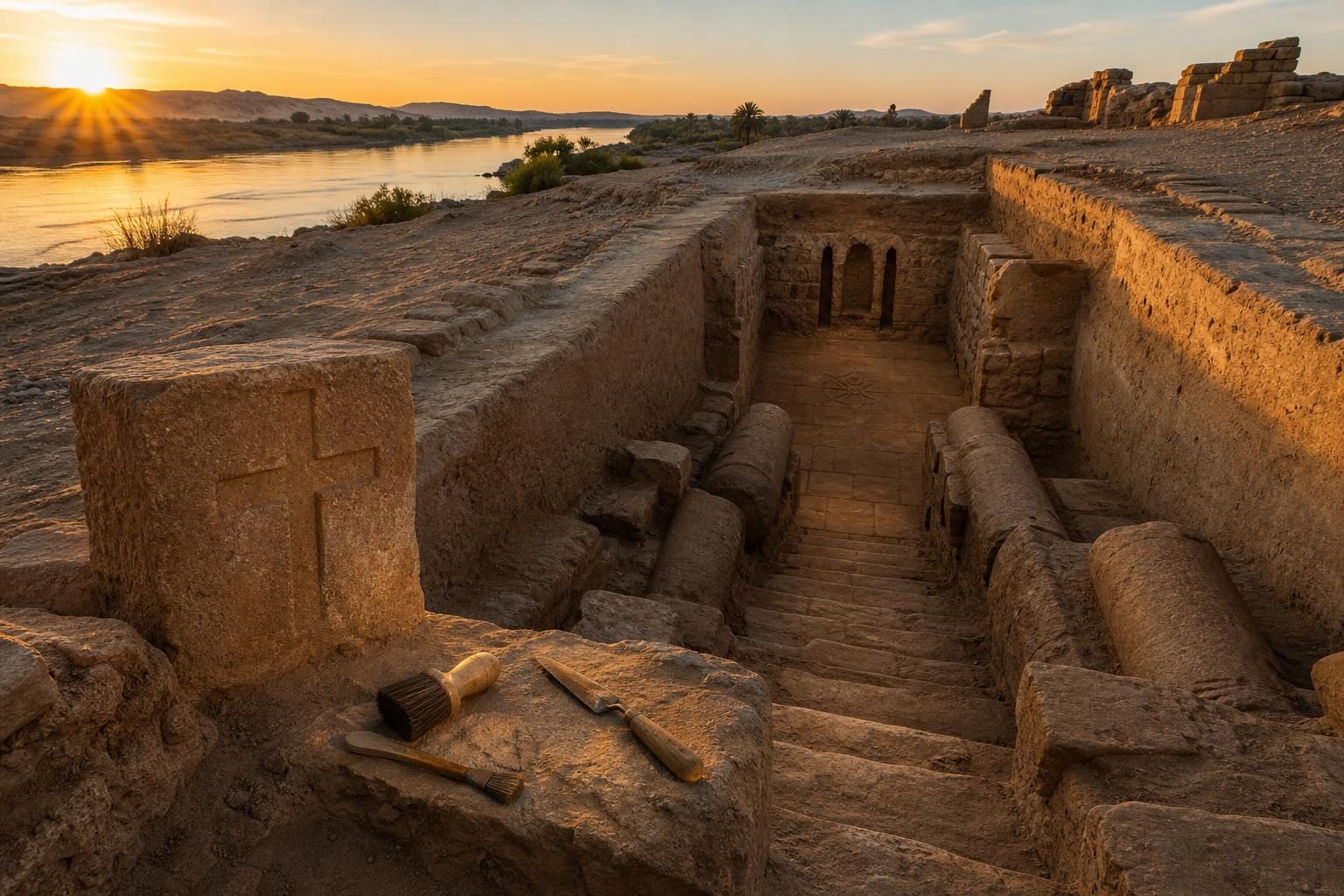
Deep beneath the ruins of an ancient city on the Nile, archaeologists have reached the floor of what was probably the largest church in medieval Nubia, the Christian land that once stretched along the river in what is now northern Sudan. A Polish-Sudanese mission working earlier this month uncovered a staircase framed by walls about 36 feet (11 meters) high, and at its foot found the original floor level of the Great Church of Jesus in Old Dongola, the Associated Press reported [1].
Artur Obłuski, who leads the mission, told the AP the cathedral was "a building larger than the famous White House" and said his team intends to excavate it [1]. Earth.com, reviewing the find, stressed how much remains hidden: so far the diggers have reached the floor at a single staircase [4].
What the Team Found
The excavation is a joint project of the Polish Centre of Mediterranean Archaeology at the University of Warsaw and Sudan's National Corporation for Antiquities and Museums, Archaeology magazine reported [2]. The church was first identified in 2021, but most of it still lies buried beneath the old city, according to the AP [1].
Even with so little exposed, the scale is plain. Archaeologists estimate the church measured about 154 feet (47 meters) wide and 187 feet (57 meters) long [1], and Archaeology magazine reported that the building rose more than six stories high [2]. It was a house of worship built on a scale meant to proclaim the faith to an entire kingdom.
The dig produced a surprise as well. Excavators found a smaller church on the upper floor of a structure that had been added onto the cathedral, ArchaeologyMag reported [3]. The discoveries may force scholars to rethink a church outside the city walls that has long been treated as Dongola's cathedral [2][3]. Because only the stairwell has been taken down to floor level, the layout of the vast interior is still largely a mystery, which is exactly why the team is eager to keep digging [1][4].
A Lost Christian Kingdom on the Nile
For many American believers, the story of Christian Nubia is unfamiliar. It deserves to be better known. The kingdom of Makuria embraced Christianity in the middle of the sixth century, and Old Dongola became its capital [6]. For centuries afterward, the faith shaped public life in this African kingdom, with a bishop seated at Dongola [2][6].
Archaeology magazine reported that the Great Church of Jesus most likely served as the seat of the Bishop of Dongola, one of the most senior Christian figures in medieval sub-Saharan Africa, and that Obłuski compared the building's possible role to that of Hagia Sophia, the great church of Constantinople [2]. The very name the church carries today, the Great Church of Jesus, is a reminder of whom it was built to honor.
That history corrects a common misunderstanding. The Church in Africa did not arrive only with European missionaries in the modern era. Its roots on the continent run back roughly 1,500 years in Nubia alone, to a time when much of northern Europe was still pagan. Christians in Sudan today, who have endured hardship and persecution, stand in a long and honorable line.
Makuria's decline was slow and painful. The kingdom faced repeated invasions beginning in 1265, and a civil war devastated Old Dongola in 1365 [6]. Over the centuries the great church disappeared beneath the rubble and settlement of the city around it, where the Polish-Sudanese team located it five years ago [1].
A Discovery in a Time of War
The find comes as Sudan suffers one of the gravest catastrophes on earth. The Independent reported this week that the country's civil war is causing the largest humanitarian, displacement and hunger crisis in the world, and that the United Nations has warned of genocide [5].
Against that backdrop, the patient work of Sudanese and Polish scholars carries extra weight. Sudan's own antiquities authority is a full partner in the excavation [2], and every season of careful digging helps preserve a heritage that belongs to the Sudanese people and to the wider Christian family alike. Wars destroy archives, museums and monuments. A recovered cathedral floor is a small act of defiance against that loss.
For the faithful, Old Dongola also offers a lesson in perspective. Kingdoms rose and fell around this church, and the city that built it was wrecked by war. Yet the witness of the believers who worshiped there was not erased. It waited under the ground until it could be found again. That is worth remembering as Christians pray for peace in Sudan today.
What comes next is more digging. Obłuski has said the team plans to excavate the building [1], and with only one staircase reaching the original floor so far, the full story of Nubia's great cathedral has barely begun to be told [1][4].
Sources
- [1]Los Angeles Times (AP)A hidden cathedral floor emerges in Sudan, revealing one of the biggest medieval churchesOpens in a new tab ↗
- [2]Archaeology MagazineArchaeologists Uncover Original Floor of Nubia's Largest Medieval CathedralOpens in a new tab ↗
- [3]Opens in a new tab ↗
- [4]Opens in a new tab ↗
- [5]Opens in a new tab ↗
- [6]WikipediaThrone Hall of DongolaOpens in a new tab ↗
Pope Leo XIV drew more than a million people in Argentina. Would you travel to see the pope?
- Absolutely
- Maybe, if he came to the U.S.
- No, but I'd watch on TV
- No
More in Faith & Religion
Attacks on Christians in Europe Jumped 44% Last Year, a Watchdog Finds, as Assaults on French Clergy Quadrupled
Tonight on From the Bench with Margaret Callahan
Lit by Children Fighting Cancer: The Vatican's Christmas Tree Will Honor St. Francis in the 800th Year Since His Death
Today on From the Bench with Margaret Callahan
Pew: Islam on Track to Pass Christianity as the World's Largest Faith by 2035, but the Church Keeps Growing, Led by Africa
Today on Faith & Family with Ethan Calloway
Were you there?
If you were at the scene, or this story touched your life, tell us what you saw and what it was like.
Discussion 0
Sign in or create a free account to join the discussion.
No comments yet. Start the discussion.