
 This morning on Deep Dive with Kevin Nakamura
Ireland's Russian-Owned Refinery Keeps Shipping Alumina to Putin's Smelters as Pressure Builds in Dublin
As European leaders gather in Dublin, a cargo ship has left the Shannon estuary for Russia carrying a raw material an EU envoy says 'undoubtedly' reaches Moscow's war industry. Ireland's government says the evidence isn't there.
Filed November 12, 2026 · 📍 World desk · Washington, DC
Were you there? Share your story
Key points
- The Aughinish refinery in County Limerick, owned by Russia's Rusal, ships alumina to St. Petersburg in a steady stream.
- Alumina is not on any EU sanctions list, and new sanctions require unanimity among all 27 member states.
- Ireland's statistics office said 83% of Irish alumina exports went to Russia in the first quarter; the government disputes the figure.
- The EU's sanctions envoy says some of the material undoubtedly supplies Russia's military industry.
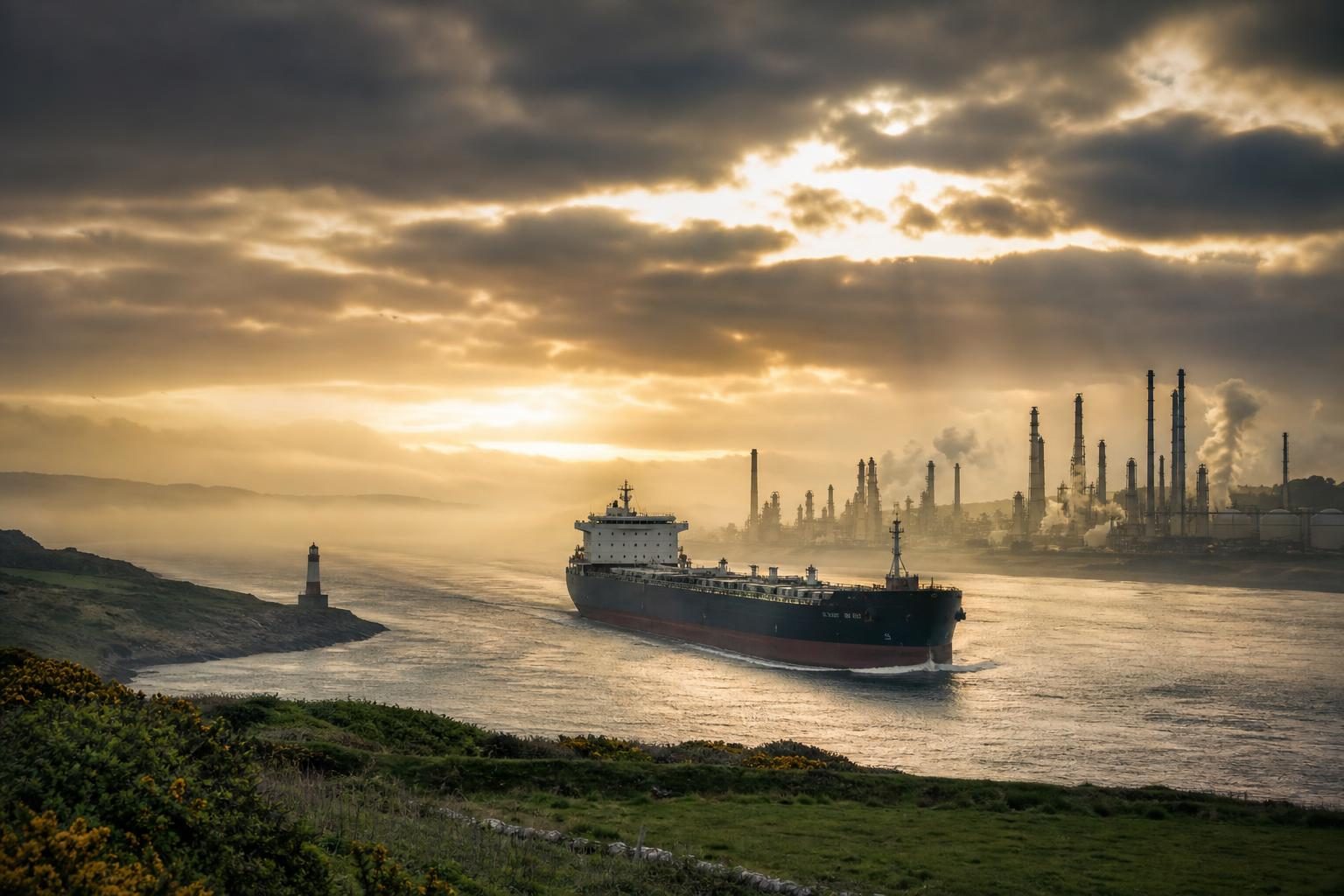
As dozens of European leaders gathered in Dublin this week to talk about security on a continent at war, a 400-foot cargo ship slipped out of the Shannon estuary bound for Russia, its hold full of a white powder called alumina, the Associated Press reported [1].
The ship, the Karin, had been moored near Europe's biggest alumina refinery, Aughinish Alumina in County Limerick, which is owned by the Russian aluminum giant Rusal [1]. According to an AP analysis of ship-tracking data, vessels from the plant travel in a steady stream straight to the port of St. Petersburg [1]. The question Ireland can no longer avoid is what happens to that powder once it arrives.
What Alumina Is and Why It Matters
Alumina is refined from bauxite ore and then smelted into aluminum, the AP explained [1]. Aluminum goes into everything from soda cans to aircraft, and aluminum alloys are used in missiles and drones [1].
Rusal makes virtually all of Russia's aluminum, according to the U.S. and Australian governments, and was founded by and is still partly owned by Oleg Deripaska, a sanctioned oligarch with ties to Vladimir Putin, the AP reported [1]. After Australia and Ukraine stopped exporting alumina to Russia when the war began, Russia's supply fell by about 40%, and Ireland now provides roughly 17% of Rusal's alumina, according to research by the Ukrainian analysis group ESCU cited by the AP [1].
Olena Yurchenko, analytics director at ESCU, told the AP that almost everything Rusal produces is with a high probability ending up in the hands of Russian military enterprises [1]. An investigation by the journalism network OCCRP and The Irish Times this year found that Aughinish alumina is smelted in Russia and the resulting aluminum sold to a Moscow trader that supplies arms and missile makers, the AP and The Irish Times reported [1][2].
The Numbers
Ireland's own statistics office reported that 200,619 tonnes, or 83% of Irish alumina exports, went to Russia in the first three months of 2026, the highest share since the invasion began [4]. The government has disputed that figure; Enterprise Minister Peter Burke called it inaccurate and put the true share closer to 45%, and the company blamed a clerical error [4]. For all of 2025, the statistics office recorded 1,161,310 tonnes of alumina exports, 66.8% of them to Russia, while the company says 45% went to Russia that year [4].
The activist group Alumina 22, which is lobbying for sanctions, estimates that 491,307 metric tons went from Ireland to Russia between March and October [1]. Russia now accounts for about half of Aughinish's business, The Irish Times reported [2].
What Brussels Says
The European Union's own sanctions envoy is not mincing words. David O'Sullivan told The Irish Times that some of the plant's alumina undoubtedly supplies the Russian military, at least in part [3]. He told the AP he had little doubt the material reaches smelters that feed Russia's military-industrial complex, and that in his view the investigative journalists got it right [1].
Yet alumina is not on any EU sanctions list [1]. The 21st sanctions package, adopted in July, left it out, and the European Commission's draft 22nd package, reported in October, does not propose a ban either [1][2]. The Commission considered a quota to phase down the plant's Russian sales, then dropped it, though it has not ruled out action in a later package [2][3]. A Commission spokesperson described the policy as a delicate balance and noted that alumina is a critical raw material [1]. Estonia has formally proposed alumina sanctions at the EU level, and The Irish Times reported that Ireland is not expected to oppose the idea, while France may object and Poland would likely support it [2]. Any new sanctions require the unanimous support of all 27 member states [1].
In July, the European Parliament passed a non-binding call for an alumina export ban, with Irish members split: Fine Gael and Sinn Féin members voted for it while Fianna Fáil abstained [5][1].
What Dublin Says
Ireland's government says it does not want material from an Irish plant to support the Russian war machine, Taoiseach Micheál Martin told the AP [1]. In May, however, he called sanctions on Aughinish self-defeating and said they would hurt the EU more than Russia, according to The Irish Times [4]. Tánaiste Simon Harris has said Ireland cannot cherry-pick sanctions and would not oppose adding alumina to a future EU list [4]. Foreign Affairs and Defence Minister Helen McEntee said Ireland would back any measures the Commission puts forward [3].
Others are more dismissive. Niall Collins, a government minister from County Limerick, told the AP there is absolutely no evidence that the material ends up in military supply chains, and that Ukraine has not produced any [1]. Burke, who is responsible for enforcement, said his department found no evidence of military use but also could not prove otherwise, and called Rusal's claim that the alumina is used only for aluminum exported from Russia impossible to prove [1]. The findings of the government's investigation have not been published [1].
Aughinish says its product has no connection to the Russian military supply chain, that it complies with EU law and that it has hired an independent firm to carry out monthly audits for Irish authorities [1][4].
Jobs on the Shannon
The plant has deep roots in the region. It was built in the 1970s and bought by Rusal in 2007, the AP reported [1]. The government's caution has a lot to do with jobs. The plant employs 475 people directly, about 400 contractors on site and supports roughly 1,000 more jobs in the region, The Irish Times reported [4]. The company has warned it could shut down if exports to Russia are banned [2].
Ireland has been here before. In 2018, the U.S. Treasury sanctioned Deripaska, Rusal and its parent company, which effectively covered the Irish plant. The sanctions were lifted in early 2019 after Deripaska's stake fell below 50%; the Irish government's statement on the decision noted that the plant then employed more than 600 people and produced roughly a third of Europe's alumina [6].
The Opposition and Kyiv
The opposition Labour Party, led by Ivana Bacik, wants the government to temporarily nationalize the refinery, as Ireland did with its banks in 2008, to stop exports to Russia and find other European customers [1]. "The material is clearly ending up in military supplies," Bacik told the AP [1].
Ukraine's President Volodymyr Zelensky, speaking in Dublin in June, said companies in Europe that are owned or controlled by Russia and its sanctioned oligarchs keep supplying the aggressor, the AP reported [1].
Why It Matters
For Americans, this is a story about whether Europe is serious. The United States has poured enormous sums into helping Ukraine defend itself, and Washington is now leading a hard push for a negotiated peace. It is fair to ask why a European Union member is still shipping a key industrial ingredient to the very company that makes Russia's aluminum.
Ireland's leaders are right that jobs matter and that sanctions should rest on evidence. But the evidence from Brussels' own envoy and from investigative reporters points one way, and the government's findings remain under wraps. As the next sanctions package is negotiated in the coming weeks, the simplest step Dublin could take is to publish what it found and let Europe decide [2].
Sources
- [1]Opens in a new tab ↗
- [2]Opens in a new tab ↗
- [3]Opens in a new tab ↗
- [4]The Irish TimesAmount of Irish-made alumina exported to Russia hits highest level since start of Ukraine warOpens in a new tab ↗
- [5]Opens in a new tab ↗
- [6]Government of Ireland, Department of EnterpriseStatement by Tánaiste and Government Ministers on Aughinish AluminaOpens in a new tab ↗
Israel's new parliament is sworn in. Who would you rather see lead Israel?
- Benjamin Netanyahu
- Gadi Eisenkot
- Someone new
- That's for Israelis to decide
More in World News

Leverage Abroad, Honest Books at Home: Why the Trump-Vance Plan Puts Taxpayers First
Today on World Watch with Grace Whitfield

Trump: America Holds the Leverage on Iran, No Deal Needed; Vance Turns to the Fraud Fight
Today on The Briefing Room with Claire Donovan

Ukraine Says Starshield Speed Caps Are Back, Slowing the Drone Interceptors That Guard Its Skies
This morning on Free Speech Frontline with Ryan Mercer
Were you there?
If you were at the scene, or this story touched your life, tell us what you saw and what it was like.
Discussion 0
Sign in or create a free account to join the discussion.
No comments yet. Start the discussion.