
 Tonight on Deep Dive with Kevin Nakamura
Massie's Second Epstein Petition Hits 218, Setting Up a Lame-Duck Showdown Over Withheld Records
A razor-thin coalition of every Democrat and four departing Republicans will force a floor vote on a bill giving victims, state prosecutors and lawmakers the power to sue the attorney general over records still kept from them.
Filed November 11, 2026 · 📍 KY 40601
Were you there? Share your story

Key points
- Rep. John Garamendi was the 218th signer; all 214 Democrats and four outgoing Republicans, including Massie, Mace, Norman and Fitzpatrick, signed.
- The bill text lets state prosecutors, victims and members of Congress sue the attorney general, grants victims their own unredacted records and bars common-law privilege claims.
- The Justice Department released about 3.5 million pages but withheld roughly 2.5 million more, with a federal judge finding a likely violation of the 2025 law.
- Floor action could come as early as Dec. 2 or 3, before Democrats take control of the House on Jan. 3.
For the second time in almost exactly a year, a Kentucky Republican with little left to lose has gone around his own party's leadership on the Epstein files [1][2]. A discharge petition led by Rep. Thomas Massie for the Epstein Files Transparency Act II reached the 218 signatures it needed on Wednesday, ABC News reported, forcing the House to take up a bill aimed at a Justice Department that lawmakers in both parties accuse of falling short under the first transparency law [1][2][5].
The timing gives the moment weight: it comes in the closing weeks of a Republican House majority, eight days after voters handed the chamber to Democrats [6], and one day after Oversight Committee Republicans closed their own Epstein investigation [5].
How the Petition Crossed the Line
Rep. John Garamendi, a California Democrat, was the 218th and deciding signer, with Rep. Adam Smith of Washington signing just before him, according to Roll Call [2]. ABC News reported that the final list included all 214 House Democrats and four Republicans it described as lame ducks: Massie, Reps. Nancy Mace and Ralph Norman of South Carolina, and Rep. Brian Fitzpatrick of Pennsylvania [1]. Roll Call noted that none of the three Republicans who joined Massie will be back next Congress, and that Massie is departing after a challenger backed by President Trump beat him in this year's GOP primary [2].
Rep. Lauren Boebert of Colorado, who supported the first petition last fall, left her name off this one, Roll Call reported [2]. With exactly 218 names, the coalition had no room to spare [1].
What Act II Would Actually Do
ABC News described the measure as giving state attorneys general, victims and members of Congress the power to take the U.S. attorney general to court over withheld or redacted Epstein investigative records [1]. The text of H.R. 9694, introduced July 15 by Massie with Democratic Reps. Ro Khanna and Teresa Leger Fernandez as an amendment to the 2025 law, is broader and more precise than headlines suggest [3].
Under the bill, a state attorney general, district attorney or other authorized state officer, along with any individual victim, could sue the attorney general over an unlawful withholding, redaction, delay, removal or failure to publish covered records [3]. Judges could grant declaratory and injunctive relief, money damages and attorney's fees, and courts would be told to expedite these cases [3].
The attorney general would also have to give victims, on request, complete unredacted records that concern them, including FBI interview reports, while still shielding details about other victims [3]. Roll Call summarized this as letting victims privately review unredacted records that mention them [2]. State and local prosecutors would get unredacted files for their own cases under protective orders guarding victims' personal information, with classified material reviewed in a secure facility under court-approved procedures [3]. Any member of Congress could demand unredacted access in writing, and the department would have seven calendar days to comply [3].
Two less-noticed provisions may carry the most weight. The bill says the attorney general "may not invoke any common law privilege," including deliberative process and work-product privileges, to hold back or black out covered records beyond the original law's exceptions [3]. It would also require a written justification for each individual redaction, and it spells out that existing federal criminal laws on false statements, obstruction and destroying records apply to officials who knowingly hide or falsify covered files [3].
Put plainly, Act II is less an order to dump every page onto the internet than a toolbox for enforcement. Much of the unredacted access it grants would flow to victims, prosecutors and lawmakers rather than the general public, a design meant to protect survivors' identities while taking away the department's ability to sit on the files.
Why Supporters Say a Sequel Is Needed
The original Epstein Files Transparency Act passed the House 427-1 last November, cleared the Senate a few days later and was signed by President Trump, Roll Call reported [2]. It, too, reached the floor through a Massie discharge petition, according to ABC News [1].
The aftermath has satisfied almost no one. The department released roughly 3.5 million pages connected to Epstein but held back another 2.5 million, USA Today reported in July [4]. In a court filing, Todd Blanche, then the acting attorney general, defended the withholding as necessary to protect victims and the government [4]. U.S. District Judge Emmet Sullivan had found in a June 25 order that Blanche likely violated the transparency law, and some records were withheld on grounds the statute does not explicitly allow, such as protecting internal deliberations, USA Today reported [4]. That is exactly the kind of privilege claim Act II would bar [3].
Massie's own estimate is larger. This summer he said the department was still withholding more than 3 million files and "maintaining heavy redactions" on others, Roll Call reported [2]. The counts differ depending on whether critics tally files or pages, but each points to millions of records still out of view [2][4][5].
This week the Oversight Committee's Republican majority issued its 137-page final report. The Hill reported that it offered little new information but blamed law enforcement and federal prosecutors for repeated failures that let Epstein's abuse continue, and stated President Trump was not implicated in his trafficking [5]. The report also urged the Justice Department to interview or re-interview key witnesses and to ensure survivors can obtain their own records [5]. On that last point, Republican investigators and the Massie-Khanna bill are pulling in the same direction.
Where the Parties Stand
As of Wednesday evening, the ABC News and Roll Call reports included no new statement on the petition from the White House or Speaker Mike Johnson's office [1][2]. The administration's position on the records, however, is on file in the Justice Department's court arguments for withholding them [4]. Roll Call noted that the president, who signed last year's law, had signaled openness to declassifying some Epstein documents during his 2024 campaign before later calling the matter a hoax [2].
Rep. James Comer of Kentucky, the committee's departing chairman, used the report to call for legislation letting survivors and others with knowledge of sexual abuse speak freely regardless of nondisclosure agreements, The Hill reported [5].
Democrats are signaling the fight will outlast this Congress. Rep. Robert Garcia, the committee's top Democrat, said the department is illegally holding back more than 2.5 million pages, faulted the GOP probe for holding no public hearings, and declared, "Our work is just getting started," according to The Hill [5].
The Clock and the Calendar
House rules limit leadership's options. Once a petition hits 218, the motion must sit on the calendar for at least seven legislative days; a signer may then call it up, and the speaker has two legislative days to act, ABC News explained [1]. ABC reported that the earliest window for floor action falls after Thanksgiving, possibly Dec. 2 or 3 [1]. Leadership can also move first: last time, Johnson scheduled a vote on the original bill before the waiting period expired, Roll Call reported [2]. The once-uncommon tool has now succeeded eight times in the 119th Congress, according to ABC News [1].
Passing the House is only the first hurdle. The Senate would have to act and the president would have to sign before this Congress ends, or the bill dies and must start over. The 120th Congress is scheduled to take office on Jan. 3, 2027, with Democrats controlling the House and Rep. Hakeem Jeffries likely to become speaker, Al Jazeera reported [6]. Democrats have vowed to keep pressing the Epstein inquiry once they take charge, The Hill reported [5].
Why This Should Matter to Conservatives
This is not simply a partisan skirmish. The principle behind Act II is one conservatives have long claimed: no agency stands above the law, and a statute passed 427-1 and signed by the president means what it says. Republicans' own report concluded the president was not implicated while faulting the government's failures, which undercuts the idea that transparency is a weapon aimed at him [5].
There is also a moral dimension. Scripture repeatedly charges believers to defend the vulnerable and seek justice for the oppressed. The women and girls Epstein abused have waited roughly two decades since the first criminal investigation for a full accounting [5]. A bill that puts their own records in their hands, while guarding their privacy, honors that charge.
Transparency also demands restraint. Appearing in an investigative file is not proof of wrongdoing, and the goal is verified truth, followed by accountability wherever the evidence leads.
The outgoing Republican majority now has a choice: bring the bill up on its own terms in December, or leave the matter to a Democratic majority whose Oversight leader has already promised public hearings [5]. Either way, the files are not going away.
In pictures

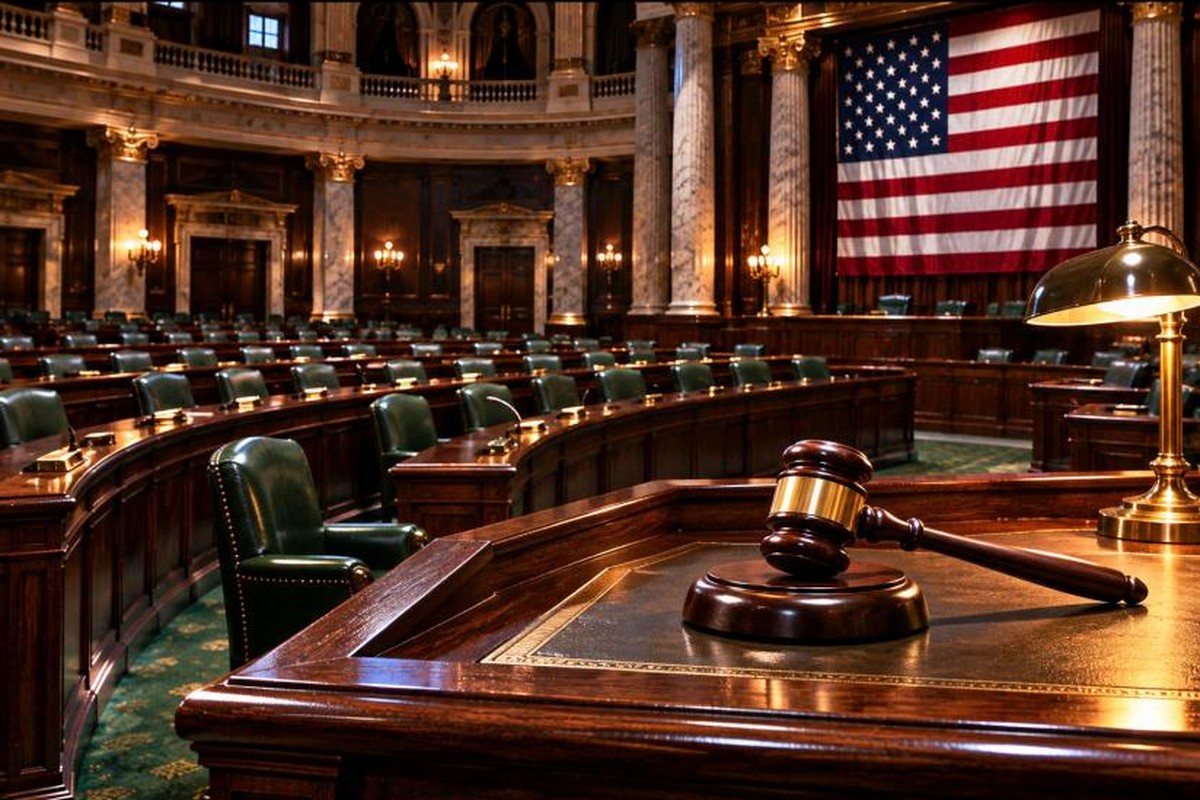

Illustration · Liberty Bell Report
Sources
- [1]Opens in a new tab ↗
- [2]Opens in a new tab ↗
- [3]U.S. Government Publishing OfficeH.R. 9694, Epstein Files Transparency Act II (introduced in House)Opens in a new tab ↗
- [4]USA Today (via The Spokesman-Review)DOJ defends decision to withhold millions of Epstein documentsOpens in a new tab ↗
- [5]The Hill (via Yahoo News)House Oversight Republicans release final Epstein reportOpens in a new tab ↗
- [6]Opens in a new tab ↗
With Democrats taking Congress, what should Republicans focus on first?
- Blocking bad bills
- Working on prices and costs
- Winning back the House in 2028
- Confirming judges before January
More in Politics

Hyde-Smith Concedes Mississippi Senate Race to Scott Colom, Saying She Respects Voters' Decision
Tonight on Campaign Trail with Sophia Reyes

At Arlington, Trump Honors Four Veterans, Defends the Iran War and Says His Arch Will Be Dedicated to the Military
Tonight on The Briefing Room with Claire Donovan

Biden Now Says a Man of 80 With Cancer Shouldn't Run. The Hard Questions Start There.
Tonight on Cross-Examination with Dominic Kane
Were you there?
If you were at the scene, or this story touched your life, tell us what you saw and what it was like.
Discussion 0
Sign in or create a free account to join the discussion.
No comments yet. Start the discussion.