
 This morning on Free Speech Frontline with Ryan Mercer
Ukraine Says Starshield Speed Caps Are Back, Slowing the Drone Interceptors That Guard Its Skies
Zelensky says the military version of Starlink is again being throttled at about 100 mph, weeks after a similar cap was lifted. Who orders the limits remains the unanswered question.
Filed November 12, 2026 · 📍 Washington, DC 20001
Were you there? Share your story
Key points
- Zelensky says Starshield terminals are again capped at about 161 km/h (100 mph), hampering drone interceptors.
- A similar cap imposed in mid-October was lifted by Oct. 24.
- Musk says Starshield is owned and controlled by the U.S. government; Trump denied ordering the October slowdown.
- Ukraine's Starshield agreement with Washington runs to mid-2027.
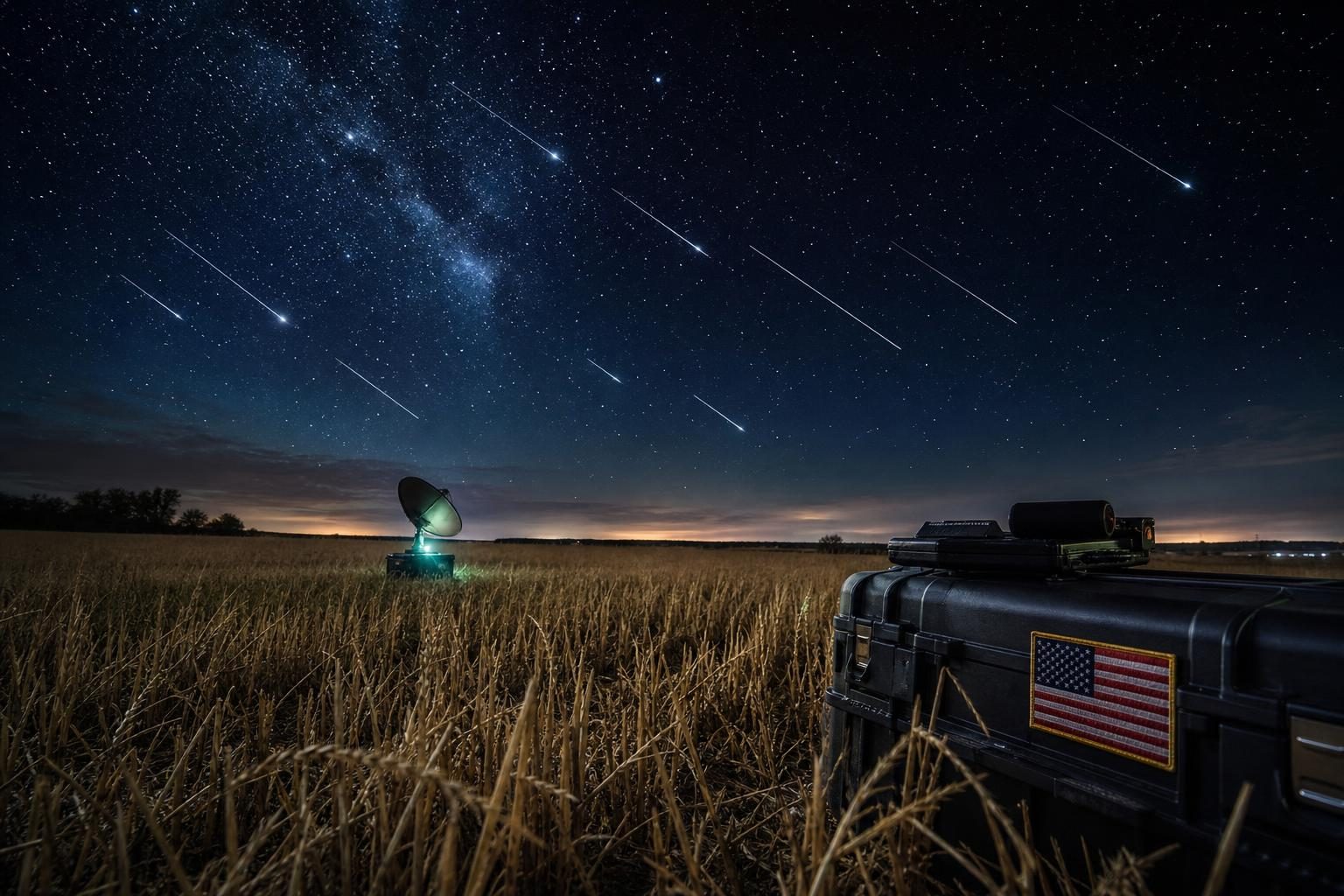
Ukraine says the satellite link its drone hunters depend on has been slowed again. President Volodymyr Zelensky said Thursday that Ukrainian units have recorded significant disruptions to Starshield, the military version of SpaceX's Starlink service, over the past several days, and that the limits are systematic rather than random glitches [1][2].
The restriction caps how fast a terminal can travel and still hold its satellite connection at roughly 161 kilometers an hour, or about 100 miles an hour, according to Euronews and the Kyiv Independent [2][1]. That matters because the interceptor drones Ukraine uses to chase down Russian attack drones need to fly much faster than that. "For us, this primarily means a significant complication in intercepting Russian jet-powered drones," Zelensky said, according to Euronews [2].
What Zelensky Said
Zelensky made the announcement on X after briefings from Defense Minister Yevhenii Khmara and Commander-in-Chief Mykhailo Drapatyi [2][1]. He said some Russian strikes had already gotten through because interception systems could not reach sufficient speeds, and he said the limits are helping Russia kill more Ukrainians and hit its targets more accurately [2][1]. Ukraine is working to establish all the circumstances with the American side, he said [2].
The restrictions affect operations along the whole front line and in occupied territories [2][1]. An unnamed corps-level commander in Donetsk Oblast told the Kyiv Independent that the cap is still in place and makes Ukraine's mid-range strike drones easier for Russia to intercept or dodge [1]. No start date for the new limits has been reported, and SpaceX had not commented [1][2].
How a Speed Cap Grounds a Drone
The restriction does not slow the internet connection itself. It limits how fast a terminal can be moving and still keep its link to the satellites overhead, Euronews explained [2]. In October, Reuters reported that receivers stopped working when mounted on fast-moving objects and worked in motion only up to about 100 mph [4]. When the October cap was lifted, Ukraine's defense ministry said its units again had stable connections at speeds above 400 km/h, roughly 250 mph [2].
That gap is the whole story for an interceptor drone, which has to run down Russian attack drones flying far faster than a car on a highway. Commercial Starlink terminals are limited even further: they reboot after about two minutes above 90 km/h, according to Meduza, and a Ukrainian adviser told the Kyiv Independent that commercial service tops out at 70 to 90 km/h and does not work over Russia [6][1]. That is why the military Starshield package matters so much to Ukraine's air defense.
This Has Happened Before
The new complaint comes less than three weeks after a nearly identical episode. Overnight on Oct. 13 and 14, Ukrainian forces found their Starshield terminals capped at about 160 km/h without any warning, according to Euronews and the Kyiv Independent [3][2]. Serhii Beskrestnov, an adviser to Ukraine's defense ministry, said several missions were disrupted and argued that the timing could not be a coincidence given the political situation, though he offered no evidence [3]. Interceptors, strike drones, logistics and reconnaissance units were all affected, and one drone unit canceled its missions [3].
That October slowdown came during a public dispute between Washington and Kyiv over Ukrainian strikes on Russian oil refineries; Reuters reported that Jared Kushner and Steve Witkoff had pressed Ukraine over those strikes at a meeting in Miami on Oct. 9 [4]. Reuters, citing two U.S. officials and a Western official, reported on Oct. 16 that the order to slow the service came from inside the White House, though the sources did not say who made the decision [4]. Pentagon leaders received the message to slow the service, Reuters reported, while a U.S. official said no such request was ever made by the President [4]. Zelensky told Fox News on Oct. 21 that the services were still restricted and that Secretary of State Marco Rubio had promised to work on unblocking them [5]. The Wall Street Journal later reported that the President asked Musk to lift the restrictions, though Mr. Trump said publicly that he had not spoken to Musk, the Kyiv Independent noted [1]. Ukraine's defense ministry confirmed on Oct. 24 that the limits had been lifted [2].
Who Controls the Switch
The central question, then and now, is who is turning the dial. Elon Musk has said the limits are decided by the U.S. military and ultimately the President, and he has written that Starshield systems are owned and controlled by the U.S. government [3]. Defense Secretary Pete Hegseth said in October that the Pentagon had not pulled anything back and pointed to Starlink's terms of service [5]. President Trump has denied ordering the slowdown, and Rubio has said the administration was not responsible [2]. Neither Washington nor SpaceX has accepted responsibility for the earlier episode [2].
Musk has also raised a fair point about how the terminals are used. On Oct. 24, he accused Kyiv of using commercial terminals for offensive drone strikes and said that loophole had been closed [1]. Ukrainian officials rejected that, saying commercial Starlink is limited to much lower speeds and does not work over Russia [1]. Musk has also stressed how much Ukraine depends on the system: "Were Starlink to be turned off, the Ukrainian front line would collapse immediately," he wrote [1].
The Pentagon is Starshield's largest customer and has spent billions of dollars on Starlink and Starshield services, Reuters reported [4]. Ukraine's Starshield agreement with Washington runs to the middle of 2027, and Ukrainian officials say talks on renewing it need to start soon [2].
Musk's Record in Ukraine Is Not One-Sided
It is easy to cast the story as one man holding a war hostage. The record is more complicated. Starlink has been central to Ukrainian battlefield communications for most of the war [6]. And in February, after reports that Russian troops were using Starlink terminals on the front, SpaceX worked with Ukraine's defense ministry on a mandatory registration system that cut off unregistered terminals, according to Meduza [6]. Russian troops lost access, and Russian assaults stalled in several sectors as a result [6].
That is the part of the story too often left out. An American company built a system that kept a democracy connected under fire, then shut out the invader when it tried to exploit it.
Why It Matters
The new caps come at a delicate moment. They were reported the day after U.S.-mediated talks between Russia and Ukraine in Abu Dhabi ended without a breakthrough [1][2]. Whatever the reason for the slowdown, it tilts the balance in the skies over Ukraine at the very moment Washington is trying to push both sides toward a settlement.
For American taxpayers, there is a straightforward interest at stake: the Pentagon is the largest customer for this service [4], and the public deserves to know who decides when it is throttled and why. If the restriction is a deliberate policy lever, the administration should say so and own it. If it is a technical or contractual matter, SpaceX and the Pentagon should explain it.
Ukraine is not waiting. On Oct. 22, its defense ministry signed a letter of intent with the Finnish firm ICEYE and Nokia to build a sovereign satellite communications system, Euronews reported [2]. That will take years. In the meantime, the speed limit on a satellite dish may decide whether the next Russian drone gets through.
Sources
- [1]Kyiv IndependentStarshield speed restrictions return, hampering efforts to intercept Russian drones, Zelensky saysOpens in a new tab ↗
- [2]EuronewsZelenskyy: Starlink again facing restrictions in Ukraine, hampering Russian drone interceptionsOpens in a new tab ↗
- [3]Kyiv Independent"This cannot be a coincidence" — Ukraine's Starlink access restricted without warning, Zelensky adviser saysOpens in a new tab ↗
- [4]Honolulu Star-Advertiser (Reuters)U.S. officials: White House ordered Starshield limits for UkraineOpens in a new tab ↗
- [5]Opens in a new tab ↗
- [6]Opens in a new tab ↗
Do you trust AI chatbots to give straight answers on politics?
- Yes
- Sometimes
- No, they lean left
- I don't use them
More in Technology
Microsoft Outlook and Teams Go Down for Users Across the U.S.; Microsoft Cites Overloaded Infrastructure
Today on Breaking Now with Nathan Brooks

Jensen Huang Steps Down at Nvidia as the Spy Scandal Ends a 33-Year Run; CFO Colette Kress Takes the Helm
Today on Money Wire with Victoria Chen
Texas' Incoming Democratic Governor Softens Her Tone on Musk as a Florida Republican Rolls Out the Red Carpet for Tesla
This morning on Hollister Tonight with Jack Hollister
Were you there?
If you were at the scene, or this story touched your life, tell us what you saw and what it was like.
Discussion 0
Sign in or create a free account to join the discussion.
No comments yet. Start the discussion.