
 Tonight on Cross-Examination with Dominic Kane
Drones Over Khartoum Hit Homes and a U.N. Building, and Sudan's Army Points at Ethiopia. The Hard Question Is Who Stops the Next Wave
Sunday's predawn strikes on Sudan's capital damaged a United Nations office with staff inside. With accusations flying across the border and drones pouring in from abroad, the war's most dangerous phase may be just beginning.
Filed November 22, 2026 · 📍 World desk · Washington, DC
Were you there? Share your story
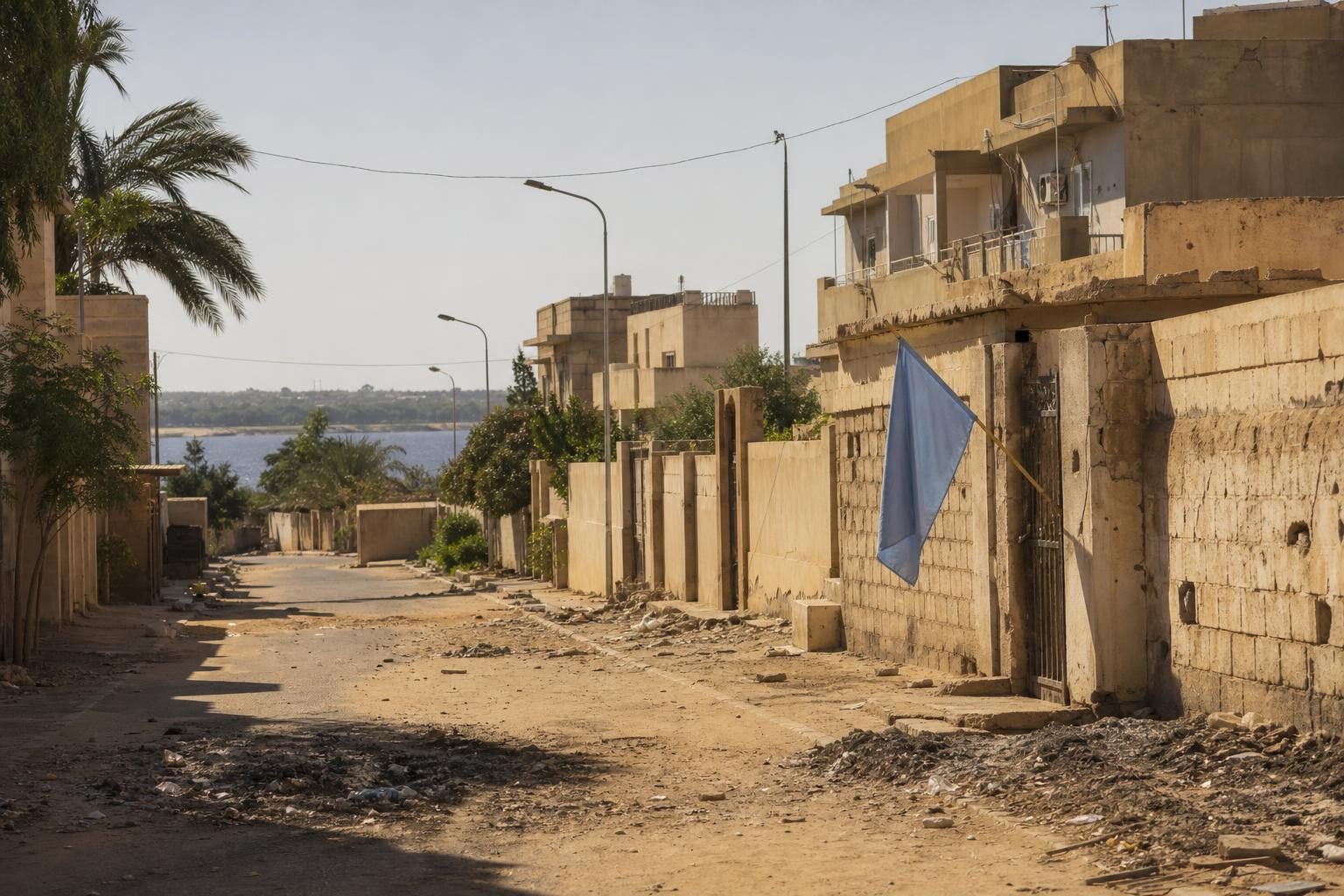
Key points
- Drone strikes before dawn Sunday damaged homes and a United Nations building in a residential area of Khartoum.
- An army source told AFP the drones were launched from Bahir Dar airport in Ethiopia; Ethiopia has denied backing the RSF paramilitary force.
- Local reports said at least four civilians were killed and nine injured, according to ABC News in Australia.
- The U.N. says drone warfare is causing untold suffering, and experts say both sides are being armed with drones from abroad.
Drones struck Sudan's capital before dawn on Sunday, damaging homes and a United Nations building in a residential neighborhood of Khartoum, according to multiple reports [1][2]. The U.N. humanitarian office said one of its premises, with staff inside, was damaged in the civilian area [4]. A witness said one strike destroyed the building completely [1].
Sudan's army quickly pointed across its eastern border. An army source told the French news agency AFP that the drones had been launched from Bahir Dar airport in neighboring Ethiopia, calling the strikes a continuation of Ethiopian aggression against Sudanese territory [1][5]. Sudan's military has accused Ethiopia of backing the Rapid Support Forces, the paramilitary group it has been fighting since April 2023. Ethiopia has denied it [1].
What We Know About the Toll
Early reports said authorities had not yet released casualty figures [1]. Later on Sunday, ABC News in Australia reported that at least four civilians had been killed and at least nine injured, citing local reports, and that the RSF was blamed for the attacks [3].
The U.N. agency whose building was hit said it was unacceptable that humanitarian workers had been exposed to such danger, Deutsche Welle reported [2]. Denise Brown, the U.N.'s top humanitarian official for Sudan, said drone strikes were causing untold suffering across the country [4].
The Hard Questions
The first question is the most basic one: who launched these drones? The army says Ethiopia. Ethiopia denies being party to the war [1]. The RSF has also been blamed [3]. Those accounts cannot all be fully true, and none of the parties has offered public proof.
That matters enormously. If drones are being launched from Ethiopian soil, with or without the government's blessing, Sudan's civil war is no longer contained within Sudan. Two of the largest countries in the Horn of Africa trading strikes, or accusing each other of doing so, is a recipe for a regional war that would make an already historic humanitarian disaster worse.
The second question is where the drones come from in the first place. Experts say both sides in Sudan's war are being supplied with drones by countries in the Middle East and beyond [1]. A war that began as a power struggle between two generals has become a market for foreign weapons, and each new delivery makes it harder to end.
The third question is how to protect the people trying to help. Aid workers are often the only lifeline for millions of displaced Sudanese. When a U.N. office with staff inside can be hit in the capital, the message to every relief group is that nowhere is safe [2][4].
Why It Matters to Americans
Sudan's war can seem remote to American readers, but it is one of the largest humanitarian emergencies on earth, now in its fourth year [1]. Christians in particular have reason to pay attention. Sudan has an ancient Christian heritage, and believers there, like millions of their Muslim neighbors, have suffered terribly as the fighting has spread.
There is also a strategic interest. The Red Sea coast that Sudan shares with its neighbors is one of the world's critical shipping corridors, and a wider war in the Horn of Africa would hand new openings to every power that wants to profit from chaos there. Preventing that is not charity. It is common sense.
What Comes Next
The immediate test is whether anyone can establish, with evidence, where Sunday's drones came from [1][3]. If Sudan's accusation against Ethiopia hardens, the diplomatic temperature in the region will rise sharply. The U.N. and aid groups will press for guarantees that their staff and buildings are protected [2][4].
And the larger question will not go away: as long as outside powers keep supplying the drones, the people of Khartoum will keep waking up to the sound of them. Real pressure on the suppliers, from Washington and its partners, may be the only thing that changes that.
Sources
Israel's new parliament is sworn in. Who would you rather see lead Israel?
- Benjamin Netanyahu
- Gadi Eisenkot
- Someone new
- That's for Israelis to decide
More in World News
Fourteen Hours Under the Rubble: A 7-Year-Old Is Pulled Alive After Russia's Drone Strike on a Kyiv-Area Apartment Block
Tonight on World Watch with Grace Whitfield

Thousands March in Istanbul After Opposition TV Seized
Tonight on World Watch with Grace Whitfield

Funeral Boat Sinks in Nigeria, Killing at Least 24
Tonight on On Scene with Beau Thibodeaux
Were you there?
If you were at the scene, or this story touched your life, tell us what you saw and what it was like.
Discussion 0
Sign in or create a free account to join the discussion.
No comments yet. Start the discussion.