
 Today on World Watch with Grace Whitfield
Colombia's Tough-on-Crime President Touts 51,000 Arrests in 100 Days
Abelardo de la Espriella ended talks with armed groups and took the fight to the cartels. His government's numbers are big; independent monitors say the violence has not eased yet.
Filed November 19, 2026 · 📍 Washington, DC 20001
Were you there? Share your story
Key points
- Colombia's presidency reports 51,254 arrests, more than 389 tons of narcotics seized and 167 extradition orders in 100 days.
- Defense and police figures, counted differently, show about 48,000 arrests and hundreds of drug labs destroyed.
- The ACLED monitoring group says armed-group violence rose 11% compared with Petro's last 100 days.
- De la Espriella says the attacks are the criminals' answer to a government that no longer tolerates impunity.
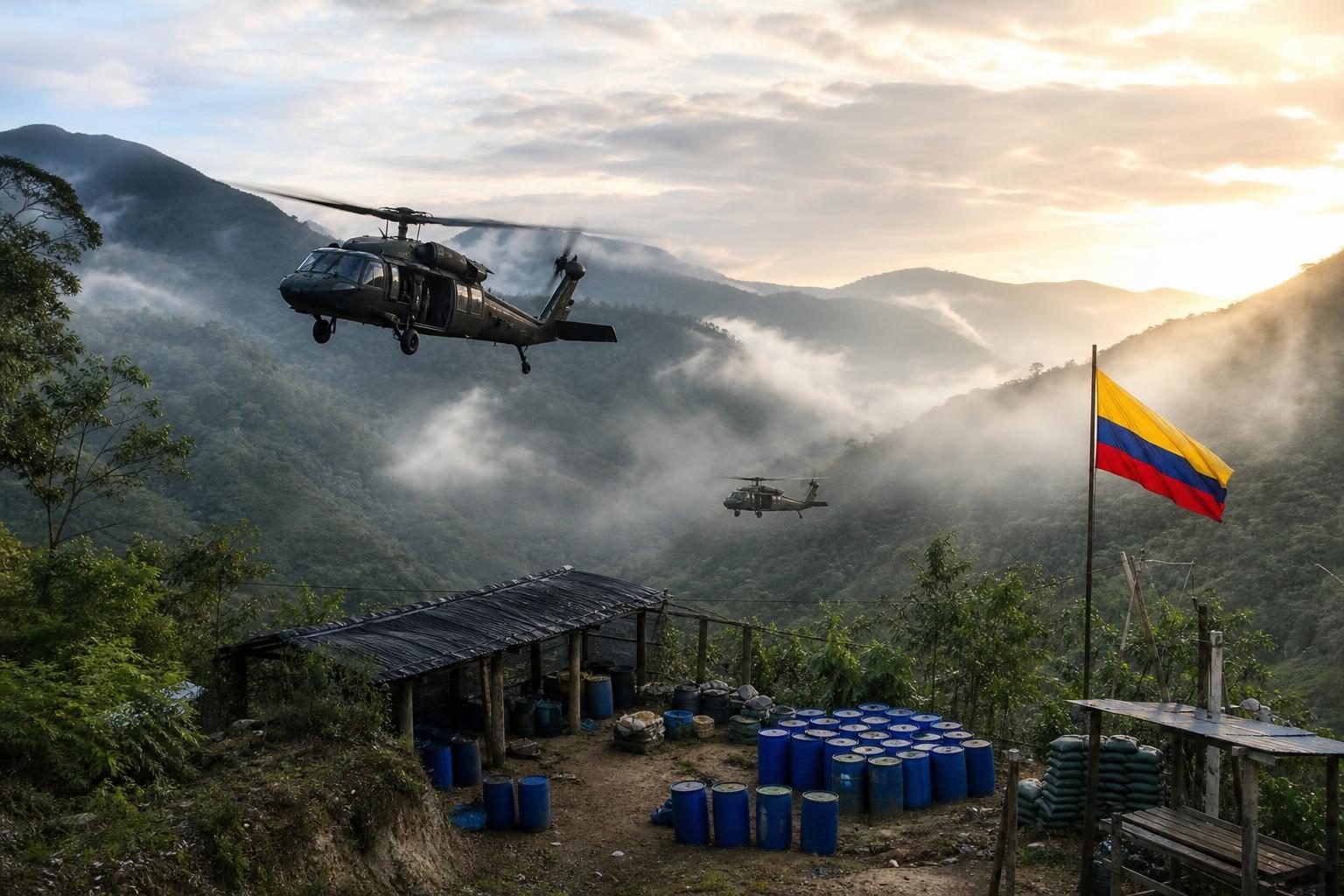
Colombian President Abelardo de la Espriella marked his first 100 days in office with a security report built around one message: the era of negotiating with narco-terrorists is over. His office says security forces made 51,254 arrests, seized 6,336 firearms and more than 389 tons of narcotics, and issued 167 extradition orders, 91 of which have already been carried out [1].
The government's numbers
Separate tallies from the Defense Ministry and the National Police, which count operations differently, point in the same direction. The ministry reported 47,873 arrests, nine bombing raids against armed groups and the destruction of more than 637 drug-processing labs [2]. The police reported about 48,000 arrests and 212 tons of drugs seized, including 131 tons of cocaine, along with 794 labs destroyed, El Heraldo reported [3].
The president used the milestone to draw a sharp line with his predecessor, the leftist Gustavo Petro, accusing Petro's government of acting as a partner to narco-terrorism, and arguing that the recent rise in attacks on his administration is the armed groups' reaction to a government that refuses to tolerate their impunity [6].
The critics' case
Independent monitors say the results on the ground are mixed. The Armed Conflict Location and Event Data project, known as ACLED, found that violence involving armed groups rose 11% compared with the last 100 days of the Petro administration [4]. ACLED noted that De la Espriella campaigned on capturing or killing 10 prominent criminal leaders within 90 days, and that the arrest of a high-profile commander came only just before the 100-day mark [4]. He also ended talks with all armed groups in late August, ACLED reported [4].
Analysts consulted by the Colombian outlet Pulzo concluded that a military offensive and large-scale operations have not yet brought full territorial control or met the government's main security goals [5].
Why it matters to Americans
Colombia is the world's largest cocaine producer and has been one of Washington's closest partners in the Western Hemisphere. Under Petro, the country pursued a so-called total peace policy of negotiating with guerrillas and cartel-linked groups. De la Espriella was elected promising the opposite, and extradition has long been one of the main ways Colombian cartel figures end up facing justice in American courtrooms.
Violence often rises before it falls when a government stops bargaining and starts enforcing the law, as gangs fight back against pressure they have not faced in years. The fair test for De la Espriella is not one 100-day snapshot, but whether the arrests, seizures and extraditions add up to safer towns and fewer drugs reaching American streets in the year ahead. For a country that spent four years trying to talk armed groups into laying down their weapons, the new course deserves time to prove itself.
Sources
- [1]Presidencia de la República de ColombiaMás de 51.000 capturas, 389 toneladas de drogas incautadas y 167 extradiciones: Presidente de la República presentó balance de seguridad de los primeros 100 díasOpens in a new tab ↗
- [2]Opens in a new tab ↗
- [3]Opens in a new tab ↗
- [4]Opens in a new tab ↗
- [5]Opens in a new tab ↗
- [6]Opens in a new tab ↗
Israel's new parliament is sworn in. Who would you rather see lead Israel?
- Benjamin Netanyahu
- Gadi Eisenkot
- Someone new
- That's for Israelis to decide
More in World News
Somalia Gives the UAE's Ambassador 72 Hours to Leave, Accusing Abu Dhabi of Violating Its Sovereignty
Tonight on World Watch with Grace Whitfield
Netanyahu's Office Defends Aide Who Relayed Election-Day Tip
Tonight on World Watch with Grace Whitfield

Tories Tap James Cleverly to Take On Sadiq Khan, Promising Safer Streets and Renewed Pride in London
Today on World Watch with Grace Whitfield
Were you there?
If you were at the scene, or this story touched your life, tell us what you saw and what it was like.
Discussion 0
Sign in or create a free account to join the discussion.
No comments yet. Start the discussion.