
 Today on Free Speech Frontline with Ryan Mercer
America's Chip Alliance Grows Up: A New AI Supply Chain Accord Lands Days Before Trump Meets Xi in Shenzhen
The U.S. and its allies signed a pact to keep the chips, minerals and power behind artificial intelligence out of Beijing's grip, as Europe and the Philippines weigh how far to go with Washington.
Filed November 15, 2026 · 📍 San Francisco, CA 94102
Were you there? Share your story
Key points
- U.S. and allies sign an accord to protect AI supply chains from China, the FT reports
- Pax Silica began with seven signers in December 2025 and has since grown
- EU governments raised concerns about the broader economic security declaration
- APEC leaders meet in Shenzhen Nov. 18-19, where Trump will meet Xi
The United States and its allies signed an accord on Sunday to protect the supply chains behind artificial intelligence from China, the Financial Times reported, and the timing was no accident. The paper noted that the pact comes just ahead of President Trump's meeting with Chinese leader Xi Jinping at the Asia-Pacific Economic Cooperation forum in Shenzhen [1].
Sunday was also the day Washington had circled for a bigger step. Euronews reported last week that the administration wanted members of Pax Silica, its year-old alliance on chips and AI supply chains, to endorse a broader economic security declaration at a ceremony in San Francisco on Sunday, and that some European governments were pushing back on the wording [2].
The details of who signed what will matter, and they will come out in the days ahead. But the direction is already clear. The Trump administration is trying to turn a loose club of technology partners into something closer to an economic alliance, built to make sure that the chips, minerals and power that drive the next generation of computing come from friends rather than from Beijing.
From a Washington Summit to a Growing Network
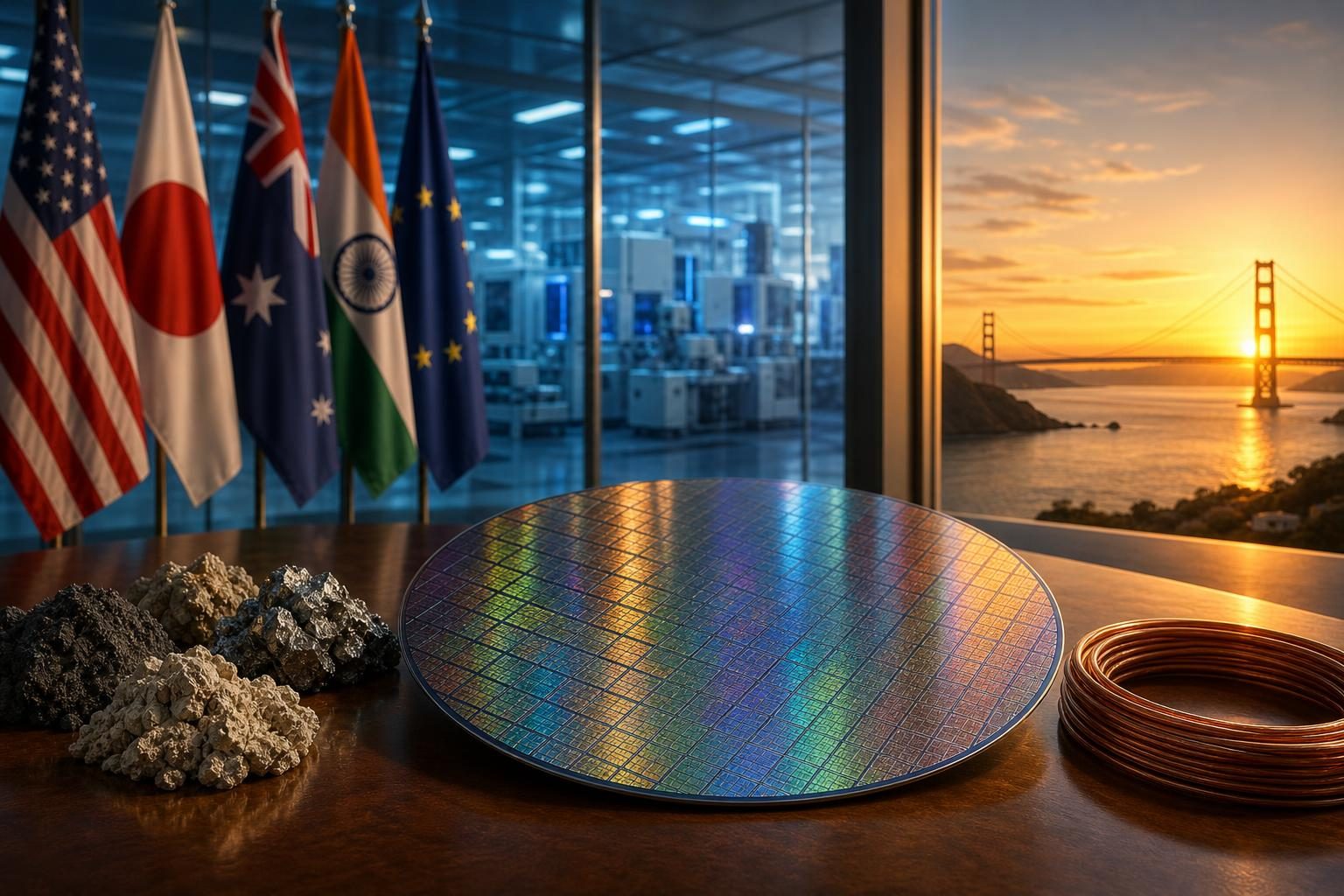
Pax Silica began at a summit in Washington on Dec. 12, 2025. According to the declaration as published by Australia's Department of Industry, the first signers were the United States, Australia, Japan, South Korea, the United Kingdom, Singapore and Israel [3].
The document's starting premise is plain. It says true economic security requires cutting excessive dependencies and building new links with reliable partners and suppliers committed to fair market practices [3]. The signers pledged to work together on investment security, infrastructure and incentives, and listed possible areas of partnership that read like a map of the modern economy: compute and semiconductors, advanced manufacturing, transportation and logistics, the refining and processing of minerals, and energy [3].
The club has grown since. The State Department now describes Pax Silica as its flagship effort on superintelligence and supply chain security, and its official page lists a much wider set of signatories than the original seven, including India, Argentina, Chile, Costa Rica and El Salvador [4].
That growth is the point. No single country, not even the United States, makes every part of an advanced chip or mines every mineral that goes into it. A network of trusted partners can.
Why the Supply Chain Is the Front Line
The fight over artificial intelligence is often described as a race between software companies. In practice, it is just as much a race over physical things: the specialized minerals that have to be refined before they can be used, the factories that turn silicon into chips, the ports and shipping lanes that move them, and the electricity that powers vast data centers.
The declaration's own list of priorities makes that clear, putting mineral refining, logistics and energy alongside chips and computing [3]. A country that controls any one of those choke points can squeeze everyone downstream. The founding premise of Pax Silica, reducing excessive dependencies [3], is a polite way of saying that America and its friends no longer want to be in a position where a rival can cut off a critical input during a crisis.
From a conservative point of view, this is the right instinct. Free trade among free nations has made Americans richer and more secure. Dependence on an authoritarian government for the building blocks of national defense and the modern economy does the opposite. Building supply lines with democracies and reliable partners is not protectionism. It is prudence, the same common sense a family uses when it keeps more than one way to heat the house in winter.
Europe's Reservations
Not every ally is comfortable with how far Washington wants to take this. Euronews reported that EU governments have raised concerns about the planned economic security declaration, citing vague definitions, a clash over the term superintelligence and risks to their own regulatory independence [2].
One sticking point, according to Euronews, is how broadly the text defines sensitive technologies and critical infrastructure. Some EU member states want objective criteria because they fear the current wording would give Washington wide discretion to impose restrictions [2]. Another is vocabulary. The administration has embraced the idea of superintelligence, while the European Commission proposed an explanatory note saying the EU reads the term to mean artificial intelligence as already defined in its own AI Act [2].
Euronews reported that EU governments gave the Commission a mandate on Wednesday to negotiate the declaration's content with the United States, but that the Commission might not receive permission to sign it in time for the San Francisco ceremony [2]. The outlet also reported that the EU joined Pax Silica in June despite reservations from France [2].
Those are real differences, and they deserve a respectful hearing. But they also show why American leadership matters here. Europe's instinct is to regulate first. America's instinct is to build. An alliance that moves at the speed of Brussels committees will lose the race to a rival that does not wait for anyone.
The Philippine Test
The alliance's reach into Southeast Asia is being tested in real time. Rappler reported that the Philippines will not sign its Pax Silica project agreement during the ASEAN Summit now underway in Manila, though officials still hope to finalize it before the end of the year [5]. Trade Undersecretary Ceferino Rodolfo told reporters the government remains hopeful, according to Rappler [5].
The project, a planned technology hub, has drawn opposition from environmental groups, farmers and Indigenous communities worried about displacement and the energy and water it would use, Rappler reported [5]. Those concerns are worth taking seriously. A partnership meant to strengthen free nations should win the trust of the people who live next to its factories, not just the governments that sign its documents. Done right, it can bring good jobs and investment to a close American ally that sits on the front line of Chinese pressure in the South China Sea.
Shenzhen Next
All of this is prologue to the week ahead. China's state broadcaster CGTN has reported that the 33rd APEC Economic Leaders' Meeting will be held in Shenzhen on Nov. 18 and 19 [6]. The Financial Times tied Sunday's accord directly to the President's meeting with Xi there [1].
That sequence is worth noticing. The President is walking into a summit on Chinese soil after first locking arms with partners on the very supply chains Beijing would most like to dominate. That is how negotiation from strength works. The message to Beijing is not hostility. It is that America has options, and friends, and does not have to accept dependence as the price of doing business.
What It Means for Americans
For most families, AI supply chains sound remote. They are not. The same chips run the phones in our pockets, the cars in our driveways, the hospitals that care for our parents and the weapons that protect our sons and daughters in uniform. The minerals and power behind them shape the price of electricity and the security of American jobs.
A faithful steward plans ahead. Scripture commends the wise who see trouble coming and prepare for it, and the founders built a republic meant to stand on its own feet. Pax Silica, and the accord the Financial Times reported on Sunday [1], are attempts to apply that old wisdom to a new technology.
The test now is execution. Allies will have to turn declarations into factories, mines and power plants. Washington will have to keep partners like the EU and the Philippines on board without watering down the goal [2][5]. And when the President sits down with Xi in Shenzhen this week [1][6], the strongest card on the table may be the one America dealt on Sunday: a coalition that does not need Beijing's permission to build the future.
Sources
- [1]Opens in a new tab ↗
- [2]Opens in a new tab ↗
- [3]Australian Department of Industry, Science and ResourcesThe Pax Silica Declaration by countries attending the Pax Silica Summit, 12 December 2025Opens in a new tab ↗
- [4]U.S. Department of StatePax SilicaOpens in a new tab ↗
- [5]Opens in a new tab ↗
- [6]Opens in a new tab ↗
Do you trust AI chatbots to give straight answers on politics?
- Yes
- Sometimes
- No, they lean left
- I don't use them
More in Technology
Megaspeed Breaks Its Silence: Alice Huang Left in August 2025, Company Says, as It Hires Outside Lawyers for a Review
This morning on Free Speech Frontline with Ryan Mercer

Fact Check: What We Know, and What We Don't, About the Spy Claim That Brought Down Jensen Huang
Last night on Trending Tonight with Maya Thompson

Italy Fines Meta €805 Million Over Facebook's Access to Android Users' Photos
Yesterday on Free Speech Frontline with Ryan Mercer
Were you there?
If you were at the scene, or this story touched your life, tell us what you saw and what it was like.
Discussion 0
Sign in or create a free account to join the discussion.
No comments yet. Start the discussion.