
 This morning on Free Speech Frontline with Ryan Mercer
Who Wrote the Report? Arizona Judge Frees a DUI Suspect After a Trooper's Arrest Narrative Carried an AI Disclosure
The judge said he could not tell which facts the trooper wrote and which a drafting tool did, so he could not find probable cause. State police say officers remain responsible for every word.
Filed November 14, 2026 · 📍 Phoenix, AZ 85003
Were you there? Share your story
Key points
- A Maricopa County judge released a DUI suspect after the arrest report disclosed that AI helped draft it
- The judge said he could not weigh whether the facts were written by the trooper or by generative AI
- Arizona DPS says it uses Truleo as a drafting aid and the trooper remains responsible for accuracy
- The Fourth Amendment requires probable cause supported by oath or affirmation
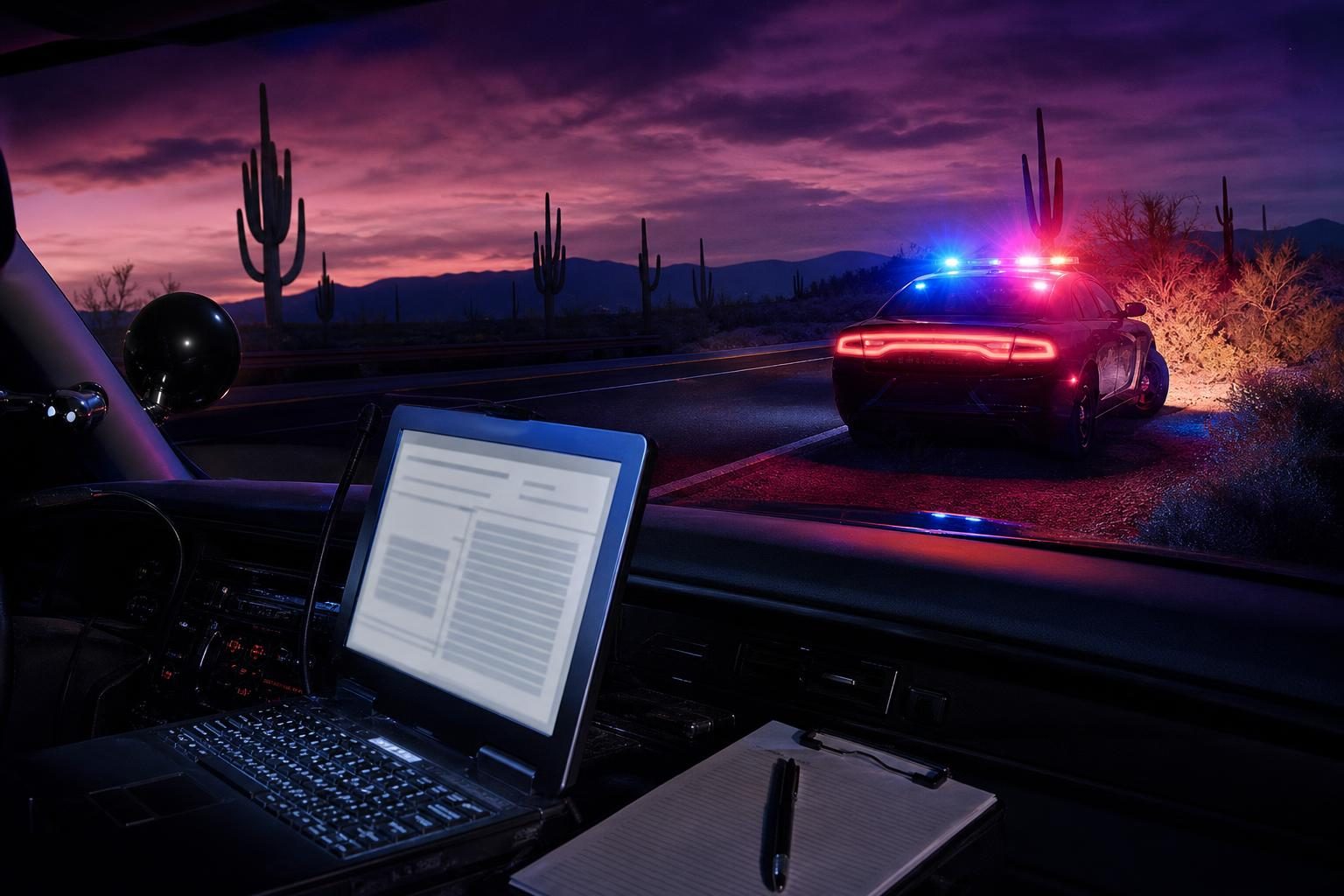
A drunk-driving case in metro Phoenix has run headlong into one of the newest questions in American law enforcement: when software helps write a police report, whose word is the court relying on?
A Maricopa County judge, Daniel Fenzel, ordered a DUI suspect released at his initial court appearance after the report on his Oct. 29 arrest carried a disclosure that artificial intelligence had been used to help prepare it, ABC News reported [1]. The judge wrote that the court could not meaningfully weigh whether the factual allegations had been written, in whole or in part, by generative AI, and so it could not determine whether there was probable cause to hold the man [1]. Fenzel added that his ruling did not mean the case could never go forward [1].
What the State Police Say
The Arizona Department of Public Safety, whose trooper made the arrest, said it uses a product called Truleo to help draft reports, ABC15 in Phoenix reported [2]. A department spokesman said AI tools may be used only as an aid in preparing a report narrative and that the trooper remains the author, responsible for the report's accuracy [2].
Accounts differ on what has happened to the case since. KGUN9 in Tucson reported that the man was later charged and scheduled for arraignment on Nov. 12 [3], while Phoenix station AZFamily described the case as dismissed [4]. As reported, the judge's concern was not that the trooper's observations were wrong but that he could not tell who had authored them [1].
Legal observers noted that nothing in the court rules specifically bars an officer from using AI to help write something like a probable-cause statement, ABC News reported, which is why the ruling raises open questions for police agencies and courts [1].
Why a Human Signature Matters
The judge's concern goes back to the Constitution. The Fourth Amendment says no warrants shall issue except upon probable cause, "supported by Oath or affirmation" [5]. The same principle runs through the way courts decide whether to hold someone after a warrantless arrest: a human officer swears to what he saw, smelled and heard, and stakes his credibility and his career on it. That sworn account is what a judge weighs, and what a defense lawyer can test on cross-examination.
Drafting software does not change who saw the weaving car or administered the field sobriety test. But if a judge cannot tell where the officer's memory ends and the software's phrasing begins, the sworn word that the system depends on starts to blur. A tool that turns an officer's notes and body-camera audio into tidy paragraphs might save hours of paperwork, and officers on short-staffed forces have good reason to want that time back on patrol. The price cannot be a report that no one can confidently call the officer's own.
Getting the Rules Right
This is the kind of problem that calls for clear, simple policy rather than panic. Conservatives have rightly warned against both blind faith in new technology and knee-jerk bans that leave police with yesterday's tools. A sensible approach would require officers to review and personally attest to every factual statement in an AI-assisted report, keep their original notes and recordings, and disclose when a drafting tool was used, so that judges, prosecutors and defendants know exactly what they are reading. Arizona DPS's own policy, which makes the trooper the responsible author, points in that direction [2].
Due process protects the innocent, and it also protects convictions of the guilty from being thrown out later. Drunk drivers endanger every family on the road, and no one should want a valid DUI case lost because of uncertainty about who wrote a report. Getting the rules right now is how agencies keep both promises: safer streets and fair courts.
What Comes Next
Prosecutors can still pursue the case, according to the judge's own order [1]. Police departments that use AI drafting tools, and the courts that review their work, will be watching how other judges respond. Lawmakers and court rule-makers may soon be asked to decide what disclosures and sign-offs an AI-assisted report needs before it can be the basis for holding a citizen in jail.
Sources
- [1]Opens in a new tab ↗
- [2]Opens in a new tab ↗
- [3]Opens in a new tab ↗
- [4]Opens in a new tab ↗
- [5]Constitution Annotated (Congress.gov)Fourth AmendmentOpens in a new tab ↗
Do you trust AI chatbots to give straight answers on politics?
- Yes
- Sometimes
- No, they lean left
- I don't use them
More in Technology
Ontario Appeal Court Clears the Way for Canadian Newsrooms' Copyright Case Against OpenAI
Overnight on Free Speech Frontline with Ryan Mercer

Meta Quietly Tests 'Takes,' a Prediction-Market App Built on Points, Not Dollars
Last night on Code & Coin with Kendall Price
Hackers Stole Uber Drivers' License Data Through an AI Vendor. Here Is What Drivers Should Know
Last night on Free Speech Frontline with Ryan Mercer
Were you there?
If you were at the scene, or this story touched your life, tell us what you saw and what it was like.
Discussion 0
Sign in or create a free account to join the discussion.
No comments yet. Start the discussion.