
 This morning on Hollister Tonight with Jack Hollister
Alaska Keeps Ranked-Choice Voting as a Repeal Fails for the Second Time in Two Years
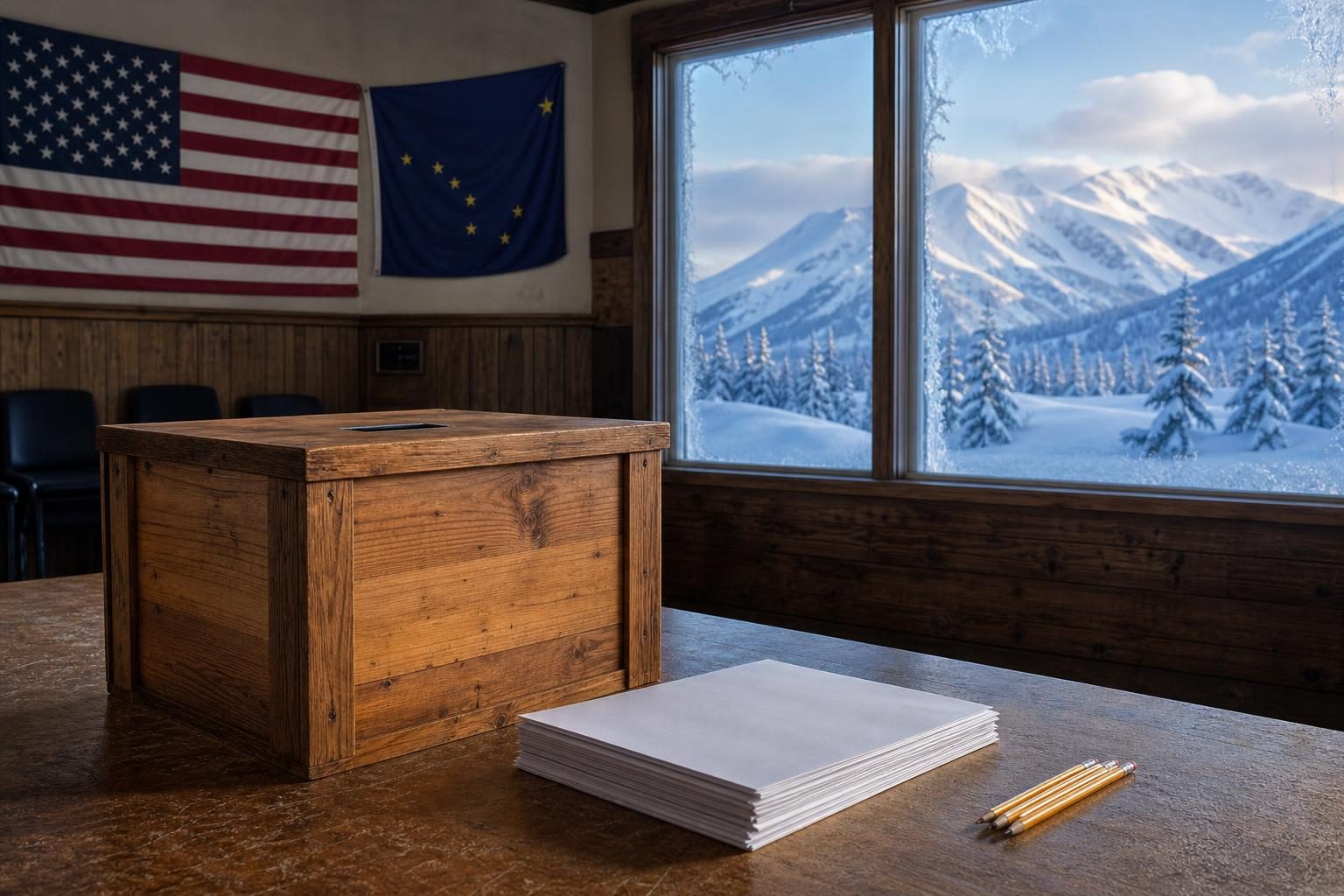
Voters again turned back an effort to restore party primaries and traditional general elections, two years after a repeal lost by just 743 votes. Ranked-choice counting in this year's still-open races is set for Nov. 18.
Filed November 14, 2026 · 📍 Juneau, AK 99801
Were you there? Share your story
Key points
- The AP called Alaska's Ballot Measure 2 overnight: voters rejected repealing ranked-choice voting and top-four primaries
- Decision Desk HQ's count showed about 52.8% against repeal with most ballots counted
- A 2024 repeal failed by 743 votes, the narrowest ballot-measure result in state history
- Democrat Jonathan Kreiss-Tomkins won the governor's race outright, without a ranked-choice runoff
Alaska is keeping its unusual way of electing leaders. Voters have rejected a ballot measure that would have repealed the state's top-four open primaries and ranked-choice general elections, NPR reported Saturday, citing an overnight race call by the Associated Press [1]. It is the second time Alaskans have voted down an effort to undo the system they first approved in 2020, after a 2024 repeal also failed narrowly [1].
NBC News also projected the result [2], and The Hill reported Friday that Decision Desk HQ had projected the repeal would fail [3]. In Decision Desk HQ's latest tally, "no" led with 52.81%, or 128,573 votes, to 47.19%, or 114,883 votes, with about 84% of the expected vote counted [4].
How Alaska's System Works
Alaska adopted open primaries and ranked-choice voting through a 2020 ballot measure [3]. Under the system, every candidate for an office runs on a single primary ballot regardless of party, and the top four finishers advance to November. In the general election, voters may rank those candidates in order of preference. If no one wins a majority of first choices, the last-place candidate is eliminated and those ballots move to each voter's next choice, round by round, until someone crosses 50% [5].
This year's repeal, like the one before it, would have restored party primaries and traditional winner-take-all general elections [5]. The 2024 version came heartbreakingly close for its backers: it failed by 743 votes, 160,230 in favor to 160,973 against, which Ballotpedia describes as the narrowest result for a ballot measure in Alaska's history [5]. Repeal supporters asked for a recount then, and the recount confirmed the outcome [6].
The Races Still Being Counted
The decision lands while several of this year's contests remain open. The Associated Press reported that state election officials have targeted Nov. 18 to run the ranked-choice tabulations, and that the U.S. Senate race between Republican Sen. Dan Sullivan and Democratic former Rep. Mary Peltola had been too early to call as counting continued [7].
The governor's race did not need the extra rounds. Democrat Jonathan Kreiss-Tomkins won with more than 50% of first-choice votes, Newsweek reported, so no ranked-choice runoff was required [8]. CBS News reported that he is the first Democrat elected governor of Alaska since 1998 [9].
What It Means
For conservatives in Alaska, the result is a hard one. Backers of repeal have argued that ranked-choice voting is confusing, slows down results and weakens the parties that voters use to understand what candidates stand for [5]. Critics also point out that a ballot ranking only one or two candidates can drop out of the later rounds of counting entirely, so the eventual winner's majority is a majority of the ballots still in play, not of every ballot cast [5].
But Alaskans have now heard those arguments twice and decided twice to keep the system. That deserves respect. Election rules are supposed to be set by the people, and in Alaska the people have spoken through the ballot-measure process the state constitution provides.
The practical lesson for Republicans is the one this year's governor's race made plain: under any set of rules, a divided field loses and a united one with a clear message wins. Candidates who can earn first-choice votes and second-choice support from voters who agree with them on most things will do well in Alaska's system. Those who cannot will struggle no matter how the ballot is designed.
What Comes Next
The ranked-choice tabulations scheduled for Nov. 18 will settle the races still in doubt [7], and the vote on the repeal measure will be certified along with the rest of the results. Opponents of the system can try again in a future election, and the legislature could propose changes of its own. For now, Alaska keeps its one-of-a-kind system [1], and its voters have made clear they intend to keep it that way.
Sources
- [1]Opens in a new tab ↗
- [2]Opens in a new tab ↗
- [3]Opens in a new tab ↗
- [4]Opens in a new tab ↗
- [5]Opens in a new tab ↗
- [6]Opens in a new tab ↗
- [7]WFSB (AP)Alaskans wait for more votes in US Senate, governor's races. Both could go to ranked tabulationsOpens in a new tab ↗
- [8]Opens in a new tab ↗
- [9]Opens in a new tab ↗
Who should lead the Republican ticket in 2028?
- JD Vance
- A governor from outside Washington
- A fresh face
- Too early to say
More in Elections
No Deadline, No Decision: Vance Takes the Long View on 2028 as Allies Urge Him to Stay in the Fight
This morning on Campaign Trail with Sophia Reyes
A Divided Field and a Clear Verdict: What Alaska's Democratic Governor Win Should Teach Republicans
Overnight on Campaign Trail with Sophia Reyes
Boebert's Seat Is Called, Alaska Counts On, and Three House Races Hang by a Few Hundred Votes
Last night on Campaign Trail with Sophia Reyes
Were you there?
If you were at the scene, or this story touched your life, tell us what you saw and what it was like.
Discussion 0
Sign in or create a free account to join the discussion.
No comments yet. Start the discussion.