
 Today on World Watch with Grace Whitfield
Hoaxes Without End: Europe Struggles for a Common Answer as Bomb Threats Hit Schools, Trains, Flights and Newsrooms
Every threat so far has proven false, but the disruption is real. Italy has changed its rules, Scottish classrooms have emptied, and experts are calling for one Europe-wide standard.
Filed November 15, 2026 · 📍 World desk · Washington, DC
Were you there? Share your story
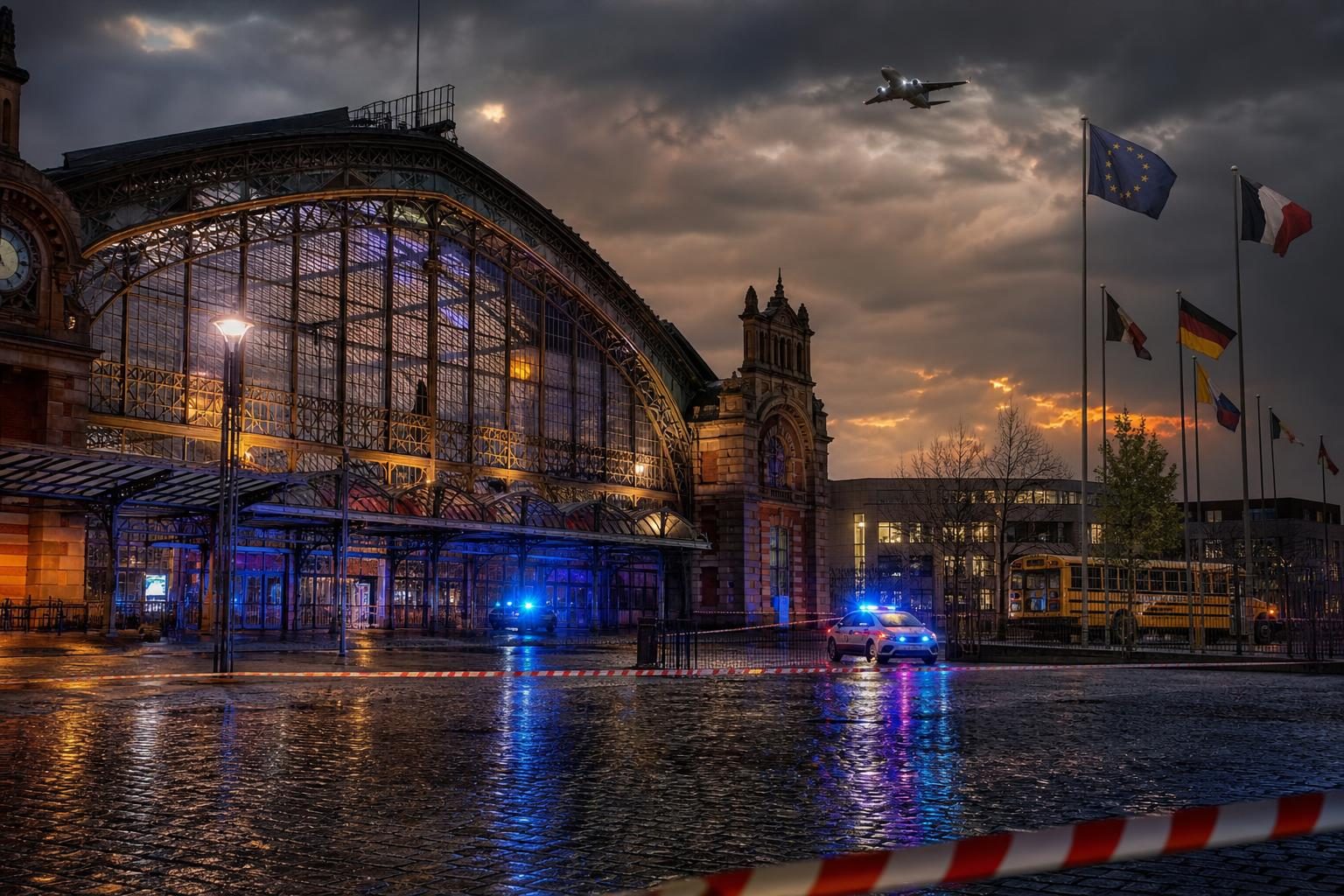
Part of our continuing coverage: Hoax Bomb Threats Hit Hundreds of Schools in Northern Ireland, Scotland, Ireland and Italy
Key points
- Emailed bomb threats have hit European schools, broadcasters, flights and trains; all have proven false
- Macron says there is not yet evidence to blame foreign powers, and Russia denies involvement
- Italy's new guidance says a mass email alone may no longer empty classrooms
- Experts urge a Europe-wide threat-assessment standard as Glasgow reports attendance falling
Europe's wave of bomb threats has now reached schools, railway stations, airliners and newsrooms, and the continent is still searching for a common way to answer it. The threats have arrived mostly by email, and every one so far has proven false, but it remains unclear who is sending them, CNN reported Sunday [1].
French President Emmanuel Macron cautioned on Thursday against jumping to conclusions, saying there was not yet evidence to attribute the threats to foreign powers, according to CNN [1]. Russia has denied any involvement [1]. That caution is sensible. So is the determination across European capitals to find out who is behind the campaign and hold them to account.
Planes, Trains and Broadcasters
The disruption has spread well beyond the classroom. Earlier this month, Ireland's national broadcaster RTE, Britain's Sky and Bulgaria's NOVA TV received security threats, and RTE evacuated its Dublin headquarters and replaced live broadcasts with prerecorded programs, NPR reported [2]. Air travel has been hit, too. Eurocontrol, which manages the European air traffic network, counted threats against 14 flights on a single day, a tiny share of the nearly 26,300 flights in the network that day, according to NPR [2].
Rail passengers have felt it as well. A bomb threat at France's Calais-Fretin station delayed train service between London and Paris, Townhall reported, as Italian schools faced threats for a second straight day [6].
Some authorities have decided not to let an anonymous message shut them down. Heathrow and Birmingham airports stayed open after threats there were judged not credible, CNN reported [1].
Italy Writes New Rules
Italy has been hit hardest, and it has moved first to change its approach. A second round of emailed threats reached more than 3,700 Italian schools, and authorities advised them to keep operating normally unless a specific danger was identified, Brussels Signal reported [4].
Under new government guidance, a mass email by itself may no longer be enough to empty classrooms, Euronews reported, as Prime Minister Giorgia Meloni summoned opposition leaders to discuss the threats [3]. The center-left opposition said it would not hand ministers a "blank cheque," according to the outlet [3]. That debate is healthy. Free countries should give their governments the tools to protect children without handing them powers no one has examined.
The Cost to Families
The damage from a hoax is measured in fear and lost learning, not rubble. In Scotland, Glasgow City Council reported a drop in school attendance after a hoax threat, with attendance as low as 50 percent at some schools, compared with an overall average of 88.7 percent for the 2025-26 school year, The Scotsman reported [5]. Edinburgh and East Dunbartonshire saw similar patterns, and Glasgow said it would keep reassuring families, the paper reported [5]. Experts also warned that the threats could inspire copycats [5].
Every empty desk is a child who missed a day of school because a stranger sent an email. Every evacuated broadcaster or delayed train is a small victory for whoever wants ordinary people to feel unsafe in their own towns.
A Patchwork Defense
Part of Europe's problem is that it is answering one campaign with many playbooks. Because the phenomenon is so new, each country is responding with "its own toolbox and standards," CNN reported [1].
Gregoire Roos of Chatham House, the London think tank, has argued for a Europe-wide threat-assessment standard and more information sharing, so that authorities can compare technical evidence and judge where threats come from and whether they are real, according to CNN [1]. He also suggested that not every alert should trigger a full closure [1].
Why It Matters
There is common sense in that. The purpose of a hoax is to make free people afraid, to empty schools and stations, and to wear down trust in the authorities who keep the peace. A sober, shared standard denies the senders what they want: take every threat seriously, check it quickly, and refuse to let an anonymous email shut down a nation. Parents deserve to know that decisions about their children's schools rest on evidence, not panic.
For Americans, the story is closer to home than it looks. Many American service members and their families live and work across Europe, and Liberty Bell Report has reported on a string of threats facing America's air bases in Britain. A continent that can tell a real danger from a fake one quickly is a safer place for them, too.
The questions now are whether European governments can agree on common rules, and whether investigators can trace the emails back to their source. Liberty Bell Report will keep following both.
Sources
Israel's new parliament is sworn in. Who would you rather see lead Israel?
- Benjamin Netanyahu
- Gadi Eisenkot
- Someone new
- That's for Israelis to decide
More in World News
Estonia Will Seal Its Russian Border on December 1 After Foiling a GRU-Linked Plot Against a Drone Maker
Today on World Watch with Grace Whitfield
Guatemala Declares a State of Emergency Along a Cartel Corridor After a Congressman and Three Police Officers Are Gunned Down
This morning on Street Watch with Elijah Carter
Europe Boards Another Russian 'Shadow Fleet' Tanker, Finds a False Flag and Readies New Sanctions for Monday
This morning on World Watch with Grace Whitfield
Were you there?
If you were at the scene, or this story touched your life, tell us what you saw and what it was like.
Discussion 0
Sign in or create a free account to join the discussion.
No comments yet. Start the discussion.