
 Tonight on Launch Pad with Hannah Lindgren
NASA Opens Bids on Lunar Reactor-1, a Nuclear Power Plant for the Moon by 2030
NASA has opened bidding on a 20-kilowatt fission reactor meant to power a South Pole Moon Base by 2030, as China and Russia pursue a reactor of their own.
Filed November 24, 2026 · 📍 Cleveland, OH 44113
Were you there? Share your story
Key points
- NASA wants industry partners to design, build and test Lunar Reactor-1, a 20-kilowatt fission system ready to launch by 2030.
- Proposals are due Dec. 21; the reactor must run at least five years and meet Energy Department safety standards.
- The effort follows 2022 design studies and a 2025 directive that warned China or Russia could claim keep-out zones.
- Russia and China have discussed installing their own lunar power unit between 2033 and 2035.
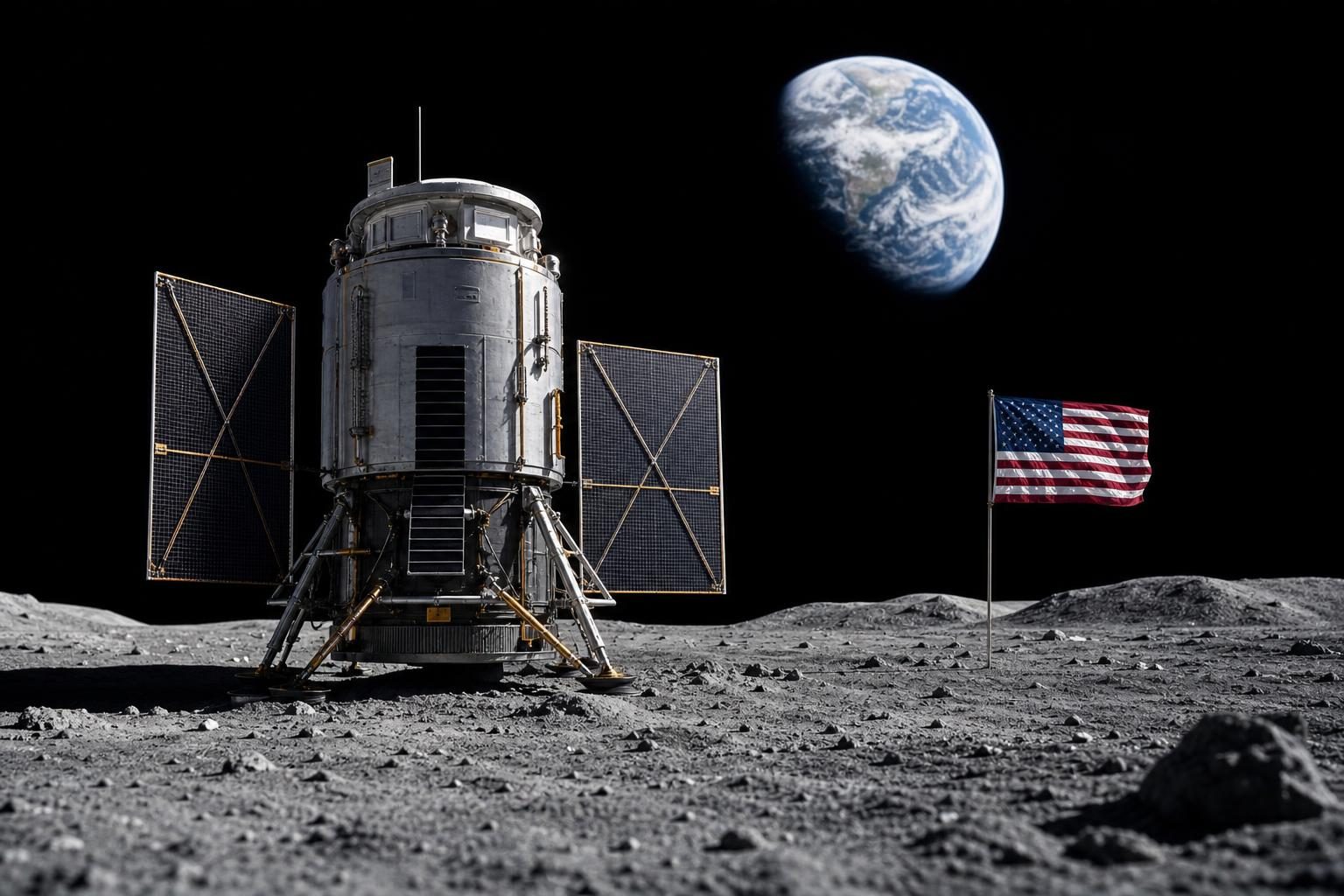
NASA has formally asked American industry to help design, build and test the first nuclear fission reactor meant to run on the surface of the Moon, a project the agency calls Lunar Reactor-1, or LR-1 [1]. The request for proposals, released this week, seeks a compact fission system that produces 20 kilowatts of electricity and is ready to launch by 2030, according to ExecutiveBiz, which covers federal contracting [2].
Newsweek reported that 20 kilowatts is roughly what 16 average American homes use over a year, and that the power is meant for NASA's planned Moon Base near the lunar South Pole [1]. The agency has pointed to uses ranging from living quarters and communications gear to rovers and science instruments [1].
What NASA Is Asking For
The procurement is being run by NASA's Glenn Research Center in Cleveland as a multiple-award, indefinite-delivery contract, ExecutiveBiz reported [2]. It covers the development, testing and flight design of LR-1, and it also lets NASA order work on other space nuclear power projects through additional task orders, though the reactor remains the main focus [2]. Once on the Moon, the reactor is expected to operate for at least five years, and any design must meet Department of Energy standards for nuclear safety [2].
Proposals are due Dec. 21 [2]. The final request follows a draft version released in August and an industry day held in September at the Ohio Aerospace Institute in Cleveland [2]. LR-1 is managed by NASA's Space Reactors Division in partnership with the Energy Department, alongside a separate effort, Space Reactor-1 Freedom, which is slated to launch in 2028 [2].
The case for nuclear power on the Moon comes down to darkness. A single lunar night lasts about two weeks, and a reactor can keep equipment running through that stretch when solar panels cannot, Newsweek noted [1]. A reactor could also operate inside permanently shadowed areas, some of which may hold ice [1]. Newsweek reported that a December 2025 executive order set the goal of a reactor on the lunar surface by 2030 [1].
Years in the Making
LR-1 builds on groundwork NASA laid years ago. In June 2022, the agency announced three contracts, each worth about $5 million and awarded through the Energy Department's Idaho National Laboratory, to develop early designs for a 40-kilowatt-class fission system built to last at least 10 years on the Moon [3]. The teams were led by Lockheed Martin, Westinghouse and IX, a joint venture of Intuitive Machines and X-energy [3].
In 2025, then-acting NASA Administrator Sean Duffy pushed the effort further with a directive calling for a reactor of at least 100 kilowatts to launch by 2030, NPR reported that August [4]. Even a reactor of that size would produce far less power than a typical American nuclear plant, enough for only 70 to 80 homes, scientists said, according to NPR [4].
The new 20-kilowatt target is smaller than both the 2022 design studies [3] and the 2025 directive [4], and the reports on the solicitation did not explain why NASA settled on a smaller first unit [1][2].
The Race for the Lunar South Pole
The urgency is not only about engineering. Duffy's directive warned that if China or Russia got to the Moon first with a reactor, either nation could declare a keep-out zone that would significantly hamper American activity there, according to NPR [4].
Those two rivals have plans of their own. In March 2024, the head of Russia's space agency Roscosmos, Yury Borisov, said Russia and China were seriously considering delivering and installing a nuclear power unit on the Moon sometime between 2033 and 2035, Space.com reported [5]. He said the job would likely be done autonomously, "without humans," and claimed the key technologies were almost ready [5]. The reactor would power the International Lunar Research Station that the two countries are developing together [5].
America's crewed schedule is moving as well. At an Oct. 23 briefing, NASA laid out a plan for Artemis III to carry four astronauts on a roughly two-week mission in Earth orbit in 2027 to practice docking with lander test vehicles from SpaceX and Blue Origin, followed by a Moon landing on Artemis IV in 2028 [6]. NASA has said that plan builds on the Artemis II flight around the Moon in April [6].
Industry bids are due Dec. 21, and NASA's goal is a flight-ready reactor by 2030 that can run for at least five years on the surface [2]. If the schedules hold, American astronauts would be back on the Moon in 2028 [6], and a reactor would be ready to follow by 2030 to keep a South Pole base running through the long lunar night [1][2].
For the nation that led the world into both the atomic age and the space age, LR-1 is a chance to bring the two together. It is also a chance to make sure the first lasting outposts on the Moon, and the norms that come with them, are set by a free country rather than by Beijing or Moscow.
Sources
Do you trust scientific experts more or less than five years ago?
- More
- Less
- About the same
More in Science & Space
Voyager 1 Goes Quiet on Science Data After Milestone
Today on Launch Pad with Hannah Lindgren
Astronomers Find the Most Distant Quasar Ever Seen
Overnight on Launch Pad with Hannah Lindgren
Kilauea Blasts 650-Foot Lava Fountains in 57th Eruption
Overnight on Launch Pad with Hannah Lindgren
Were you there?
If you were at the scene, or this story touched your life, tell us what you saw and what it was like.
Discussion 0
Sign in or create a free account to join the discussion.
No comments yet. Start the discussion.