
 Overnight on Launch Pad with Hannah Lindgren
Astronomers Find the Most Distant Quasar Ever Seen
Light from the blazing black hole left it just 630 million years after the universe began, beating the old record by about 40 million years.
Filed November 24, 2026 · 📍 Phoenix, AZ 85003
Were you there? Share your story
Key points
- The quasar J1504+6252 dates to about 630 million years after the Big Bang.
- Spotted by Europe's Euclid telescope and confirmed by Webb at a record redshift of 8.13.
- Its black hole of several hundred million suns tightens limits on how the first giant black holes formed.
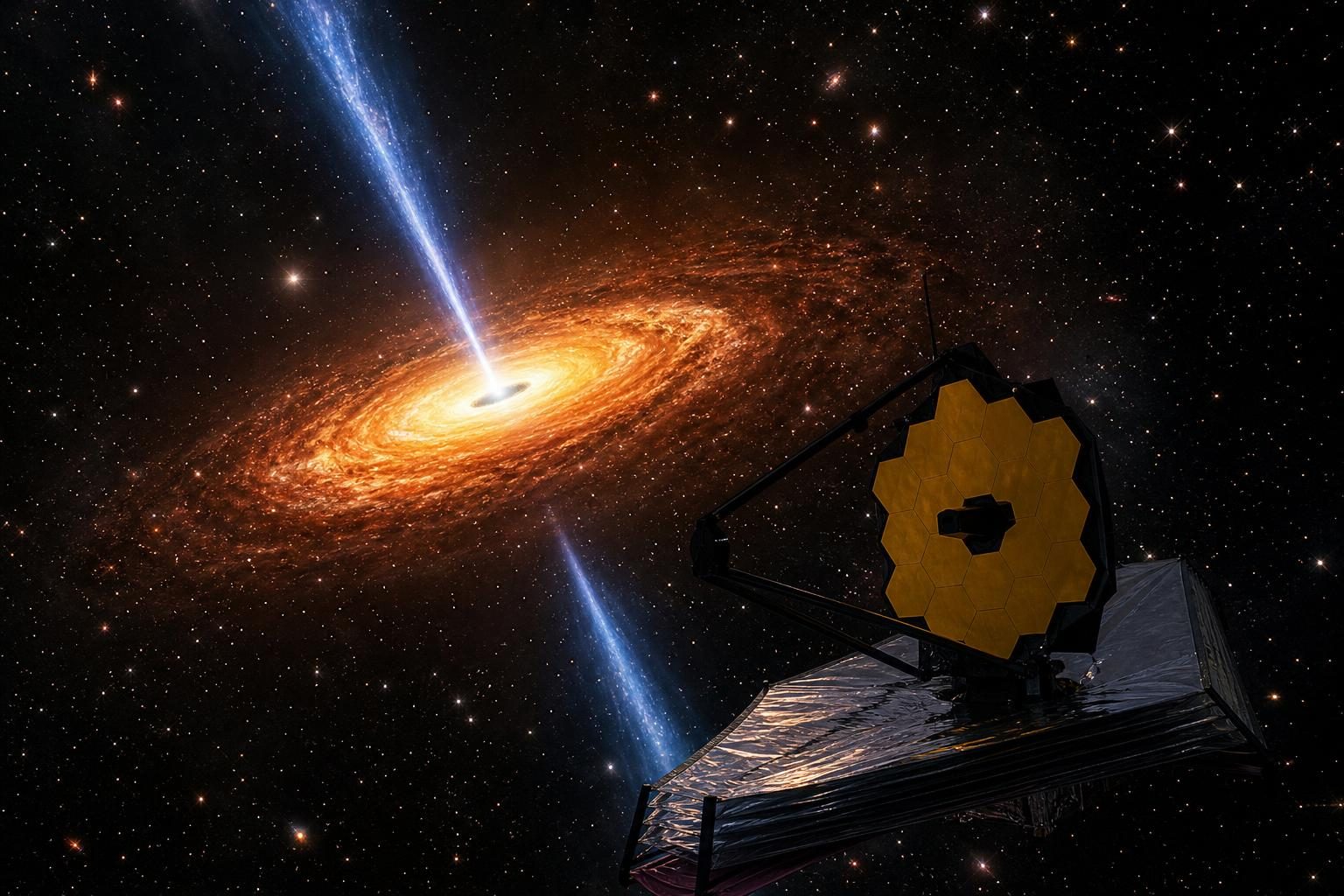
Astronomers have found the most distant quasar ever recorded, a blazing beacon powered by a giant black hole that was already shining when the universe was only about 630 million years old, the Associated Press reported [1].
The object, catalogued as J1504+6252 and nicknamed "Dún Aonghasa" by its discoverers, was found by a team led by Julien Wolf, a postdoctoral researcher at the Max Planck Institute for Astronomy in Heidelberg, Germany, Phys.org reported [2]. It pushes the quasar record back by roughly 40 million years [2].
How They Found It
The quasar first turned up in the Euclid Wide Survey, the sky map being built by the European Space Agency's Euclid space telescope [2]. The team then followed up with the Large Binocular Telescope in Arizona and, finally, the James Webb Space Telescope, which measured a redshift of 8.13 [2].
Redshift is how astronomers clock cosmic distance: the farther away an object is, the more the expansion of space stretches its light toward the red end of the spectrum. A redshift of 8.13 corresponds to a time about 630 million years after the Big Bang, making this the first quasar ever confirmed beyond a redshift of 8, according to the team [2].
The nickname honors Dún Aonghasa, the ancient stone fort perched on a cliff edge on Ireland's Aran Islands.
Why It Matters
A quasar is the brilliant core of a young galaxy, lit up by gas spiraling into a supermassive black hole. This one hosts a black hole of several hundred million times the mass of our sun, Phys.org reported [2].
That is the puzzle. Black holes are thought to grow by swallowing gas over long stretches of time, and 630 million years is a short window to build something so massive. The researchers say the new record tightens the limits on how the first giant black holes could have formed [2]. It sharpens a question astronomers have debated for years: did the earliest monsters start out unusually large, or did they grow unusually fast?
The find also shows what the newest generation of telescopes can do together. A wide survey camera spots a faint candidate, a large ground telescope narrows it down, and Webb's infrared eye confirms it. Euclid's survey of the sky is still under way, and further finds could show whether this quasar is a rare outlier or one of many from the universe's first chapter.
Our Take
There is something humbling about light that has been traveling toward us for more than 13 billion years, and something admirable about the scientists patient enough to catch it. Every discovery like this one deepens the wonder of a cosmos that is ordered, knowable and vast beyond imagining. "The heavens declare the glory of God," the psalmist wrote. Nights like this give that ancient line fresh meaning.
Sources
Do you trust scientific experts more or less than five years ago?
- More
- Less
- About the same
More in Science & Space
Kilauea Blasts 650-Foot Lava Fountains in 57th Eruption
Overnight on Launch Pad with Hannah Lindgren
China Set to Fly Pakistan's First Astronaut to Its Station
Overnight on Launch Pad with Hannah Lindgren

Countdown Halted in French Guiana: Ariane 6 Stands Down With 36 Amazon Leo Satellites After a Ground-System Glitch
Yesterday on Launch Pad with Hannah Lindgren
Were you there?
If you were at the scene, or this story touched your life, tell us what you saw and what it was like.
Discussion 0
Sign in or create a free account to join the discussion.
No comments yet. Start the discussion.