
 This morning on Launch Pad with Hannah Lindgren
Countdown Halted in French Guiana: Ariane 6 Stands Down With 36 Amazon Leo Satellites After a Ground-System Glitch
Arianespace says the rocket and its payload are safe and the next try comes no earlier than Tuesday, a week after a U.S. rocket failure cost Amazon 40 satellites.
Filed November 23, 2026 · 📍 Washington, DC 20001
Were you there? Share your story
Part of our continuing coverage: Amazon Tries Again: Ariane 6 Set to Launch 36 Leo Satellites, Eight Days After Vulcan Lost 40
Key points
- Arianespace stopped Monday's Ariane 6 countdown after a technical problem with ground support systems.
- The rocket and all 36 Amazon Leo satellites remain in stable and safe condition, the company said.
- The next launch opportunity is no earlier than Tuesday, Nov. 24.
- A success would bring the number of Amazon satellites launched by Arianespace to 136.
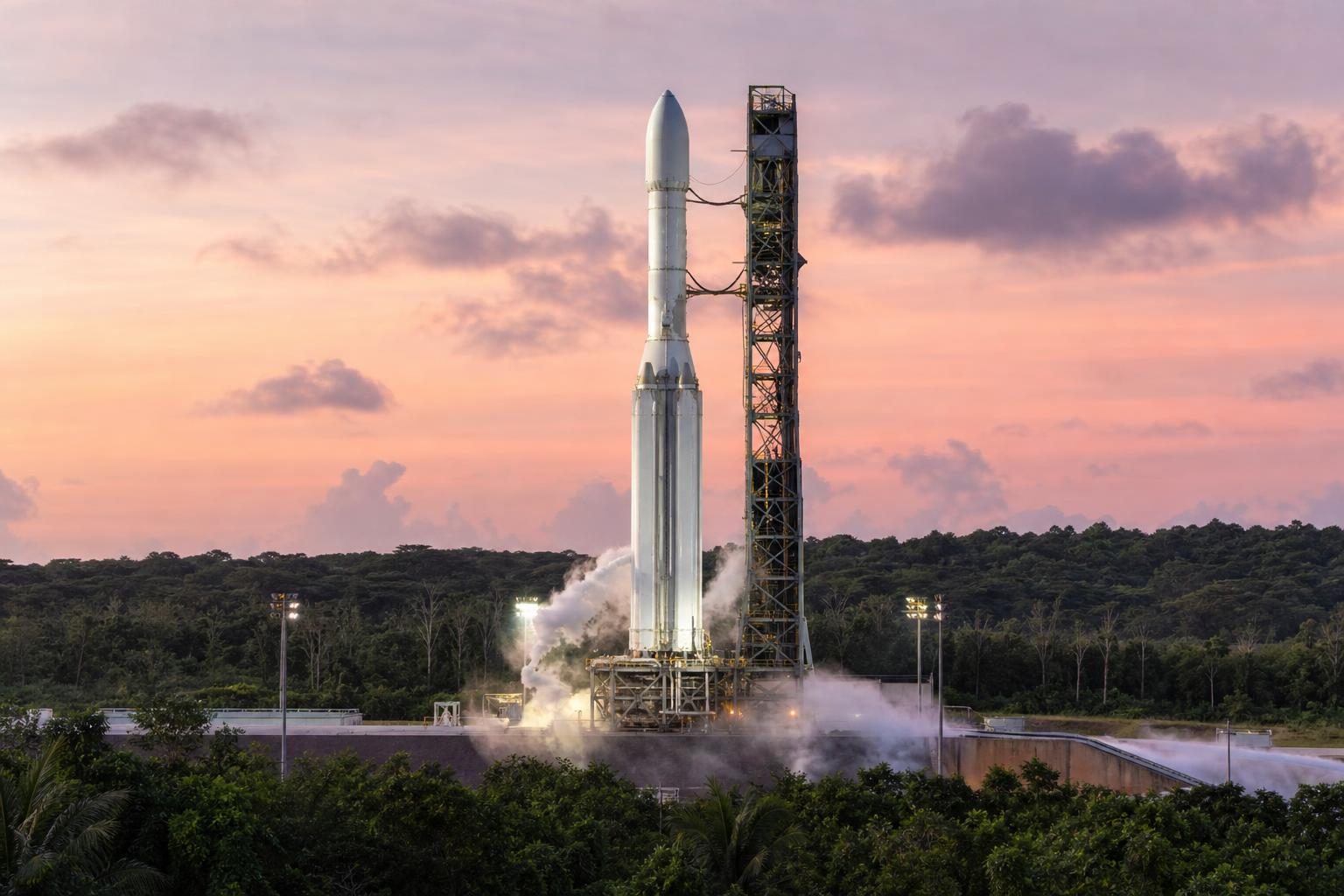
Europe's most powerful rocket stayed on the ground Monday. Arianespace halted the countdown for its Ariane 6 launch of 36 Amazon Leo broadband satellites after what it described as a technical event affecting ground support systems at the Guiana Space Centre in Kourou, French Guiana [1].
The company said the rocket and all 36 satellites remain in stable and safe condition, and that the next launch opportunity is no earlier than Tuesday, Nov. 24 [1]. The flight, designated VA271 and known to Amazon as mission LE-04, had been targeted for liftoff at 10:12 a.m. Universal Time, or 5:12 a.m. Eastern, on Monday [2].
The mission
The flight is the tenth for Ariane 6 and the fourth in its heavier Ariane 64 configuration, which uses four strap-on solid rocket boosters [3]. It is also the second to fly with the upgraded P160C boosters, which debuted on a successful Amazon launch in June [3][4].
The rocket is designed to carry the 36 satellites, weighing about 19,200 kilograms in all, and release them at an initial altitude of about 465 kilometers, or roughly 290 miles [1]. The full sequence from liftoff to the separation of the last satellites takes just over two hours [1]. If successful, the mission would bring the total number of satellites Arianespace has launched for Amazon to 136 [1].
A tense stretch for Amazon
The delay comes eight days after a painful setback. On Nov. 15, United Launch Alliance's Vulcan rocket failed about 10 minutes into its comeback flight, taking 40 Amazon Leo satellites with it, as this site reported at the time. Amazon is racing to build out its low-Earth-orbit internet network to compete with SpaceX's Starlink, which already serves millions of customers worldwide, and every lost or delayed launch slows that effort.
Amazon's network is planned to include more than 3,000 satellites in low Earth orbit, a scale that requires dozens of launches over the next several years. Amazon has spread its launches across several providers, including Arianespace, United Launch Alliance, Blue Origin and SpaceX, precisely to reduce the risk of any single failure. Arianespace's contract with Amazon has grown over time, and the European company's reliability will matter more after the Vulcan loss.
Why a scrub is good news, in its way
A countdown halt is frustrating, but it is how safe spaceflight is supposed to work. Launch teams set strict limits on everything from ground equipment to weather, and they stop the clock the moment something falls outside those limits. A rocket that waits a day is far better than a rocket that flies with a problem. Arianespace's statement that the vehicle and satellites are safe suggests the issue lay with the launch site's systems rather than with the rocket itself [1].
For Europe, Ariane 6 represents a costly effort to keep independent access to space after the retirement of the Ariane 5. Each successful flight strengthens that case; each delay invites questions about how quickly the system can reach the steady launch rate its customers need.
What comes next
Arianespace said it will confirm the new launch time after its teams complete their checks [1]. The European Space Agency carries the launches live on its website [5]. A successful flight on Tuesday would put the mission back on track before the Thanksgiving holiday in the United States, and give Amazon a much-needed win.
Sources
- [1]Opens in a new tab ↗
- [2]Opens in a new tab ↗
- [3]Opens in a new tab ↗
- [4]CNES Guiana Space CentreAriane 6 successfully launches 36 additional Amazon Leo satellitesOpens in a new tab ↗
- [5]European Space AgencyWatch live: Ariane 6 launches another set of Amazon Leo satellites to orbitOpens in a new tab ↗
Do you trust scientific experts more or less than five years ago?
- More
- Less
- About the same
More in Science & Space
Amazon Tries Again: Ariane 6 Set to Launch 36 Leo Satellites, Eight Days After Vulcan Lost 40
Overnight on Launch Pad with Hannah Lindgren

A Mosquito That Fights Back: Brazil Trial Finds Bacteria-Carrying Insects Cut Dengue and Chikungunya Infections by About 69%
Last night on Launch Pad with Hannah Lindgren

Look North Tonight: NOAA Gives Nine States a Chance at the Northern Lights Into Monday Morning
Last night on Launch Pad with Hannah Lindgren
Were you there?
If you were at the scene, or this story touched your life, tell us what you saw and what it was like.
Discussion 0
Sign in or create a free account to join the discussion.
No comments yet. Start the discussion.