
 Today on First Principles with Benjamin Stone
Thanksgiving Began With a Treaty and a Prayer. Boston's Council Should Remember Both
Boston's City Council has again recast Thanksgiving as a Day of Mourning, but the 1621 treaty, the shared harvest and Washington's call to give thanks tell a fuller story.
Filed November 24, 2026 · 📍 Boston, MA 02108
Were you there? Share your story
Key points
- Boston's City Council adopted a resolution marking Thanksgiving as a Day of Mourning, Fox News reported; it passed a similar measure in 2024.
- The 1621 harvest followed a March 1621 peace treaty with Massasoit that he kept for roughly 40 years.
- Washington, at the First Congress's request, proclaimed Nov. 26, 1789, a day of 'sincere and humble thanks' to God.
- Plymouth says it supports the mourners' gathering while keeping its own celebration; a court fight over the 1998 agreement continues.
The Boston City Council has adopted a resolution marking Thanksgiving as a Day of Mourning in honor of Indigenous peoples, Fox News reported Tuesday, while in Plymouth, officials and activists are fighting in court over how the holiday is observed on the town's own historic ground [1]. In 2024 the council adopted a similar resolution for that year's Thanksgiving, presented by Council President Ruthzee Louijeune, according to the city's website [2].
The city's own account explains the purpose. The observance traces to 1970, when Wamsutta Frank James of the Wampanoag Tribe of Gay Head (Aquinnah) founded it, and it is meant to confront what the city describes as the English colonists' invasion of Wampanoag homelands and the violence that followed [2].
Those who gather on Thanksgiving to grieve have every right to do it, and the suffering of New England's native peoples in the decades after 1620 is real history that deserves to be taught honestly. But there is a difference between a private group's day of remembrance and a city government putting its name behind a recasting of the national holiday. When a council speaks for a whole city, it owes the people the whole story. And the whole story of Thanksgiving is not a story of mourning.
A Treaty Came Before the Feast
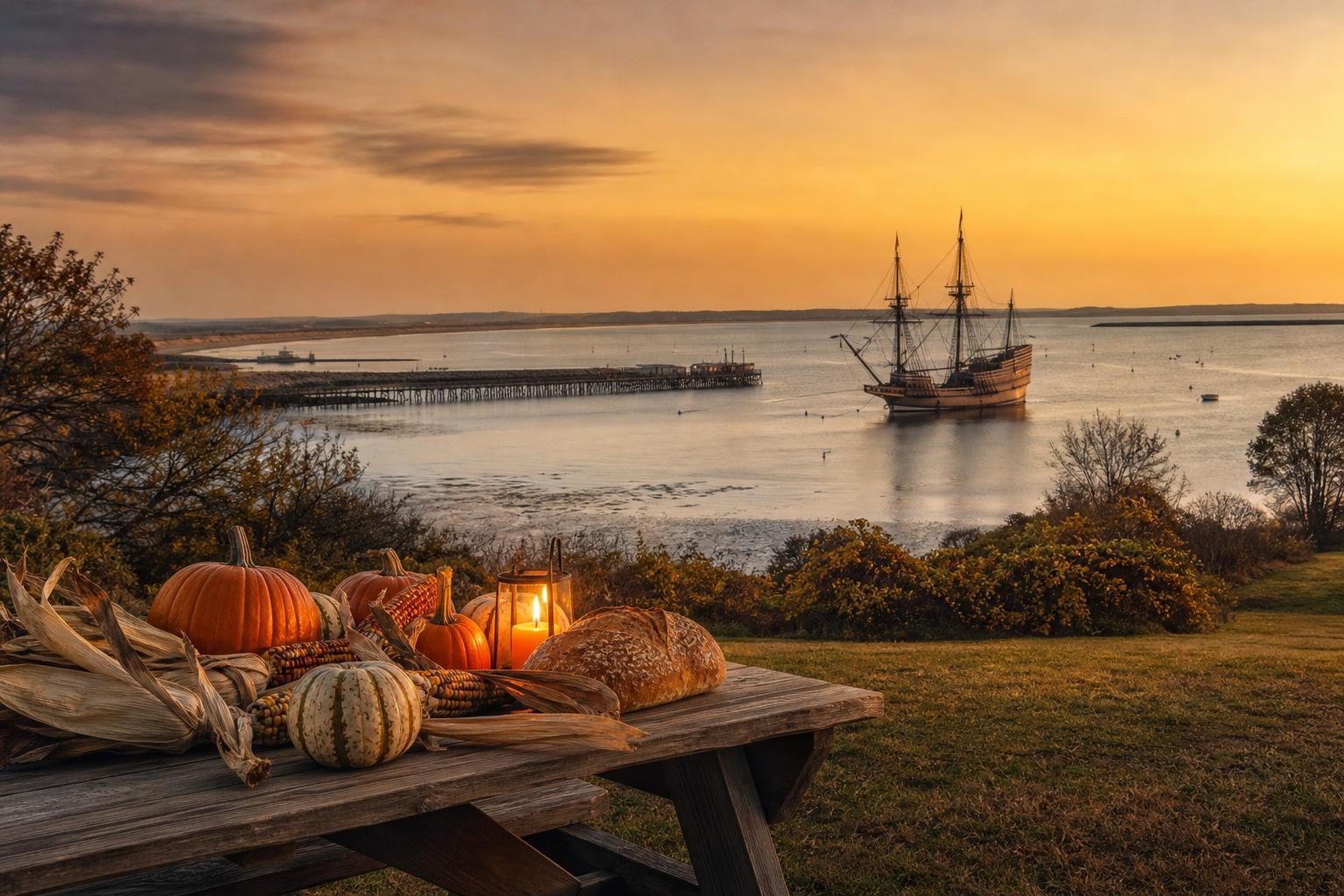
The first Thanksgiving did not begin with a conquest. It began with a peace agreement. On March 22, 1621, the Plymouth settlers and the Wampanoag leader Massasoit concluded a treaty, as the Library of Congress has documented [3]. Each side pledged not to harm the other, and Massasoit agreed to join the newcomers in common defense against rival peoples, especially the Narragansett [3].
That autumn, after the colonists' first harvest, Massasoit arrived with about 90 of his men, who stayed for three days of feasting and games and brought five deer as a gift to the governor, according to National Geographic's account of the colonists' own records [4]. This was not a scene of one people erasing another. It was two peoples, each with its own reasons, choosing friendship over war.
The friendship held. Massasoit kept the treaty for the rest of his life, roughly 40 years, according to colonial chronicler Nathaniel Morton, as cited by the Library of Congress [3]. Peace between the two peoples lasted until after his death in 1661 [4]. Much of what came later was tragic for both peoples. But a council resolution that skips the four decades of peace that followed the 1621 harvest is not telling the history more fully. It is telling less of it.
Washington and the First Congress Made It a Day of Thanks
The national holiday has its own history, and it is a story of gratitude, not grievance. On Sept. 25, 1789, Rep. Elias Boudinot of New Jersey asked the House to request that President Washington set aside a day of public thanksgiving, and a joint committee carried that request to the President, according to Washington's papers at the National Archives [5]. On Oct. 3, 1789, Washington issued a proclamation naming Thursday, Nov. 26, as a day of "sincere and humble thanks" to God [5].
Even then, Americans argued. Some members of the First Congress objected that a national proclamation intruded on matters better left to the states [5]. But the purpose Washington stated was never in doubt. He called the country to give thanks to Almighty God for His protection and for the blessing of a new government formed peaceably, by consent [5].
That is what Thanksgiving still means to millions of American families who will bow their heads over a meal this Thursday. Gratitude does not deny past wrongs. Faith teaches that thankfulness and honest repentance belong together, and that a grateful heart is better able to see its own failures, not less able.
Plymouth Is Trying to Keep Both
A Native American coalition, United American Indians of New England, wants to take the town back to court, accusing it of blocking its gathering on Coles Hill, Axios reported [6]. The dispute turns on a 1998 agreement between the town and the group, which has held its observance there since 1970 [6]. Select Board Chair Deb Iaquinto has said the town supports the Day of Mourning and has been in talks with organizers for months, according to Axios [6].
That is the right posture: protect the right of every group to assemble peaceably on public ground, and still keep the town's own celebration of its founding. The First Amendment protects the mourners' speech. It does not require a city government to adopt that speech as its own.
The coalition still intends to gather on Coles Hill on Thanksgiving Day, even as its dispute with the town heads back toward a courtroom [6]. In Boston, a council resolution is a statement of opinion, not a law, and families across the city will keep the holiday as they always have. The better path for Boston's leaders would be to honor native neighbors and the Pilgrims' heirs alike by teaching the treaty, the feast and the long peace that followed. That history belongs to all of us, and it gives Americans of every background something to be thankful for.
Sources
- [1]Opens in a new tab ↗
- [2]City of BostonNational Day of MourningOpens in a new tab ↗
- [3]Library of CongressThe Treaty That Made ThanksgivingOpens in a new tab ↗
- [4]National GeographicMassasoit's strategic diplomacy kept peace with the Pilgrims for decadesOpens in a new tab ↗
- [5]National Archives, Founders OnlineThanksgiving Proclamation, 3 October 1789Opens in a new tab ↗
- [6]Opens in a new tab ↗
Have you ever been censored or shadow-banned on social media?
- Yes
- I think so
- No
- I'm not on social media
More in Pushback
Gunmakers Ask Judge to Halt Maryland's Glock Ban
Today on First Principles with Benjamin Stone
No Religious Test: The Constitution and History Answer the Case Against JD Vance's Faith
This morning on Faith & Family with Ethan Calloway

Nutrition Is in SNAP's Name: Why 18 States Are Right to Keep Soda and Candy Off the Taxpayer's Tab
This morning on The Bottom Line with Douglas Park
Were you there?
If you were at the scene, or this story touched your life, tell us what you saw and what it was like.
Discussion 0
Sign in or create a free account to join the discussion.
No comments yet. Start the discussion.