
 This morning on First Principles with Benjamin Stone
Oversight Has Rules: Why the President Is Right to Ask Contractors to Check In Before Congress Comes Calling
Critics call the new executive order a bid to limit oversight. The Constitution, the Supreme Court's Mazars ruling and a privilege claim made by President Obama tell a different story.
Filed November 21, 2026 · 📍 Supreme Court, DC 20543
Were you there? Share your story
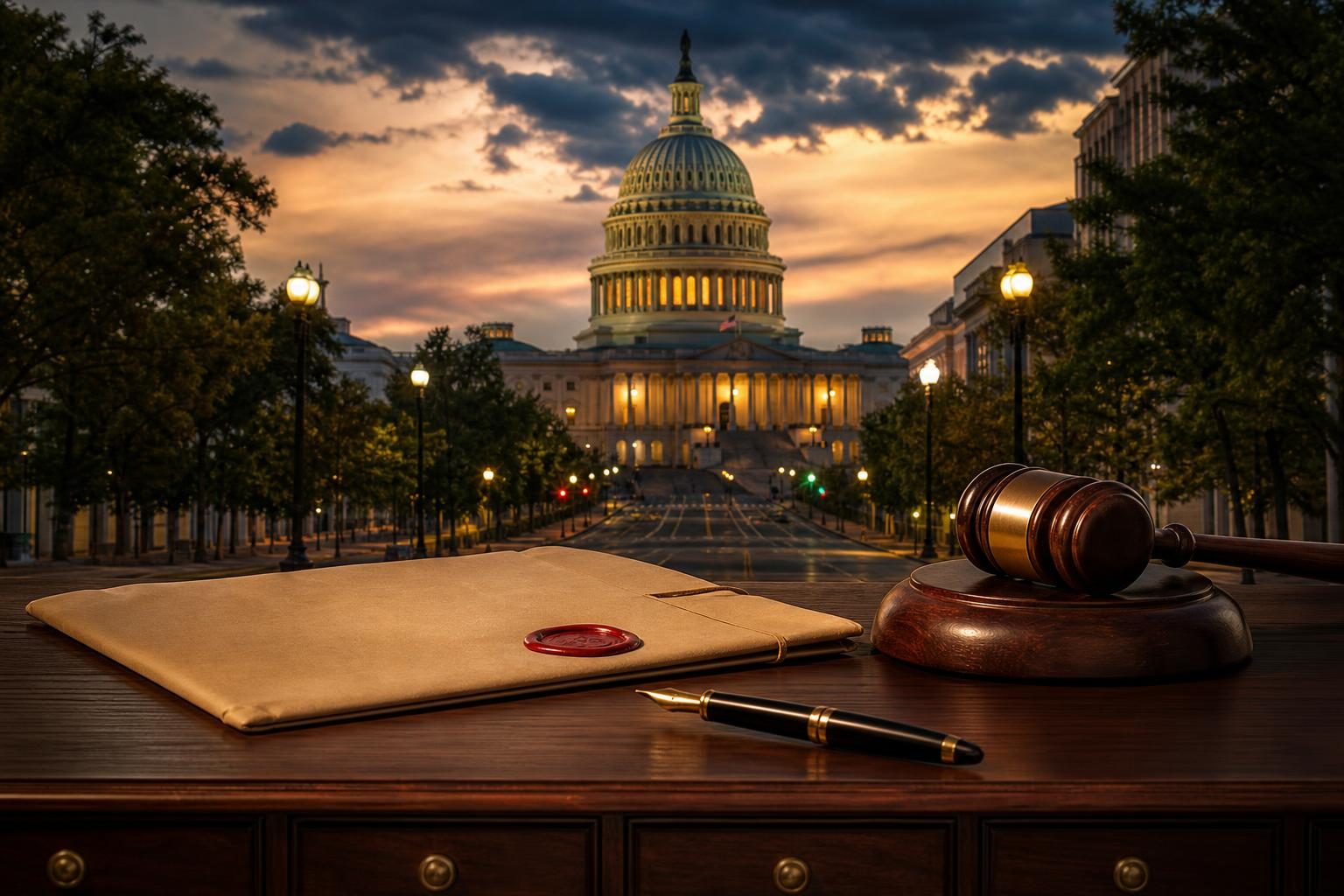
Part of our continuing coverage: White House Tells Agencies to Clear Congressional Testimony First as Democrats Ready a Wave of Investigations
Key points
- A new order requires federal contractors to notify the White House of congressional requests about their government work.
- Contractors must follow White House instructions to withhold material protected by executive privilege.
- The Supreme Court's 2020 Mazars ruling requires courts to weigh separation-of-powers concerns in such fights.
- Incoming Democratic chairmen have already put a dozen Trump allies on notice to preserve documents.
President Trump signed an executive order on Friday requiring federal contractors to tell the White House when Congress asks them about their government work, and the coverage was quick to cast it as a power grab. Reuters described the order as an expansion of the President's efforts to limit congressional oversight before Democrats take control of Congress in January, and it noted that the restrictions could face legal challenges [1].
Before accepting that framing, Americans should look at what the order actually says, what the Constitution says, and what the incoming majority has already promised to do.
What the Order Does
Under the order, federal contractors and their subcontractors must notify the White House of any request from Congress regarding their work with the executive branch, Reuters reported [1]. Contractors must also follow White House instructions to withhold communications that are protected by executive privilege, and agencies are to coordinate with the White House and contractors on how to respond, according to Reuters and CNBC [1][2]. Companies that fail to comply could face the loss of contracts or suspension from future federal business [2].
The White House defended the order as necessary to protect sensitive government communications, including those involving national security, and said contractors answering Congress on their own could expose privileged material and drag the government into costly legal fights, CNBC reported [2]. The order follows an earlier directive from White House Counsel Will Scharf requiring agencies to get White House approval before employees agree to testify [1][2].
Notice what the order does not do. It does not forbid anyone from talking to Congress. It requires notice, coordination and the protection of privileged material, the same things any large organization expects when outside investigators request its internal communications.
Contractors Do the Government's Work
Federal contractors are not bystanders. They write software for agencies, run logistics for the military, process benefits and advise senior officials. When a contractor holds the executive branch's documents and deliberations, those papers are, in every practical sense, the executive branch's papers. It would make little sense for privilege to protect a memo in an agency's files, but not the same memo in a contractor's inbox.
Article II vests the executive power in the President, and the Supreme Court has long recognized that the separation of powers protects the confidentiality of executive deliberations [6]. In Trump v. Mazars in 2020, the Court held that courts must take separation-of-powers concerns seriously when Congress seeks a President's information, and it set out considerations that include whether the legislative purpose truly requires that information, whether the request is no broader than reasonably necessary, and what burden it places on the presidency [4]. A notice requirement simply gives the executive branch the chance to raise those concerns before privileged material walks out the door.
Both Parties Have Defended Executive Privilege
This is not a Republican invention. In 2012, President Obama asserted executive privilege over Justice Department documents sought by the House Oversight Committee in the Fast and Furious gun-running investigation, NPR reported at the time [5]. The House Oversight Committee voted that same day to hold Attorney General Eric Holder in contempt, but the privilege claim itself rested on the same constitutional ground this President now invokes [5]. The principle does not change when the party in the White House does.
What has changed is the scale of what is coming. Rep. Robert Garcia, who is set to lead the House Oversight Committee, has already sent letters to a dozen of the President's allies, former aides and family members telling them to preserve documents, CNN reported [3]. Democrats are preparing to examine federal contracts, immigration enforcement, conflicts of interest and more [3]. Scharf reminded Garcia that congressional inquiries must serve a legitimate legislative purpose, according to CNN [3]. That is not obstruction. It is the standard the Supreme Court itself applies [4][6].
Oversight, Yes. A Fishing Expedition, No.
Congress has a real and important oversight role, and no serious person argues otherwise. The Constitution's design depends on each branch checking the others. But the investigative power exists to help Congress legislate, not to give one party a two-year campaign tool against the other [6].
A fair process protects everyone. Contractors deserve to know they will not be caught in the middle of a constitutional tug-of-war with no guidance. Taxpayers deserve to know that sensitive national security information will not be released piecemeal by companies acting on their own. And Congress, if its requests are legitimate, loses nothing by having the executive branch know about them in advance.
Who Is Pushing Back, and What Comes Next
The order could well end up in court, and Reuters noted that judges can step in when the branches clash over Congress's power to obtain information [1]. The administration, for its part, has signaled it will defend executive privilege firmly [2][3].
That is how the system is meant to work: disputes between the branches go through the accommodation process and, when necessary, the courts, under rules the Supreme Court has already laid out [4][6]. The President's order does not end oversight. It insists that oversight follow the Constitution, and that is a principle both parties should be willing to live by, whichever one holds the gavel.
Sources
- [1]Reuters (via Yahoo News)Trump order says contractors must notify White House of congressional probesOpens in a new tab ↗
- [2]Opens in a new tab ↗
- [3]Opens in a new tab ↗
- [4]Supreme Court of the United StatesTrump v. Mazars USA, LLP (2020)Opens in a new tab ↗
- [5]Opens in a new tab ↗
- [6]Cornell Law School Legal Information InstituteCongress's Investigatory Powers and the PresidentOpens in a new tab ↗
Have you ever been censored or shadow-banned on social media?
- Yes
- I think so
- No
- I'm not on social media
More in Pushback
Within Reach Isn't Within the Constitution: Why the Popular Vote Compact Still Has to Answer to Articles I and V
This morning on Campaign Trail with Sophia Reyes
A Bench So Deep the President Can Joke About It
Overnight on The Sterling Report with Ava Sterling

Fair Play for Girls: Why Chino Valley Parents Are Right to Stand Up for Girls' Sports Over Sacramento's Objections
Overnight on Report Card with Rebecca Hartman
Were you there?
If you were at the scene, or this story touched your life, tell us what you saw and what it was like.
Discussion 0
Sign in or create a free account to join the discussion.
No comments yet. Start the discussion.