
 Today on Health Check with Samuel Adeyemi
Nearly 30,000 Canadians Died on a Waiting List Last Year. Washington's Medicare Push Should Start With That Number
A new count of deaths on Canada's government waitlists lands just as Sen. Bernie Sanders and House Democrats press to open Medicare to millions more Americans.
Filed November 25, 2026 · 📍 Supreme Court, DC 20543
Were you there? Share your story
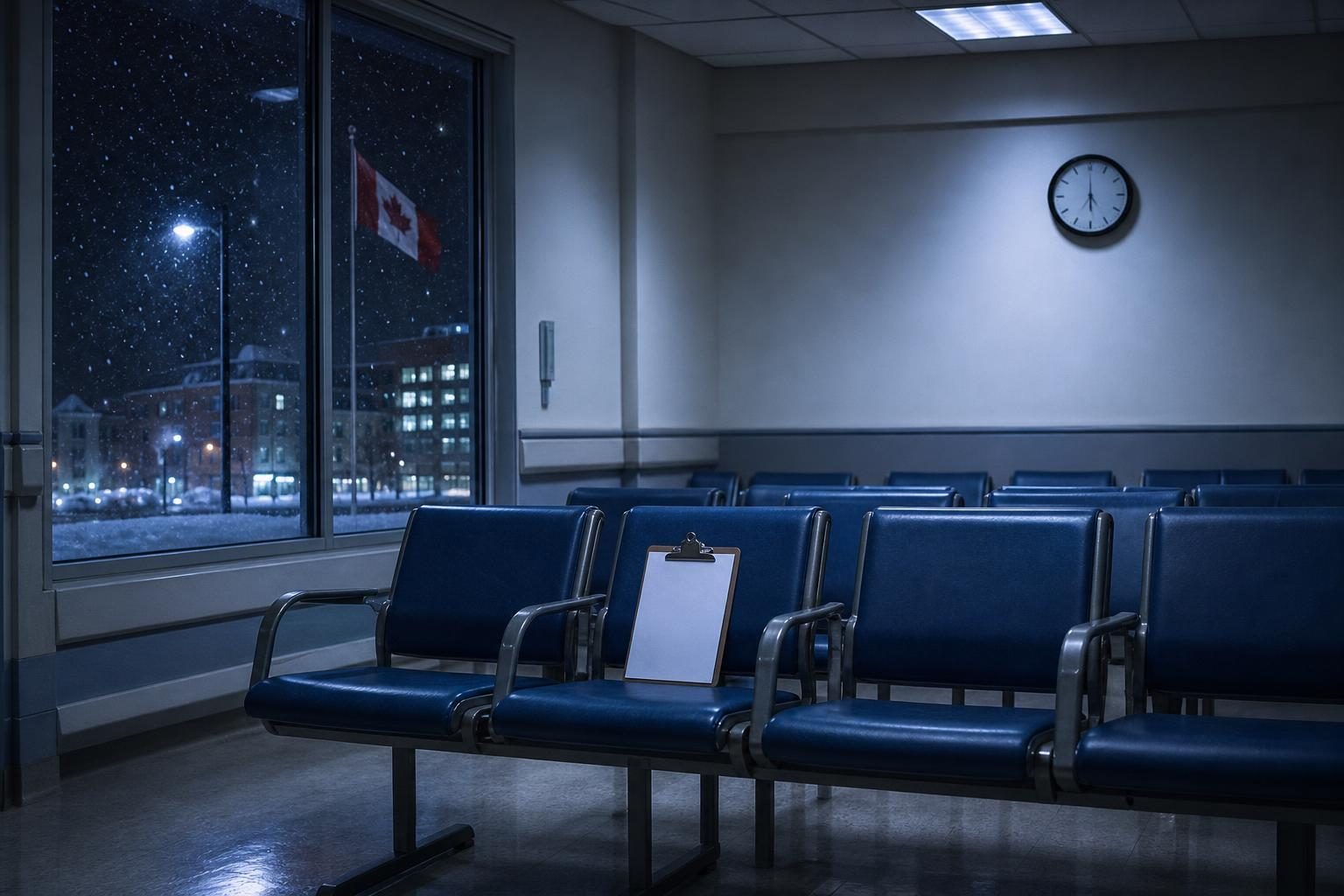
Part of our continuing coverage: Medicare for All Has a Europe Problem: Longer Lines, Higher Taxes and a Trust Fund Already Running Dry
Key points
- SecondStreet.org counted 29,468 Canadians who died on medical waiting lists in 2025-26.
- Nearly 130,000 waitlist deaths have been documented since 2018; surgical-list deaths rose 17.5%.
- Sanders wants Medicare at 55 as an immediate first step toward Medicare for All.
- Canada's Supreme Court ruled in 2005 that a waiting list is not health care.
As a new Democratic House majority prepares to take power in January, Sen. Bernie Sanders is pressing his party to move fast on health care. He wants the Medicare eligibility age lowered from 65 to 55, dental, vision and hearing coverage added, and every child covered through age 19, a package he has described as an immediate first step toward Medicare for All [3]. The Hill reports that Democrats are coalescing around a plan to put more Americans into Medicare, even as they remain divided over going all the way to a single government plan [3].
Before Congress takes that step, it should look north. On Wednesday, the Canadian think tank SecondStreet.org released its annual "Died on a Waiting List" report [1]. It found that 29,468 Canadians died in the 2025-26 fiscal year while waiting for surgery, a procedure, a diagnostic scan or a specialist appointment [1]. Since 2018, the group has documented nearly 130,000 such deaths from government records [2].
What the numbers say
The report is built from data that Canada's provinces and health authorities keep on their own patients [1][2]. SecondStreet found that deaths on surgical waiting lists rose 17.5 percent over the past year, while deaths on lists for diagnostic scans fell 2.8 percent [1]. In Ontario, where the overall total declined, the group still asked the provincial government to investigate 115 cancer surgeries that were cancelled because the patients died before their operations [1].
Fairness requires two caveats, and the authors supply them themselves. The figures do not show that the wait caused each death; some patients were elderly or gravely ill, and some may have died of unrelated causes [1]. And the count is almost certainly too low, because many health bodies do not track or release complete records [1][2]. That is why the group is asking every province to make tracking and public disclosure of waitlist deaths an annual requirement [1].
A year ago, the same group counted 23,746 deaths for 2024-25 [6]. Because the list of health bodies that report changes from year to year, the totals are not a perfect comparison. But the direction is not encouraging, and the scale is hard to wave away.
A place in line is not care
Canada's system promises that every resident is covered. But coverage on paper and care on time are two different things. When the government is the only buyer, it controls spending the way any single buyer does, by deciding how much care to pay for. When demand runs ahead of the budget, the difference shows up as a line.
Canada's own Supreme Court said as much two decades ago. In Chaoulli v. Quebec, decided 4-3 in 2005, the court struck down Quebec's ban on private insurance for services covered by the public plan, in a case brought after a patient's long wait for hip surgery [5]. Chief Justice Beverley McLachlin and Justice John Major put the principle plainly: "Access to a waiting list is not access to health care" [5].
That principle matters for Americans now. Lowering the Medicare age to 55 would open a federal program, with prices set in Washington, to millions of Americans in their late 50s and early 60s, many of whom have job-based coverage today [3][4]. Full Medicare for All would go further and replace private insurance altogether. A government plan that pays less and promises more has to ration somewhere. In Canada, the rationing is measured in months, and for tens of thousands of patients a year, it is measured in lives that ended before the appointment came.
None of this means the American system is without problems. Costs are too high, and families feel it every time a premium notice arrives. But the answer to high prices is more competition, more price transparency and more choice for patients, not a single national queue.
Who is pushing back
Even many Democrats doubt the plan can move quickly. Sen. Chris Van Hollen of Maryland said on NBC's "Meet the Press" that the party cannot reach Medicare for All in one big bite, CNN reported, and the network found that broadening Medicare in the next two years is unlikely, with Democrats still far from agreeing on a single bill [4]. Any measure would also need to clear Republican opposition in Congress and win President Trump's signature [4].
Sanders, who The Hill says is expected to lead the Senate's health committee next year, has promised to keep pushing [3]. Before the first hearing, Congress should ask for what Canadian reformers are now demanding of their own provinces: an honest public count of who is waiting, how long they wait, and how many never reach the front of the line [1]. Americans deserve to know the true cost of a promise before they are asked to trade the coverage they have for a number in a queue.
Sources
- [1]SecondStreet.orgAnnual Died on a Waiting List Report ReleasedOpens in a new tab ↗
- [2]Opens in a new tab ↗
- [3]Opens in a new tab ↗
- [4]Opens in a new tab ↗
- [5]Supreme Court of CanadaChaoulli v. Quebec (Attorney General), 2005 SCC 35Opens in a new tab ↗
- [6]SecondStreet.org23,746 Patients Died on Waitlists in Past YearOpens in a new tab ↗
Have you ever been censored or shadow-banned on social media?
- Yes
- I think so
- No
- I'm not on social media
More in Pushback
Democrats Reach 259 House Seats. The Last Two Big Democratic Majorities Were Gone in Two Years
This morning on Campaign Trail with Sophia Reyes

Liking a Tweet Isn't Misconduct: A Tribunal Tells a Manchester Council That Belief Is Protected
This morning on From the Bench with Margaret Callahan

Florida's Tax Cut Doesn't Have to Mean a Slower 911. One Sheriff Is Showing Why
This morning on Sunshine State Report with Tomás Ortega
Were you there?
If you were at the scene, or this story touched your life, tell us what you saw and what it was like.
Discussion 0
Sign in or create a free account to join the discussion.
No comments yet. Start the discussion.