
 Today on The Bottom Line with Douglas Park
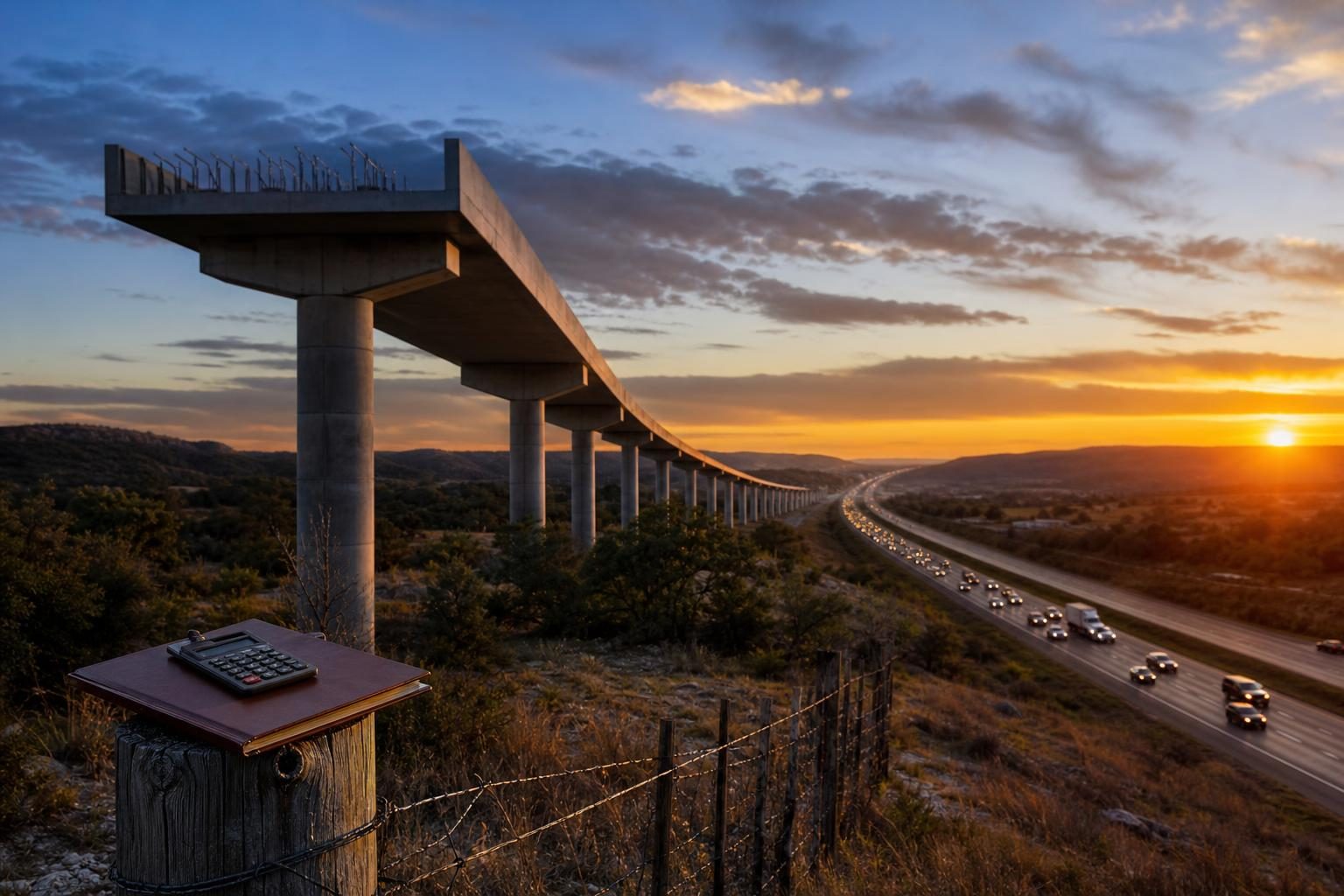
Before Texas Buys a Bullet Train, Read California's $231 Billion Receipt
Austin and San Antonio Democrats want a passenger rail link, but Texas's own studies, California's runaway costs and Austin's shrinking light-rail line all say taxpayers should see the full bill first.
Filed November 23, 2026 · 📍 Austin, TX 78701
Were you there? Share your story
Key points
- Austin and San Antonio council members, joined by a Democratic state lawmaker, are pushing passenger rail between the two cities.
- A dedicated Austin-San Antonio line is estimated at about $13.5 billion, and Union Pacific resists sharing its freight track.
- California's high-speed rail began with a nearly $10 billion bond in 2008; estimates now run up to $231 billion.
- Austin's Project Connect first phase shrank from 20.2 to 9.8 miles while its per-mile cost tripled.
Fresh off a strong election for their party, Democrats in Texas are already pitching an idea Californians know well: a passenger train linking two of the state's biggest cities. Austin City Council Member Vanessa Fuentes and San Antonio City Council Member Jalen McKee-Rodriguez are pushing for a rail line between Austin and San Antonio, the New York Post reported [1]. An Austin Democrat in the Legislature, state Rep. John Bucy, has filed a bill for a larger high-speed line along Interstate 35 connecting Dallas, Waco, Austin and San Antonio through a development agreement with a private company [1].
Supporters see a train as a way to tie together a fast-growing corridor and give drivers on Interstate 35 another option [1][2]. That goal is reasonable. Anyone who has crawled through San Marcos at rush hour understands why the idea sounds appealing. And to be fair, the Texas plans are far smaller than California's [1].
But a plan is only as good as its price tag, and the numbers from Texas's own studies and from the West Coast deserve a hard look before a single local dollar is committed.
What the Texas Studies Found
Two engineering studies released this summer priced the options. A state transportation department study looked at running passenger trains on Union Pacific's existing freight line, with stops in New Braunfels and San Marcos, while a study paid for by Travis County examined a dedicated line along State Highway 130 and Interstate 10, KUT reported [2]. The dedicated route, which would run independently of freight traffic, carries an estimated cost of about $13.5 billion [2].
The cheaper route has a problem of its own. Union Pacific, which owns the track, has said that sharing its freight line between Austin and San Antonio with passenger trains would be logistically difficult, and no funding has been committed for the expensive alternative [2].
So the choice in front of Central Texas is a line that depends on a railroad that does not want it, or a line that costs more than $13 billion with no one yet named to pay for it.
California's Receipt
Texans do not have to guess how this can go. In 2008, California voters approved nearly $10 billion in bonds for a high-speed train [1]. Today the estimated cost of the system runs from $126 billion to $231 billion, depending on the estimate, the Post reported [1]. The California High-Speed Rail Authority's draft 2026 business plan put the cost of completing the 494-mile first phase between San Francisco and Los Angeles and Anaheim at $231.3 billion, Railway Age reported [4]. The authority pointed to $1.7 billion in savings from streamlining, a small dent in a bill that size [4].
The timeline has slipped with the budget. KTVU reported that even the initial segment in the Central Valley is not expected to be finished until 2032 [3]. Washington has also stepped back: the federal government withdrew $4 billion for the Central Valley line, and California later dropped its lawsuit over the decision, the International Railway Journal reported [5].
Texas has already seen federal rail money come and go. The federal government awarded Amtrak nearly $64 million in 2023 to help plan a high-speed project in Texas, and that grant was terminated two years later [1].
Austin Has Its Own Warning Sign
The closest lesson may be in Austin itself. Project Connect, the transit plan Austin voters approved in 2020 and that is funded in part through a property tax, has seen its first light-rail phase cut from 20.2 miles to 9.8 miles, with stops reduced from 26 to 15 and the airport connection dropped, Planetizen reported [6]. The cost per mile has risen to about three times the 2020 estimate [6].
That matters for San Antonio and Austin taxpayers. A city that is still trying to deliver half of the rail line it promised five years ago should finish that work before it signs up for an intercity project that would cost billions more. Families already squeezed by property taxes and rising costs deserve to see the full bill, the ridership math and the funding plan first.
Who Is Pushing Back, and What Comes Next
Union Pacific's resistance alone may decide which route is even possible [2]. Federal officials have already pulled money from both California's project and the Amtrak planning grant for Texas [1][5]. And taxpayers in both cities will have a say as councils weigh the idea and lawmakers return to Austin in January.
Texas built its prosperity by spending carefully and letting people keep more of what they earn. Better roads, smarter traffic management and private investment that puts its own money at risk are tested ways to move people. If a train truly pencils out, private builders and riders will show it. Until then, the California receipt is the best reason to slow down.
Sources
- [1]New York PostTexas Democrats push high-speed rail plan after California's $231B bullet train debacleOpens in a new tab ↗
- [2]KUTStudies say Austin-San Antonio passenger rail requires $13 billion or a route Union Pacific resistsOpens in a new tab ↗
- [3]Opens in a new tab ↗
- [4]Railway AgeCHSRA Issues Draft 2026 Business PlanOpens in a new tab ↗
- [5]International Railway JournalCalifornia's high-speed project faces funding crisisOpens in a new tab ↗
- [6]PlanetizenAustin's Project Connect has shrunk to less than half its proposed length, at a higher costOpens in a new tab ↗
Have you ever been censored or shadow-banned on social media?
- Yes
- I think so
- No
- I'm not on social media
More in Pushback

Minnesota Vows a Semi-Auto Ban. The Second Amendment and 32 Million Owners Say Otherwise
Today on First Principles with Benjamin Stone
Medicare for All Has a Europe Problem: Longer Lines, Higher Taxes and a Trust Fund Already Running Dry
Today on The Vance Edge with Sienna Vance
Fifty Rulebooks for One Federal Badge? Why Connecticut's ICE Mask Ban Ran Into the Constitution
Today on Order in the Court with Harold Whitmore
Were you there?
If you were at the scene, or this story touched your life, tell us what you saw and what it was like.
Discussion 0
Sign in or create a free account to join the discussion.
No comments yet. Start the discussion.