
 Monday night on Rule of Law with Lauren Pierce
Judge Throws Out the Administration's Four-Year Limit on Foreign Student Visas; DHS Has Argued the Open-Ended System Invites Abuse
A federal judge in Boston vacated the rule that would have replaced 'duration of status' with fixed stays for students, exchange visitors and foreign journalists. An appeal is expected.
Filed November 16, 2026 · 📍 Boston, MA 02108
Were you there? Share your story
Key points
- Judge Dennis Saylor struck down DHS's rule replacing open-ended 'duration of status' with fixed visa stays.
- The rule would have capped F and J stays at four years and I visas for foreign journalists at 240 days, with extensions available.
- DHS cited fraud, 'pay-to-stay' schemes and long-term overstays; the judge found the rule arbitrary and capricious.
- An appeal is expected; Congress gave the executive broad power to set the terms of nonimmigrant admission.
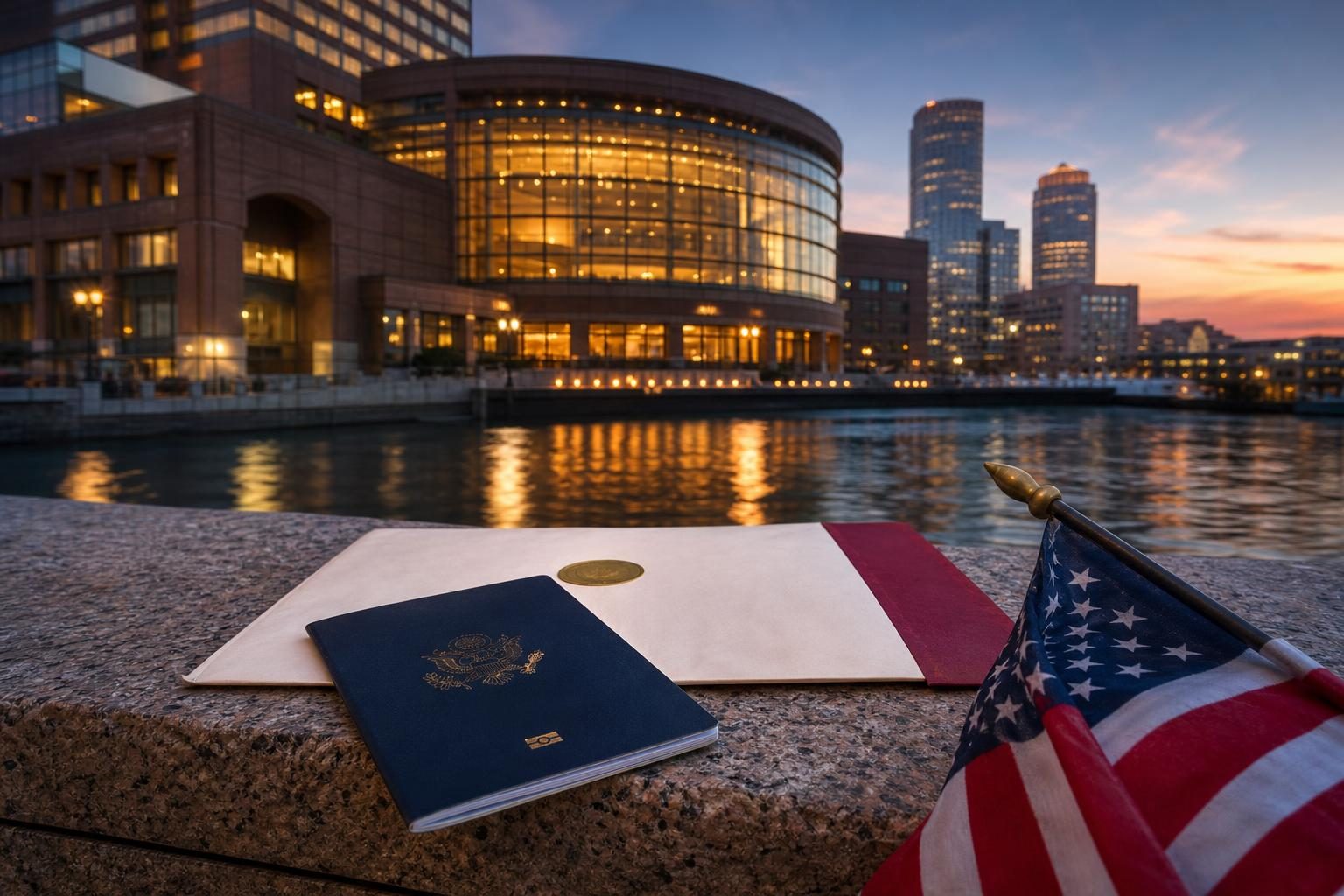
A federal judge in Boston on Monday struck down the Trump administration's rule limiting how long foreign students, exchange visitors and foreign journalists may stay in the United States, Le Monde and France 24 reported [1][2].
U.S. District Judge Dennis Saylor found the policy "arbitrary, capricious, an abuse of discretion and otherwise not in accordance with law," the language of the federal Administrative Procedure Act, Le Monde reported [1]. France 24 reported that the judge ruled the restrictions unlawful and found they would undermine opportunities for international education [2].
The decision leaves in place the decades-old system the administration had tried to replace [2].
What the Rule Would Have Done
For years, most foreign students and exchange visitors have been admitted for what is called "duration of status." Instead of a fixed end date, they may stay as long as they remain enrolled or in their program [3][4].
The Department of Homeland Security finalized a rule in July to end that system [3][4]. It would have given students on F visas and exchange visitors on J visas fixed admission periods tied to their programs and capped at four years, and limited foreign media representatives on I visas to 240 days, with extensions available through a formal application and new background checks [3][4].
Why DHS Wanted It
DHS argued that open-ended admission leaves the government without regular check-ins on foreign students and invites abuse [3]. In announcing the rule, the department pointed to fraud, so-called "pay-to-stay" schemes and foreign nationals who remain in student status for many years, and it said about 2,100 people who entered on student visas between 2000 and 2010 were still in the country in that status [3].
The department also cast the change as a screening tool, not a ban: students who needed more time could ask for it, and DHS would get a chance to review who was still here and why [3][4].
That is a reasonable goal. Congress gave the executive branch broad power over visitors like these. Federal law says a nonimmigrant's admission "shall be for such time and under such conditions" as regulations prescribe [6]. Asking a student to check in after four years is not an exotic use of that power.
The fight has been in Saylor's courtroom since the summer. In September, a day before the rule was to take effect, he issued a preliminary injunction blocking it while the case proceeded, siding with a coalition of unions and higher-education groups, The Irish Times reported [5]. DHS's general counsel, James Percival, criticized that ruling at the time, and the administration was expected to appeal [5].
Monday's decision goes further. Rather than pausing the rule, the court set it aside [1][2].
Why It Matters and What Comes Next
The legal question here is not whether America may vet foreign students. Everyone agrees it may. It is whether DHS showed its work, and the judge concluded it did not [1]. Under the Administrative Procedure Act, agencies must explain their choices, respond to serious public comments and consider reasonable alternatives. Courts enforce those duties against administrations of both parties.
But there is a cost when one district judge can wipe a nationwide rule off the books. Congress wrote the immigration laws to give the executive branch real authority over the terms of a visitor's stay [6], and the people's elected leaders, not only the universities that enroll these students, should have a say in how that authority is used. Universities and their allies argued the rule would hurt international education [2][5]. The administration argued the old system had gaps that let people disappear into it [3]. Both arguments deserve a full hearing on appeal.
An appeal to the U.S. Court of Appeals for the First Circuit is widely expected [5]. Until then, foreign students and scholars remain under the old duration-of-status rules [2]. DHS also has the option of writing a new version of the rule that answers the judge's objections, and Congress could settle the question itself by setting clear limits in law.
Sources
- [1]Opens in a new tab ↗
- [2]Opens in a new tab ↗
- [3]U.S. Department of Homeland SecurityTrump Administration Issues Final Rule to End Foreign Student Visa AbuseOpens in a new tab ↗
- [4]Inside Higher EdTrump Administration Finalizes Limits on Student VisasOpens in a new tab ↗
- [5]The Irish TimesJudge blocks Trump limits on how long foreign students and journalists can stay in USOpens in a new tab ↗
- [6]Cornell Law School LII8 U.S. Code 1184: Admission of nonimmigrantsOpens in a new tab ↗
Would you support an immigration deal with the new Democratic Congress?
- Only if the border stays secure and there's no amnesty
- Yes, it's time to fix the system
- No deals at all
More in Immigration & Border Security
Labor Department Proposes Biggest Green Card Hiring Overhaul in Two Decades to Put American Workers First
On Monday on Border Watch with Cole Brennan

Europe Turns to Rwanda: Five Nations Set to Unveil the EU's First Offshore Return Hub
On Monday on Border Watch with Cole Brennan

A Record Weekend on the Atlantic Route: Nearly 2,200 Migrants Reach the Canary Islands as El Hierro's Residents Protest
Sunday night on Border Watch with Cole Brennan
Were you there?
If you were at the scene, or this story touched your life, tell us what you saw and what it was like.
Discussion 0
Sign in or create a free account to join the discussion.
No comments yet. Start the discussion.