
 Tonight on Sunshine State Report with Tomás Ortega
Florida Won't Prosecute Law-Abiding Owners of Short-Barreled Rifles Over Missing Tax Stamps
Attorney General James Uthmeier's memo tells police and prosecutors that state law follows Washington's retreat on short-barreled rifles and shotguns, while machine guns stay banned and some federal rules still apply.
Filed November 13, 2026 · 📍 Tallahassee, FL 32301
Were you there? Share your story
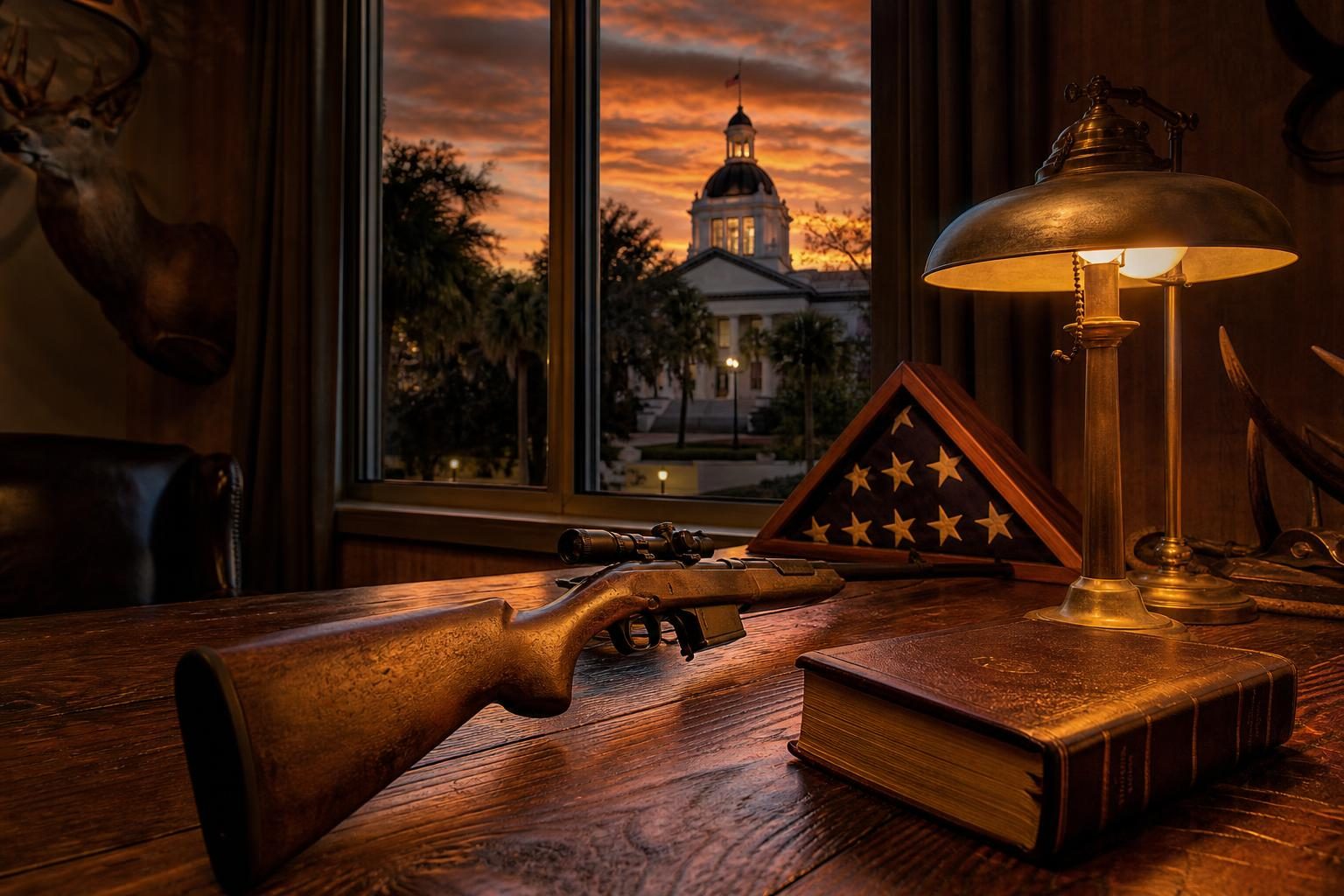
Key points
- AG James Uthmeier's Nov. 6 memo says law-abiding Floridians may possess short-barreled rifles and shotguns without NFA registration or a tax stamp.
- His office will not defend state convictions resting only on missing NFA paperwork; felons and illegal aliens remain barred.
- The shift follows the 2025 law cutting the tax to $0, an August Texas court ruling and ATF's Oct. 9 nonenforcement policy.
- Machine guns stay banned, and crossing state lines with these firearms still needs ATF approval on Form 5320.20.
Law-abiding Floridians who own short-barreled rifles or short-barreled shotguns no longer have to worry that missing federal paperwork will land them in a state courtroom. Attorney General James Uthmeier has told police and prosecutors across the state that such firearms may be possessed without National Firearms Act approval, registration or a federal tax stamp, according to a memo dated Nov. 6 and reported by the Alachua Chronicle [2].
The move drew national attention this week. The Daily Caller reported Friday that the Republican attorney general announced the change on X, writing, "We are issuing guidance and will not defend a conviction on appeal." [1] The outlet said Uthmeier pointed to an August ruling by a federal judge in Texas as the basis for the shift [1].
AmmoLand, which reviewed the five-page memo, reported that the attorney general's office will not defend a state conviction on appeal when the only problem was an owner's lack of NFA approval, registration or a tax stamp [3]. The memo also tells officers that simply possessing one of these firearms does not, by itself, give them reasonable suspicion or probable cause for a search or seizure, according to AmmoLand [3].
What Florida Law Says
The statute at the center of the memo is Section 790.221 of the Florida Statutes. It bans owning or possessing an operable short-barreled rifle, short-barreled shotgun or machine gun and makes a violation a second-degree felony, but it carves out firearms that are lawfully owned and possessed under federal law, the Alachua Chronicle reported [2]. Uthmeier's reading is that state law does not independently criminalize a firearm that federal law allows a person to own [2].
The memo does not rewrite Florida law; it applies an exception the Legislature already wrote. Bearing Arms, which called it another win for gun owners, noted that it says law-abiding residents may now possess these firearms "without fear of prosecution." [4]
The guidance has firm limits. People barred from having guns, including felons and illegal aliens, still may not possess short-barreled rifles or shotguns; location-based gun restrictions still apply; and the guidance covers only Florida, the Alachua Chronicle reported [2]. It also reaches only short-barreled rifles and shotguns. Machine guns remain banned under the same statute [2].
Uthmeier is not the first Florida official to reach this conclusion. His guidance follows a similar memo from Brian Kramer, the state attorney for the Eighth Judicial Circuit, according to the Alachua Chronicle [2].
The Federal Changes Behind the Memo
The National Firearms Act dates to 1934 and imposed a $200 tax on suppressors and certain other firearms, The Daily Signal reported [5]. The budget reconciliation law President Donald Trump signed in July 2025 cut the tax on suppressors, short-barreled rifles, short-barreled shotguns and the category known as "any other weapons" to zero, the Daily Caller reported [1].
In August, U.S. District Judge James Hendrix of the Northern District of Texas, a Trump appointee, ruled in a case involving the National Rifle Association that the tax cut had effectively nullified the 1934 levy, and he blocked enforcement of the registration rules tied to it, according to The Daily Signal [5]. The Justice Department chose not to appeal, and the ATF announced that starting Oct. 9 it would no longer require people to seek its approval under the NFA before making or transferring those items, the Daily Caller reported [1].
The National Law Review described the ATF's step as a policy of enforcement discretion for suppressors, short-barreled rifles, short-barreled shotguns and "any other weapons," not a repeal of the law [6]. That distinction is why state officials like Uthmeier have stepped in: Florida's statute turns on what federal law permits, and the federal ground has moved.
What Is Still Illegal, and What Comes Next
Gun owners should read the fine print. Congress has not repealed the National Firearms Act, Bearing Arms noted [4]. The ATF's nonenforcement policy reaches only those four categories, so machine guns and destructive devices remain fully regulated under the NFA [6].
Travel is another trap. Taking a short-barreled rifle or shotgun across state lines still requires ATF approval on Form 5320.20, the National Law Review reported, and a proposal to replace that approval with a simpler notice has not taken effect [6]. The agency is also still drafting the rules that would let licensed dealers transfer short-barreled rifles and shotguns under the Gun Control Act [6]. Owners who carry one into a state with its own ban will find that Florida's memo offers them no protection there [2].
There is also the question of how long this lasts. Bearing Arms cautioned that this gain may prove more fragile than Uthmeier's other Second Amendment moves, because a future Congress could restore the tax and pull the federal footing out from under the guidance [4]. The outlet argued that lasting protection will depend on federal courts willing to confront whether the NFA itself is constitutional [4].
For now, the message from Tallahassee is clear: Florida will not treat peaceable citizens as felons over a federal tax that Congress itself cut to zero [1][3]. It is a sensible reading that honors the right to keep and bear arms while still keeping guns away from those the law already forbids to have them [2].
Sources
- [1]Opens in a new tab ↗
- [2]Opens in a new tab ↗
- [3]AmmoLandFlorida AG Declares Short-Barreled Rifles and Shotguns Legal Without NFA Registration or Tax StampsOpens in a new tab ↗
- [4]Opens in a new tab ↗
- [5]The Daily Signal'Enjoined as Unconstitutional': How Tax Cut Bill Unraveled 92-Year-Old Gun Control ProvisionOpens in a new tab ↗
- [6]National Law ReviewATF Stops Requiring Certain NFA Approvals and Registrations: What the Industry and Consumers Need to KnowOpens in a new tab ↗
Should Florida ban new data centers until it studies power and water use?
- Yes
- No, bring the jobs
- Only near neighborhoods
More in Florida & Southeast News
How Florida Held the Line Against the Blue Wave, and Whether Its Republican 'Seawall' Can Last
Today on Sunshine State Report with Tomás Ortega

DeSantis Presses for a Special Session to Put Voter-Approved Amendment 3 Tax Relief in Place by Jan. 1 and Block New Local Fees
This morning on Sunshine State Report with Tomás Ortega
DeSantis Says It's Too Soon for 2028 Talk and Urges Republicans to Face What Went Wrong in the Midterms
Overnight on Sunshine State Report with Tomás Ortega
Were you there?
If you were at the scene, or this story touched your life, tell us what you saw and what it was like.
Discussion 0
Sign in or create a free account to join the discussion.
No comments yet. Start the discussion.