
 Tonight on World Watch with Grace Whitfield
Israel's Coalition Standoff: Netanyahu Holds His Ground as Eisenkot Hunts for 61 Seats
The new Knesset is sworn in, Netanyahu governs as caretaker and the opposition is moving to take the speaker's chair. Friday's clash over Israel's Arab parties shows how hard the math is for everyone.
Filed November 13, 2026 · 📍 World desk · Washington, DC
Were you there? Share your story
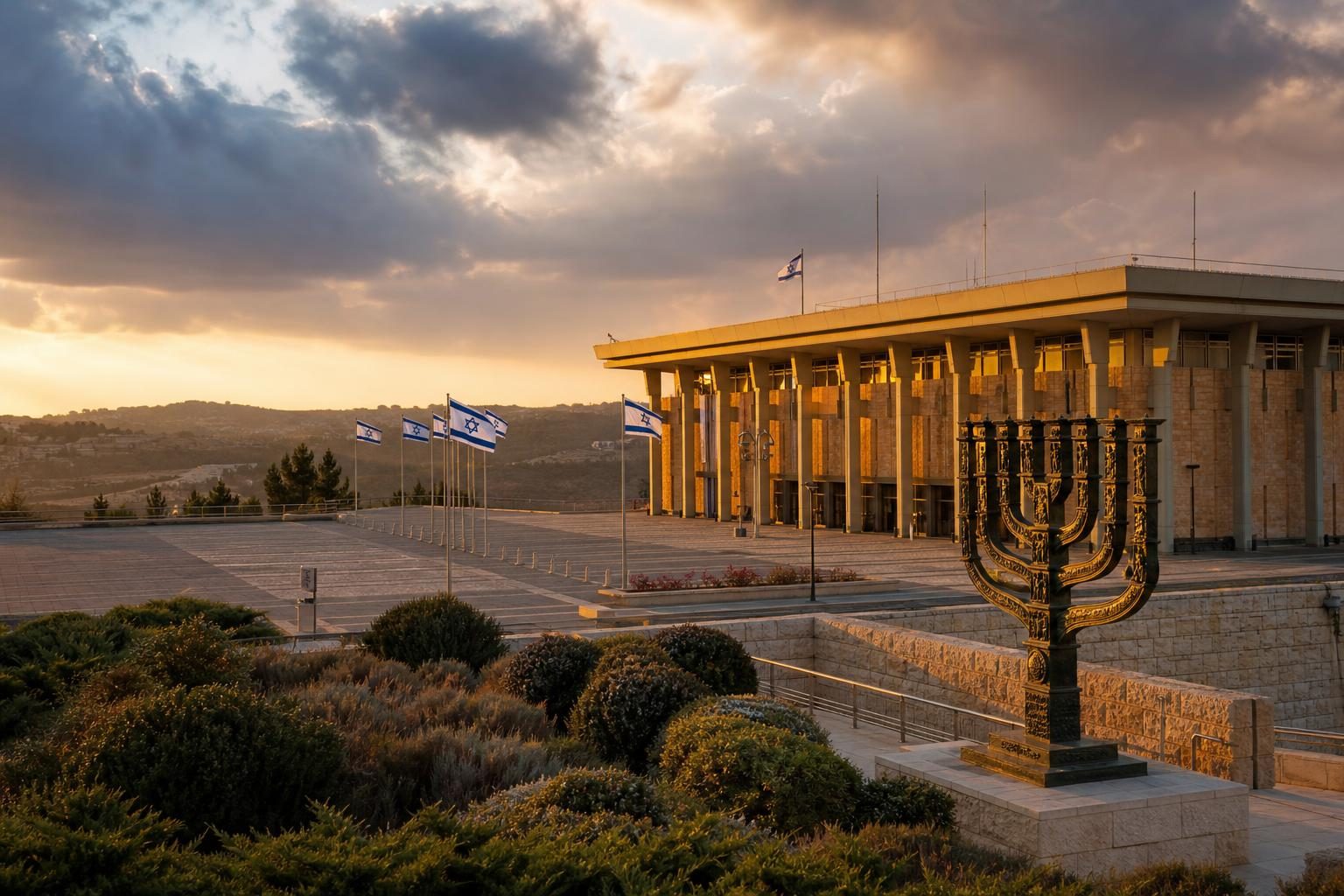
Part of our continuing coverage: Israel's New Parliament Sworn In as Eisenkot Gets First Shot at Ousting Netanyahu
Key points
- The Oct. 27 vote left Netanyahu's bloc at 53 seats, Eisenkot's at 48 and Arab-led parties at a record 19, with 61 needed to govern.
- Eisenkot's bloc won the Knesset's first vote 63-50 and is counting on Arab votes to replace Speaker Amir Ohana on Nov. 17.
- Eisenkot accused Netanyahu of a 'racist' campaign against Arab citizens; Likud warns against partners it calls supporters of terrorism.
- Netanyahu is courting haredi rabbis to keep them in his camp while Eisenkot's 28-day clock runs.
Israel's new parliament has been in session for less than a week, and the struggle over who will govern the Jewish state has already turned bitter. On Friday, Gadi Eisenkot, the former military chief who holds the mandate to form the next government, accused caretaker Prime Minister Benjamin Netanyahu of fueling a "racist" campaign against Israel's Arab citizens, Al Jazeera reported [1].
Writing on X, Eisenkot said Arab citizens had been targeted by a campaign of delegitimization driven by the outgoing prime minister and his circle for political reasons, and he called efforts to smear them as a group an act against the state itself [1].
Netanyahu's camp sees the matter very differently. Likud has spent the week warning that a government leaning on the Arab parties would put Israel at risk, criticizing any negotiations with what it called "supporters of terrorism" while insisting it remains open to talks on a broad unity government, Israel Hayom reported [2].
The Numbers Behind the Deadlock
The Oct. 27 election left no one with a majority in the 120-seat Knesset. Netanyahu's bloc won 53 seats and Eisenkot's alliance won 48, both short of the 61 needed to govern, while Arab-led parties won a record 19 seats, according to Al Jazeera [1]. On paper, Eisenkot's 48 plus the Arab parties' 19 would make 67, a comfortable majority. But Eisenkot has ruled out forming a government with those parties, Al Jazeera reported [1].
That leaves the former army chief with a mandate but not a majority. He has 28 days to put a coalition together, with a possible 14-day extension [1]. Until a new government is sworn in, Netanyahu remains prime minister, and his bloc is still the largest single camp in the chamber [1].
The Likud-led bloc finished first, and its leaders argue that the only way to build a stable government without relying on the Arab parties is a unity arrangement that includes Likud [2]. Eisenkot's allies answer that a majority of lawmakers want a change at the top. Both claims are rooted in the same deadlocked result.
The Speaker Fight and Control of the Agenda
The opposition has moved quickly to use the votes it can muster. In the very first vote of the new Knesset, the Eisenkot-led bloc won 63 to 50 to take a majority on the Arrangements Committee, the panel that shapes parliamentary appointments and legislation until a government is formed, and a Yashar lawmaker will chair it, The Jerusalem Post reported [3].
The next prize is the speaker's chair. The bloc has nominated Matan Kahana, a Yashar lawmaker and former minister, to replace Likud's Amir Ohana, and it is counting on the Arab parties' votes to win, ahead of a vote set for Nov. 17, Brussels Signal reported [4]. The speaker decides what reaches the floor and when, so whoever holds the gavel will have real power over the timing of bills, including the measures Eisenkot's camp has promised on an inquiry into the Oct. 7 attacks, as this site reported when the Knesset was sworn in.
There is an irony here that Likud has not missed. The same Arab parties Eisenkot will not bring into a government are the ones his bloc is counting on to take the speaker's chair [1][4]. Likud called it puzzling that Eisenkot's party canceled a scheduled coalition meeting with Netanyahu's negotiators while continuing to advance talks with the Arab parties, whose lawmakers walked out during the national anthem at the swearing-in, according to Israel Hayom [2].
The Arab Parties Question
Eisenkot's charge on Friday did not come out of nowhere. Netanyahu has repeatedly alleged that Arab-majority parties benefited from electoral fraud, claims that Israel's own electoral authorities have rejected, Al Jazeera reported [1]. Eisenkot's party canceled its scheduled meeting with Likud after Netanyahu's speech at the Knesset's opening, a speech Yashar condemned as divisive, Israel Hayom reported [2].
Netanyahu's defenders see a legitimate security argument in his position, not prejudice. Israel is a nation still at war and still living with the memory of Oct. 7, 2023. When the prime minister and his party question whether lawmakers who walked out on the national anthem should hold the balance of power in a wartime government, they are raising a serious question, not an ugly one [2].
At the same time, Israel's Arab citizens vote freely, sit in the Knesset and serve in its hospitals, courts and, in some communities, its army. That is part of what sets Israel apart in a region of dictatorships, and the country's own Declaration of Independence promises equal social and political rights to all its inhabitants. Both things can be true at once: Arab citizens deserve respect, and Israel is entitled to insist that its governing partners reject Hamas without hesitation.
The Paths to a Coalition
There are only a few roads to 61 seats, and each one runs through a difficult partner.
The first runs through the ultra-Orthodox parties. Eisenkot's bloc has opened talks with them, but Netanyahu is fighting hard to keep them in his camp. According to a source familiar with the negotiations, the prime minister is personally speaking with rabbis, sending emissaries to the haredi leadership and trying to reach rabbis beyond the senior leaders, The Jerusalem Post reported [5]. His message to them, the Post reported, is blunt: "They will use you and throw you away" [5]. In other words, Netanyahu is telling the haredi leaders that the promises coming from Eisenkot's camp cannot be trusted [5]. Any such deal would also have to bridge Israel's long-running dispute over military service for yeshiva students.
The second road is a national unity government that includes Likud. Netanyahu has made that his public demand, and Likud says its door is still open [2]. But Eisenkot's party walked away from the first scheduled meeting, and personal distrust between the two camps runs deep [2].
The third possibility is a narrower government that survives on the Arab parties' votes from outside the cabinet. Eisenkot has ruled out governing with them [1], yet his bloc is already relying on their votes to take the speaker's chair [4]. If that arrangement hardens into a pattern, Likud's warnings will only grow louder [2].
If none of these roads leads anywhere before the clock runs out, Israel's long political crisis could drag on further, with Netanyahu's caretaker government still in office in the meantime [1].
Iran, Gaza and Washington
All of this is playing out while Israel faces enemies who do not pause for politics. This week Eisenkot accused Netanyahu of withholding security briefings, asked the attorney general to step in, and warned against launching military action that is not urgent during the transition, The Times of Israel reported [6]. The two rivals then issued a joint statement saying Eisenkot would be briefed, while Defense Minister Israel Katz said the government "doesn't need permission" from the opposition to act [6].
Katz has a point. Israel's caretaker government remains the lawful government, and the Islamic Republic of Iran, which has spent years funding Hamas, Hezbollah and the Houthis, will not wait for a coalition deal. Eisenkot, a former chief of staff, also has a point when he urges care about launching new operations in the middle of a political transition [6]. The country is best served when both men keep national security above the coalition math.
The alliance with Washington is part of that calculation. As this site reported Friday, Israel's Mossad chief traveled to Washington for talks on Iran as Netanyahu presses President Trump on the next phase of the war. The Trump administration has also signaled it wants to wind down military aid to Israel faster, which this site has covered as well. Whoever leads Israel next will have to manage both the Iran threat and a changing relationship with its most important friend.
In Gaza, the work of defeating Hamas and bringing full accountability for Oct. 7 is unfinished. Eisenkot has promised an official inquiry into the attack, as this site reported on Tuesday, and that debate will now play out in a Knesset where his bloc already holds the powerful Arrangements Committee [3].
What Comes Next
The first test comes Tuesday, Nov. 17, when the Knesset votes on the speaker [4]. A win for Kahana would confirm that Eisenkot's bloc controls the chamber's agenda, even without a government. Meanwhile, Eisenkot's 28-day clock keeps running [1], and Netanyahu's outreach to the haredi rabbis will show whether he can keep his own camp intact [5].
For Christians who pray for the peace of Jerusalem, this is a moment for patience and prayer, not panic. Israel's democracy is noisy, but it is working: the votes were counted, the Knesset was sworn in, and the contest for power is being fought with ballots and committee votes. Israel's friends in America should hope for a government in Jerusalem that is strong against Iran and Hamas, fair to all its citizens and close to the United States.
Sources
- [1]Opens in a new tab ↗
- [2]Opens in a new tab ↗
- [3]The Jerusalem PostOpposition bloc secures majority in its first Knesset vote, Yashar MK to head key committeeOpens in a new tab ↗
- [4]Opens in a new tab ↗
- [5]The Jerusalem Post'They will use you and throw you away': Netanyahu warns haredi parties away from Eisenkot-led blocOpens in a new tab ↗
- [6]The Times of IsraelEisenkot to receive security briefing after accusing Netanyahu of refusing to grant oneOpens in a new tab ↗
Israel's new parliament is sworn in. Who would you rather see lead Israel?
- Benjamin Netanyahu
- Gadi Eisenkot
- Someone new
- That's for Israelis to decide
More in World News

Israel's Spy Chief Heads to Washington as Netanyahu Presses Trump to Finish the Job in Iran
Tonight on World Watch with Grace Whitfield

Dutch Government Survives a 'Millionaire Tax' Revolt, for Now, as the VVD Refuses to Let the Left Write the Budget
Today on World Watch with Grace Whitfield

U.S. Says Europe Will Join the Next Ukraine Talks, but the Kremlin Won't Confirm It and Wants One European Negotiator
This morning on World Watch with Grace Whitfield
Were you there?
If you were at the scene, or this story touched your life, tell us what you saw and what it was like.
Discussion 0
Sign in or create a free account to join the discussion.
No comments yet. Start the discussion.