
 Tonight on Home Front with Carlos Mendoza
Why America's Housing Market Is Frozen, and What It Would Take to Thaw It
Home sales just hit their slowest pace since 2010 even as mortgage rates eased for a fourth week. Here is how the lock-in effect, high prices and costly loans are keeping young families out, and what Washington has done about it.
Filed November 13, 2026 · 📍 Washington, DC 20001
Were you there? Share your story
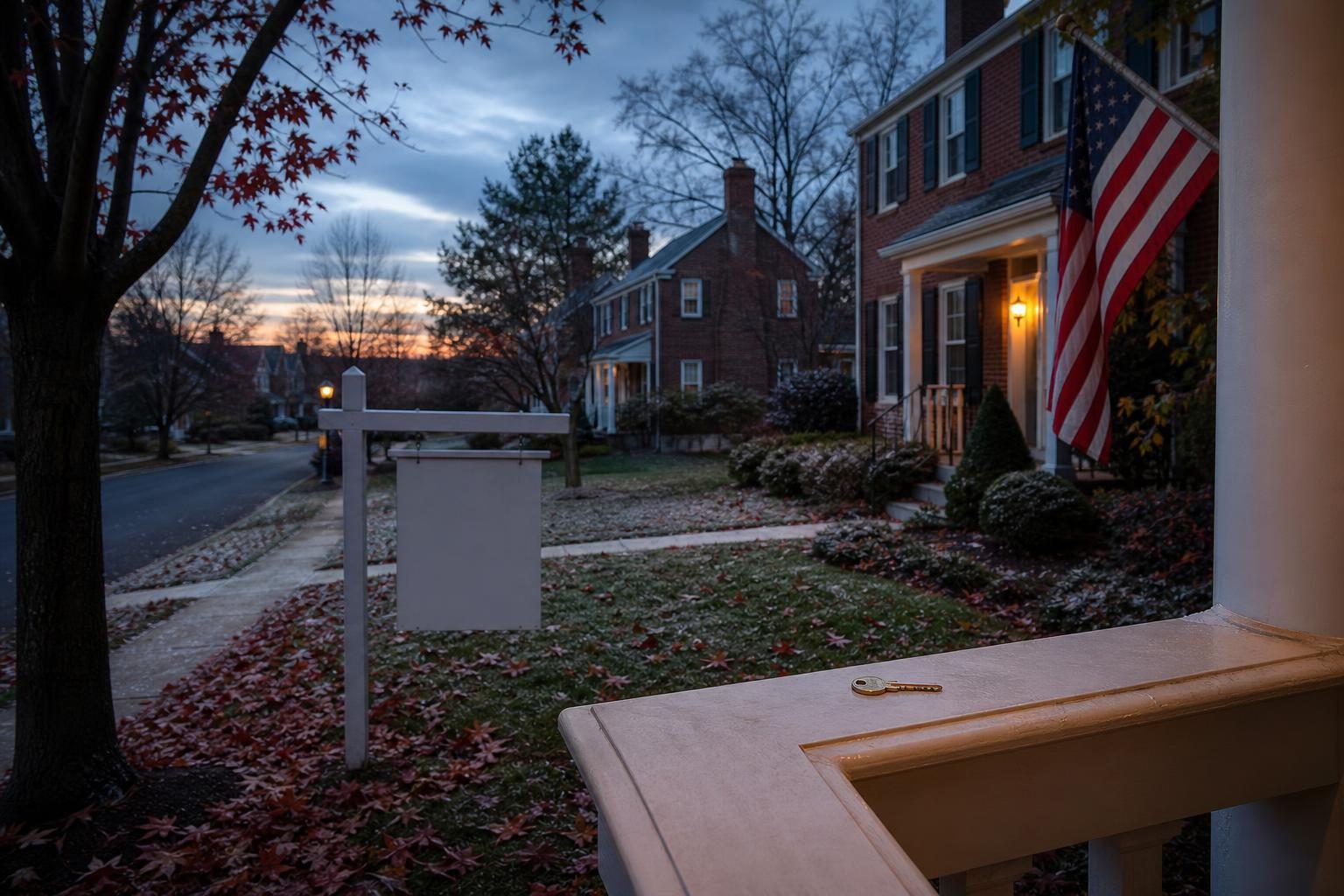
Part of our continuing coverage: Home Sales Sink to Lowest Pace Since 2010 as High Mortgage Rates Squeeze First-Time Buyers
Key points
- Existing-home sales fell to a 3.75 million annual pace in October, the slowest since August 2010.
- About half of all mortgages carry rates below 4%, while new loans average about 7.11%, so owners stay put.
- The median first-time buyer is now 40, a record high, and cash buyers are taking a larger share of sales.
- A new executive order and a law restricting large investors target costs, but neither changes the rate gap.
Americans bought previously owned homes in October at the slowest pace in more than 16 years. Sales fell 5.5% from September to a seasonally adjusted annual rate of 3.75 million, the weakest since August 2010 and 8.8% below a year earlier, the National Association of Realtors reported Thursday [1]. Yet in the same week, Freddie Mac said the average 30-year fixed mortgage rate eased to 7.11%, its fourth weekly decline in a row and the lowest reading in seven weeks [2].
How can borrowing costs slip while sales keep sinking? Because the housing market is not simply slow. It is stuck. Buyers cannot afford to get in, owners cannot afford to move, and more of the homes that do sell go to buyers who need no loan at all. Here is how the freeze works, what Washington has done about it, and what families can keep in mind.
Why Owners Will Not Sell
Start with the rate itself. Freddie Mac's 30-year average ran 7.33% in October, up from 6.86% in September and 6.25% a year earlier, according to NAR [1]. NAR chief economist Lawrence Yun noted that rates have climbed to their highest levels since 2000, apart from a single month in 2023 [1]. This week's dip to 7.11% still leaves the average well above the 6.24% of a year ago, and the 15-year rate is 6.45% [2].
Now compare that with what most homeowners already pay. A Realtor.com analysis of federal mortgage data found that in the second quarter of 2026, 65.6% of first-lien mortgages carried rates below 5%, nearly half were below 4%, and 19.2% were below 3%, HousingWire reported [3]. Economists call this the lock-in effect, and the math explains it. By our calculation, a $300,000, 30-year loan at 3% costs about $1,265 a month in principal and interest. The same loan at 7.11% costs about $2,018. A family that sells a modest house and buys a similar one down the street could pay roughly $750 more every month for the privilege of moving.
So owners stay put. NAR's newest annual survey of buyers and sellers found that sellers had lived in their homes a median of 12 years, a record [4]. Repeat buyers made up 78% of purchases, and their median age matched an all-time high of 62 [4]. When existing owners do not list, there are fewer homes for young families to buy, and fewer sales overall.
Prices Stay High as Listings Slowly Return
A frozen market does not mean falling prices. The median existing-home price in October was $416,700, up 0.4% from a year earlier and the 40th straight month of annual gains [1]. Distressed sales were just 2% of transactions, and Yun said the nation's 88 million homeowners are largely in a comfortable financial position thanks to the wealth built up in their homes [1]. Few owners are forced to sell, so few are forced to cut prices.
There are signs of loosening at the edges. Inventory rose to 1.59 million homes in October, a 5.1-month supply, up from 4.4 months a year earlier [1]. Prices diverge by region: the South's median dipped 0.4% to $360,900, while the Northeast's rose 3.2% to $519,600 [1]. In the West, sales fell 14.5% from a year ago [1].
Meanwhile, buyers with cash are filling the gap. All-cash deals made up 29% of October sales, and individual investors and second-home buyers rose to 20% of purchases from 16% a year earlier [1]. NAR's affordability index fell to 100.7 from 107.3 a year ago [1].
First-Time Buyers Are Waiting Longer Than Ever
The heaviest cost falls on the young. First-time buyers accounted for 29% of October sales, down from 32% a year earlier [1]. Over the longer survey period from July 2025 through June 2026, the first-time share edged up to 22% from a record low of 21%, but the median first-time buyer was 40 years old, matching last year's record high [4]. A record 10% of first-time buyers paid all cash, and those cash buyers had a median age of 54, compared with 38 for first-time buyers who financed [4].
Those numbers describe a generation shut out of one of the most ordinary steps in American family life. When the typical first purchase comes at 40, and the buyers who manage it without a mortgage are in their fifties, the starter home is arriving after many of the years when young families most need room to grow, a stable school and a church close by.
What Washington Has Done and Proposed
The administration has acted on costs at the margins. On Oct. 22, President Trump signed an executive order aimed at lowering housing and mortgage costs, The Hill reported [5]. The order directs the Federal Housing Finance Agency to pilot a program that cancels mortgage insurance once borrowers reach equity thresholds based on a home's current market value, makes permanent a pilot that waives title insurance on certain refinances, creates a task force on manufactured housing led by FHFA Director Bill Pulte and Housing Secretary Scott Turner, and tells the Department of Veterans Affairs and the Agriculture Department to lower rates on their direct home loans [5].
Congress has moved on a different front. The 21st Century ROAD to Housing Act, which became law in July, restricts large institutional investors, defined as those controlling 350 or more single-family homes, from buying additional single-family houses, with exceptions for projects such as build-to-rent communities, according to an analysis by the law firm Morgan Lewis [6]. The law does not force those investors to sell homes they already own, and the Treasury Department, working with HUD and the Securities and Exchange Commission, is responsible for writing the rules to carry it out [6].
Both steps aim at real problems: closing costs that pile up on families, and large investors competing with them for starter homes. Neither one changes the core math of a 3% loan versus a 7% loan, which is the honest limit of any order or statute while money stays expensive.
What Would Thaw the Market
The first answer is lower mortgage rates, and the gains so far are small. The 30-year average fell only from 7.18% to 7.11% in the latest week [2]. Yun said there could be sizable pent-up demand if rates decline [1]. And with the 10-year Treasury yield back above 5% this week, as this site reported in Friday's market wrap, even that modest relief could prove fragile.
Lower rates, in turn, depend on lower inflation. Mortgage rates are priced off the long-term bond market, and investors will not lend for 30 years at low rates while prices keep rising. That is why the surest path back to affordable housing runs through stable money rather than another government credit program. Easy lending can raise demand, but it cannot build a single house.
The second answer is supply. Rising inventory gives buyers more choices and more leverage [1], and the administration's push on manufactured housing could add lower-cost options if it produces results [5]. Time will help too. Each year, marriages, births, job changes and retirements force some locked-in owners to move, and every one of those moves frees a house for someone else.
What Families Can Keep in Mind
None of this is personal financial advice, and every household is different. But a few general facts may help families planning their next step.
Rates move every week, and Freddie Mac's survey is an average, not a quote [2]. Buyers typically compare offers from more than one lender and look at the full monthly cost, including taxes and insurance, rather than the rate alone.
Veterans and rural buyers may want to watch for changes to the VA and USDA direct loan programs, and borrowers who pay mortgage insurance may want to follow the FHFA pilot as details emerge [5]. Families open to manufactured housing may find more options as the new task force does its work [5].
Sellers face more competition than a year ago, with a 5.1-month supply on the market [1]. Owners holding low-rate loans have good reason to think carefully before giving them up, but a growing family's needs matter more than any interest rate.
Above all, a home is meant to shelter a family, not strain it. A budget that leaves room for giving, saving and the unexpected is worth more than a bigger house bought at the edge of what a family can afford. For young couples waiting their turn, patience, prudence and prayer remain wise companions until the market opens its doors again.
Sources
- [1]National Association of RealtorsExisting-Home Sales Decreased 5.5% in October, According to NAR ReportOpens in a new tab ↗
- [2]Opens in a new tab ↗
- [3]Opens in a new tab ↗
- [4]National Association of RealtorsFirst-Time Home Buyer Share Inches Up to 22%, Median Age Remains at Record High of 40Opens in a new tab ↗
- [5]Opens in a new tab ↗
- [6]Opens in a new tab ↗
Would you move to another state for lower costs?
- Already did
- Thinking about it
- No, I'm staying put
More in Real Estate & Housing
Mortgage Rates Ease for a Fourth Week, but a Bond Selloff and an Inflation-Focused Fed Cloud the Holiday Outlook for Homebuyers
Today on Home Front with Carlos Mendoza
Home Sales Sink to Lowest Pace Since 2010 as High Mortgage Rates Squeeze First-Time Buyers
Yesterday on Home Front with Carlos Mendoza
The 'Socialist Surge' Meets the Facts: Small Numbers, Unpopular Ideas and a Housing Record That Hurts Renters
Wednesday night on Home Front with Carlos Mendoza
Were you there?
If you were at the scene, or this story touched your life, tell us what you saw and what it was like.
Discussion 0
Sign in or create a free account to join the discussion.
No comments yet. Start the discussion.