
 Today on From the Bench with Margaret Callahan
From the Inca Heights to the Rainforest: Pope Leo XIV Asks Peru to Hand Its Faith to the Young and Guard God's Creation
On the next-to-last day of his homecoming, the pope praised Cusco's centuries-old devotions at 11,000 feet, showed no strain a month after lung cancer surgery, then flew to the Amazon to listen to Indigenous communities facing illegal mining and logging.
Filed November 15, 2026 · 📍 Chicago, IL 60602
Were you there? Share your story
Part of our continuing coverage: From His Former Cathedral, Pope Leo XIV Prays for Peace in a Peru Shaken by Crime
Key points
- Pope Leo XIV spent his next-to-last day in Peru in Cusco and the Amazon city of Pucallpa
- At Saqsaywaman he urged that popular devotions be handed to the young in a living way
- The 71-year-old showed no apparent strain at altitude a month after lung cancer surgery
- In Pucallpa he was set to listen to Indigenous communities facing illegal mining and deforestation
Pope Leo XIV climbed into the thin air of the Andes on Sunday and then flew down into the Amazon basin, spending the next-to-last day of his Peruvian homecoming with two of the country's most distinctive flocks. The Associated Press reported that the plight of Indigenous peoples and the protection of the Amazon took center stage as the pope crossed the country from the old Inca capital of Cusco to the rainforest city of Pucallpa [1].
It was a day built around an idea that has run through the whole journey: a faith received from parents and grandparents has to be handed on, alive, to the next generation. In Cusco, the pope told the faithful that their processions and feasts are a treasure for the young. In the Amazon, he was set to sit and listen to Indigenous communities whose forests, rivers and children face real dangers [1][2].
The trip is personal for him. Leo, who was born in Chicago, served as bishop of Chiclayo in northern Peru from 2015 until 2023, Deutsche Welle noted [6], and Peruvians have greeted him all week as one of their own.
A Gathering Above Cusco
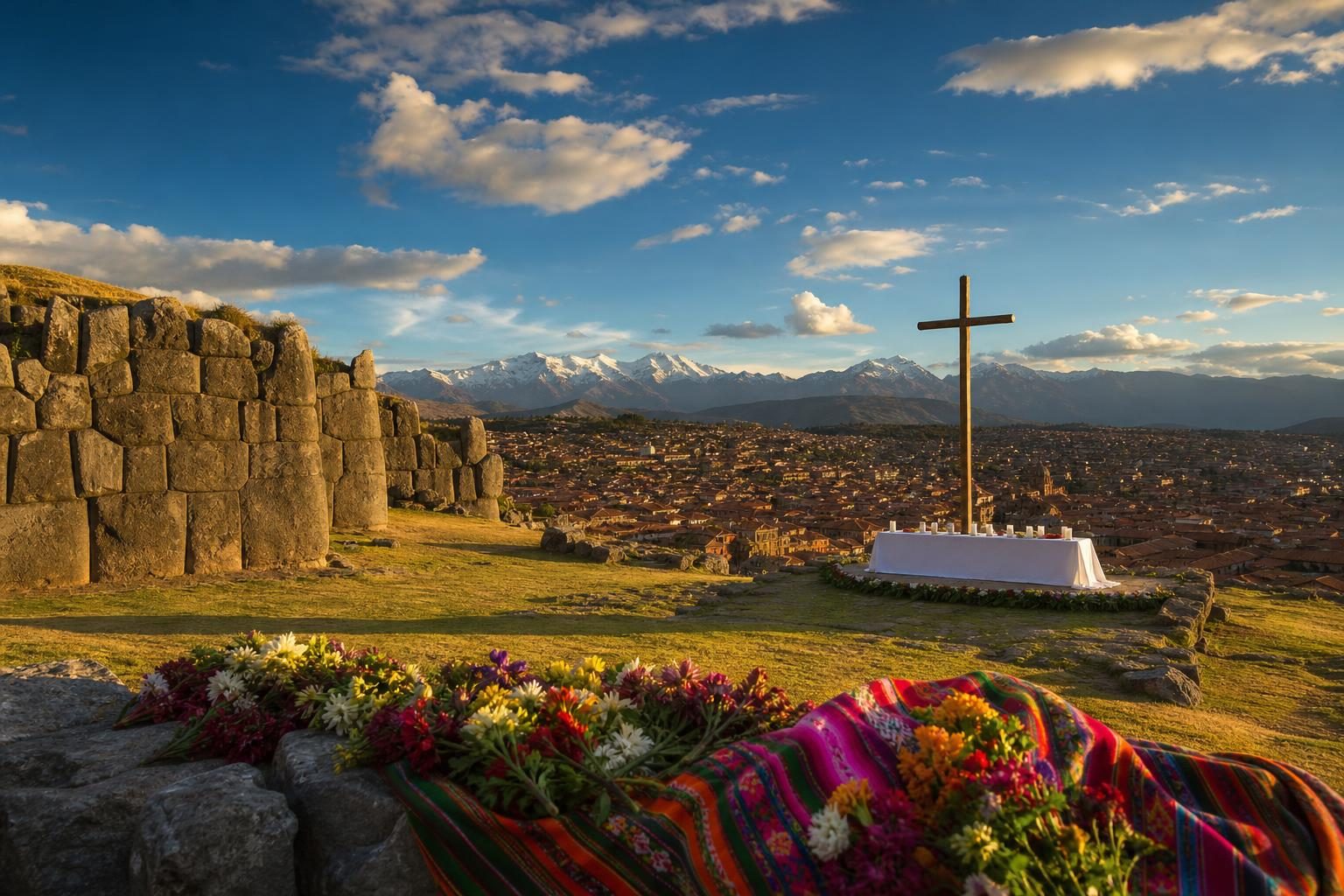
The day began at Saqsaywaman, the archaeological park on the heights above Cusco, where the Vatican billed the event as a meeting with the faithful and with representatives of the region's popular devotions [2]. The Swiss news site bluewin put the site at about 3,700 meters above sea level [3]. The AP reported that Cusco itself sits at more than 3,400 meters, roughly 11,000 feet, and that huge crowds lined the city's cobblestoned streets for the pope [1].
The setting carried its own message. Cusco was the heart of the Inca empire, and the Christian faith that took root there has been expressed for centuries in processions, patronal feasts and devotion to the Mother of God. The AP reported that Leo praised those expressions of popular piety, including processions and religious festivals, as ways of forging community and passing on the faith, especially to young people [1].
Handing On a Living Faith
According to Vatican News, the pope told the crowd that the future of those traditions depends on more than guarding what was inherited. They have to be passed on in a living way [2]. He urged that young people take part in the devotions and that their contributions be welcomed and valued, through listening, cooperation and, where needed, adaptation to the times [2].
He closed by entrusting the renewal of Cusco's devotions to the Virgin Mary under a title the city holds dear, Queen of Bethlehem, Mother and Protector of Cusco, Vatican News reported [2].
For American Catholics and evangelicals alike, the point will sound familiar. Faith is not a museum piece. It survives in families that bring their children to the feast, teach them the hymns and show them, year after year, that God is worth honoring in public. The pope's appeal in Cusco was aimed at mothers, fathers and grandparents as much as at priests: do not let the chain break. In a culture that too often treats tradition as a burden to be shed, a shepherd standing among Inca stones and telling the young that their grandparents' devotions belong to them too is a welcome word.
Testing a Recovery at 11,000 Feet
The altitude was a real concern. Leo, 71, had surgery about a month ago to remove a malignant tumor from his lung, and bluewin reported there had been worries that the thin mountain air could take a toll on him [3]. His doctors say he is cancer-free after the operation, according to the same report, and he came through the Cusco gathering without any apparent health problems [3].
The AP described the Cusco stop as a test of the pope's stamina as he recovers from the lung cancer surgery, and reported that he has shown no sign of weakness or fatigue since the trip began [1]. The 12-day journey through Uruguay, Argentina and Peru runs from Nov. 6 to Nov. 17, the AP reported [1].
Before leaving Cusco, the pope was due to deliver a message to the sick, according to the AP [1]. It is a fitting stop for a man who has spent this autumn as a patient himself, and who has chosen to keep a punishing schedule rather than cancel on the people who waited years to see him.
Into the Amazon
From the mountains, Leo flew east to Pucallpa, a rainforest city of about 434,000 people [1]. The AP reported that illegal mining, deforestation and threats to Indigenous communities were expected to be the central concerns of the stop [1].
Organizer Luca Zanta told the AP that the pope would "primarily listen to the Amazonian Indigenous peoples," including the Shipibo, Asháninka and Kukama communities gathered beside Lake Yarinacocha [1]. The program also called for the pope to lead a symbolic planting of a shihuahuaco, a native rainforest tree that can live for more than 1,000 years and grow dozens of meters tall [1]. Agence France-Presse, in a report carried by France 24, noted that the same long-lived hardwood is a prized target for loggers [4].
The AP also reported that Leo was expected to address the sexual abuse of Indigenous Awajún and Wampis girls by teachers in Peru's northern Amazon [1]. That is a grave wrong against the most defenseless, and both the Church and the state have a duty to confront it without excuses.
The Wounds of the Rainforest
The people waiting for the pope in the Amazon know what they want to hear. María Amasifuen, a leader of the Maroti Shobo community, told AFP she hoped the pope would call for an end to pollution and to the killing of trees, animals and fish [4].
The numbers behind those hopes are sobering. Peru lost 3.2 million hectares of humid Amazon forest between 2001 and 2024, mostly in the Ucayali, Madre de Dios and Loreto regions, according to environment ministry figures cited by AFP [4]. The watchdog group Global Witness has counted at least 54 land and environmental defenders killed in Peru since 2012, more than half of them Indigenous, AFP reported [4].
The AP reported that Leo was expected to echo his predecessor, Pope Francis, in stressing the Catholic teaching that ties care for the most vulnerable to care for God's creation [1]. Conservatives who are rightly wary of climate politics should hear that teaching on its own terms. In Genesis, the Lord places man in the garden to work it and to keep it. Stewardship is not a slogan invented by activists; it is an old Christian duty. The illegal gold miners and timber gangs tearing through the Amazon are breaking the law as well as the land, and protecting families who have fished these rivers for generations from criminals is a matter of justice and of the rule of law.
The Last Day of the Homecoming
The pope was scheduled to fly back to Lima and spend his final night in Peru at the apostolic nunciature, America magazine reported [5]. On Monday, according to the magazine, he is set to travel to the port city of Callao to visit a shelter for abandoned elderly people run by the Little Sisters, celebrate Mass at the Las Palmas Air Base and then be seen off at a farewell ceremony before a flight of nearly 15 hours back to Rome, with a press conference on board [5].
It is a telling way to end the trip. After the stadium crowds of Chiclayo and the Inca heights of Cusco, the pope's last scheduled visit in Peru is to the frail and forgotten elderly, cared for by religious sisters who have given their lives to them. Whatever the headlines say about politics and the environment, that is the Gospel in its plainest form: the strong bending down to serve the weak.
For the faithful in Peru, the week has been a reunion with a pastor they knew long before the world knew his name. For believers everywhere, Sunday's message from the mountains was simple enough to carry home: keep the faith of your fathers, give it to your children, and guard the good earth God entrusted to your care. Liberty Bell Report will follow the pope's final day in Peru and his return to Rome.
Sources
Pope Leo XIV drew more than a million people in Argentina. Would you travel to see the pope?
- Absolutely
- Maybe, if he came to the U.S.
- No, but I'd watch on TV
- No
More in Faith & Religion
Faith Under Pressure: Inside China's Widening Campaign Against House Churches, From Beijing to Xi'an
This morning on Faith & Family with Ethan Calloway
Jordan Sentences Three Men to Death for the Karak Church Funeral Attack That Killed Nine
This morning on Breaking Now with Nathan Brooks
A Cathedral Rises in Baghdad: Iraq Opens Its First Coptic Church and Asks the Christians It Lost to Come Home
Overnight on From the Bench with Margaret Callahan
Were you there?
If you were at the scene, or this story touched your life, tell us what you saw and what it was like.
Discussion 0
Sign in or create a free account to join the discussion.
No comments yet. Start the discussion.